Ch. 2 - Functions and Graphs
Blitzer - College Algebra 8th Edition
Blitzer8th EditionCollege AlgebraISBN: 9780136970514Non è quello che usi tu?Cambia libro di testo
Capitolo 3, Problema 54

In Exercises 51–54, graph the given square root functions, f and g, in the same rectangular coordinate system. Use the integer values of x given to the right of each function to obtain ordered pairs. Because only nonnegative numbers have square roots that are real numbers, be sure that each graph appears only for values of x that cause the expression under the radical sign to be greater than or equal to zero. Once you have obtained your graphs, describe how the graph of g is related to the graph of f. f(x) = √x (x = 0, 1, 4, 9) and g (x) = √(x + 2) (x = = −2, −1, 2, 7)

Guida verificata passo dopo passo
1
Identify the domain of each function by determining the values of x for which the expression under the square root is nonnegative. For \( f(x) = \sqrt{x} \), the domain is \( x \geq 0 \). For \( g(x) = \sqrt{x + 2} \), the domain is \( x + 2 \geq 0 \), which simplifies to \( x \geq -2 \).
Create ordered pairs for \( f(x) = \sqrt{x} \) using the given x-values \( 0, 1, 4, 9 \). Calculate each \( f(x) \) by taking the square root of x, resulting in points \( (0, \sqrt{0}), (1, \sqrt{1}), (4, \sqrt{4}), (9, \sqrt{9}) \).
Create ordered pairs for \( g(x) = \sqrt{x + 2} \) using the given x-values \( -2, -1, 2, 7 \). Calculate each \( g(x) \) by taking the square root of \( x + 2 \), resulting in points \( (-2, \sqrt{0}), (-1, \sqrt{1}), (2, \sqrt{4}), (7, \sqrt{9}) \).
Plot the points for both functions on the same coordinate system. For \( f(x) \), plot points where x is nonnegative, and for \( g(x) \), plot points starting from \( x = -2 \) onwards. Connect the points smoothly, remembering that square root functions produce curves that increase but at a decreasing rate.
Compare the graphs of \( f \) and \( g \). Notice that \( g(x) = \sqrt{x + 2} \) can be seen as a horizontal shift of \( f(x) = \sqrt{x} \) to the left by 2 units, because adding 2 inside the square root moves the graph left along the x-axis.

Risposta video verificata per un problema simile:

Questa soluzione video è stata consigliata dai nostri tutor come utile per risolvere questo problema.
Durata del video:
5m

Concetti chiave

Ecco i concetti essenziali che devi comprendere per rispondere correttamente alla domanda.

Domain of Square Root Functions

The domain of a square root function includes all x-values for which the expression inside the square root is nonnegative. Since square roots of negative numbers are not real, the input to the radical must be greater than or equal to zero. For example, in f(x) = √x, x must be ≥ 0, while in g(x) = √(x + 2), x must be ≥ -2.
Video consigliato:
02:20
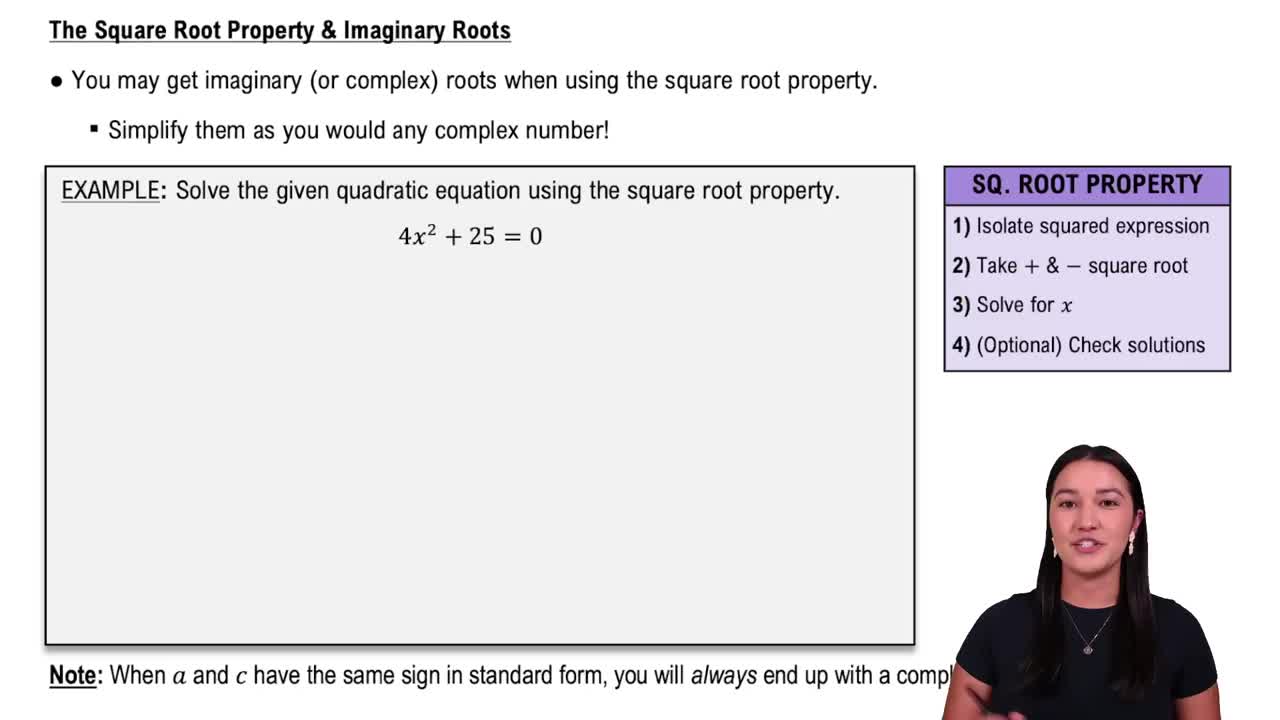
Imaginary Roots with the Square Root Property

Graphing Square Root Functions Using Ordered Pairs

To graph square root functions, calculate output values by substituting given x-values into the function to form ordered pairs (x, f(x)). Plot these points on the coordinate plane and connect them smoothly. This method helps visualize the shape and position of the graph, especially when comparing related functions.
Video consigliato:
02:20
Imaginary Roots with the Square Root Property

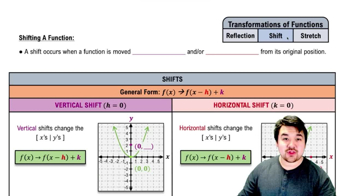
Transformations of Functions: Horizontal Shifts

Adding or subtracting a constant inside the square root function's argument causes a horizontal shift of the graph. For g(x) = √(x + 2), the graph shifts 2 units to the left compared to f(x) = √x. Understanding this helps describe how g relates to f by recognizing shifts along the x-axis.
Video consigliato:
5:34
Shifts of Functions