Ch. 3 - Polynomial and Rational Functions
Blitzer - College Algebra 8th Edition
Blitzer8th EditionCollege AlgebraISBN: 9780136970514Non è quello che usi tu?Cambia libro di testo
Capitolo 4, Problema 57

Exercises 53–60 show incomplete graphs of given polynomial functions. a) Find all the zeros of each function. b) Without using a graphing utility, draw a complete graph of the function. f(x)=2x4−3x3−7x2−8x+6

Guida verificata passo dopo passo
1
Start by finding the zeros of the polynomial function f(x)=2x4−3x3−7x2−8x+6 by setting f(x) = 0 and solving for x.
Use the Rational Root Theorem to list possible rational zeros. These are of the form \(\pm\) \(\frac{p}{q}\), where p divides the constant term 6 and q divides the leading coefficient 2. So possible roots are \(\pm\) 1, \(\pm\) 2, \(\pm\) 3, \(\pm\) 6, \(\pm\) \(\frac{1}{2}\), \(\pm\) \(\frac{3}{2}\).
Test each possible rational root by substituting into the polynomial or using synthetic division to check if it yields zero. When a root is found, factor it out from the polynomial.
After factoring out the first root, reduce the polynomial degree and repeat the process to find other zeros. Continue factoring until the polynomial is completely factored into linear and/or irreducible quadratic factors.
Once all zeros are found, analyze the multiplicity of each zero to understand the behavior of the graph at those points. Use this information along with the leading coefficient and degree to sketch the complete graph without a graphing utility.

Risposta video verificata per un problema simile:

Questa soluzione video è stata consigliata dai nostri tutor come utile per risolvere questo problema.
Durata del video:
9m

Concetti chiave

Ecco i concetti essenziali che devi comprendere per rispondere correttamente alla domanda.

Finding Zeros of Polynomial Functions

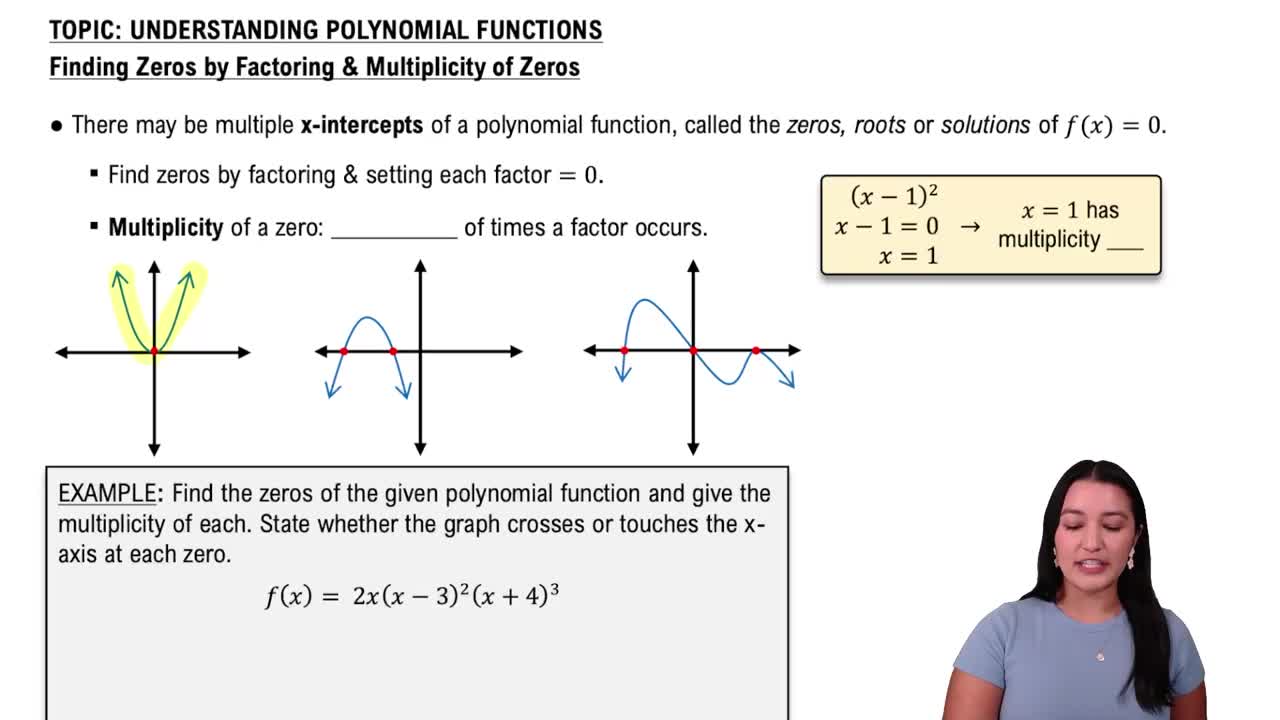
Zeros of a polynomial are the values of x for which the function equals zero. To find them, one can use factoring, synthetic division, or the Rational Root Theorem to test possible roots. Identifying all zeros is essential for understanding the behavior and shape of the graph.
Video consigliato:
03:42
Finding Zeros & Their Multiplicity

End Behavior of Polynomial Functions

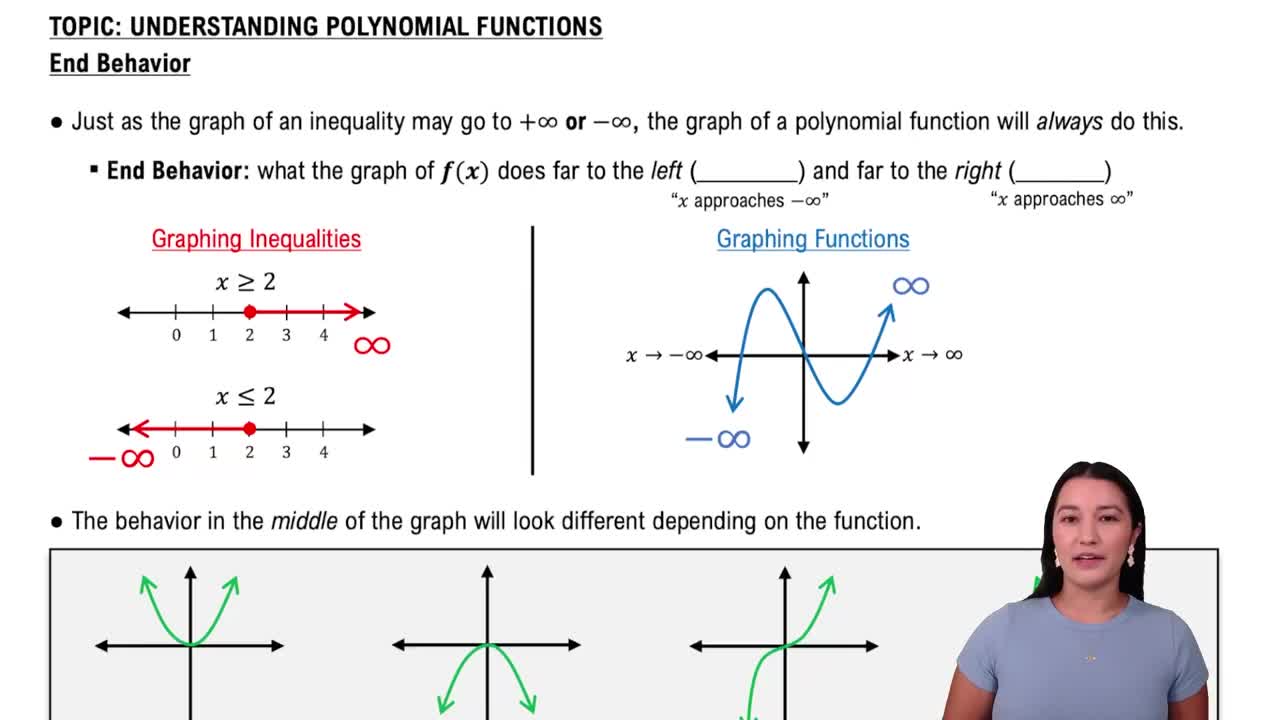
The end behavior describes how the function behaves as x approaches positive or negative infinity. It depends on the leading term's degree and coefficient. For example, a positive leading coefficient with an even degree means the graph rises on both ends, guiding the sketching of the complete graph.
Video consigliato:
06:08
End Behavior of Polynomial Functions

Sketching Polynomial Graphs Without Technology

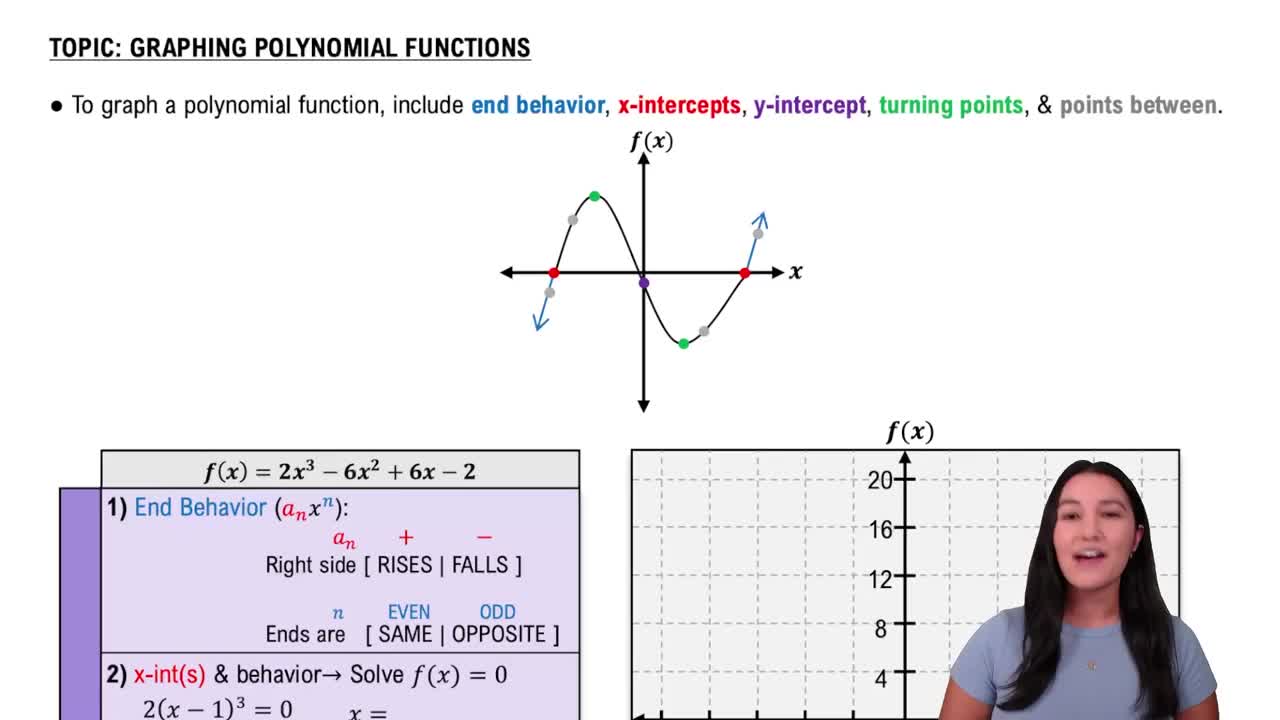
Drawing a polynomial graph by hand involves plotting zeros, determining multiplicities, analyzing end behavior, and finding key points like local maxima and minima. Understanding these features helps create an accurate, complete graph without relying on graphing utilities.
Video consigliato:
05:25
Graphing Polynomial Functions