Ch. 3 - Polynomial and Rational Functions
Blitzer - College Algebra 8th Edition
Blitzer8th EditionCollege AlgebraISBN: 9780136970514Non è quello che usi tu?Cambia libro di testo
Capitolo 4, Problema 100

Find the average rate of change of f(x)=√x from x1=4 to x2=9.

Guida verificata passo dopo passo
1
Identify the function and the interval: The function is f(x)=x, and the interval is from x1 = 4 to x2 = 9.
Recall the formula for the average rate of change of a function f over an interval [x_1, x_2]: \(\frac{f(x_2) - f(x_1)}{x_2 - x_1}\).
Calculate the function values at the endpoints: find f(4) = \(\sqrt{4}\) and f(9) = \(\sqrt{9}\).
Substitute the values into the average rate of change formula: \(\frac{f(9) - f(4)}{9 - 4}\).
Simplify the expression by evaluating the square roots and performing the subtraction and division to find the average rate of change.

Risposta video verificata per un problema simile:

Questa soluzione video è stata consigliata dai nostri tutor come utile per risolvere questo problema.
Durata del video:
2m

Concetti chiave

Ecco i concetti essenziali che devi comprendere per rispondere correttamente alla domanda.

Average Rate of Change

The average rate of change of a function between two points measures how much the function's output changes per unit change in input. It is calculated as the difference in function values divided by the difference in input values, similar to the slope of a secant line connecting the two points on the graph.
Video consigliato:
5:36
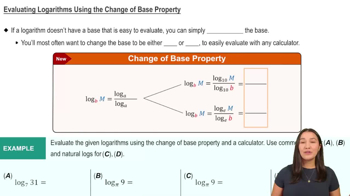
Change of Base Property

Square Root Function

The square root function, denoted as f(x) = √x, outputs the non-negative number whose square is x. It is defined for x ≥ 0 and is a nonlinear function that increases at a decreasing rate, meaning its graph is a curve that flattens as x increases.
Video consigliato:
02:20
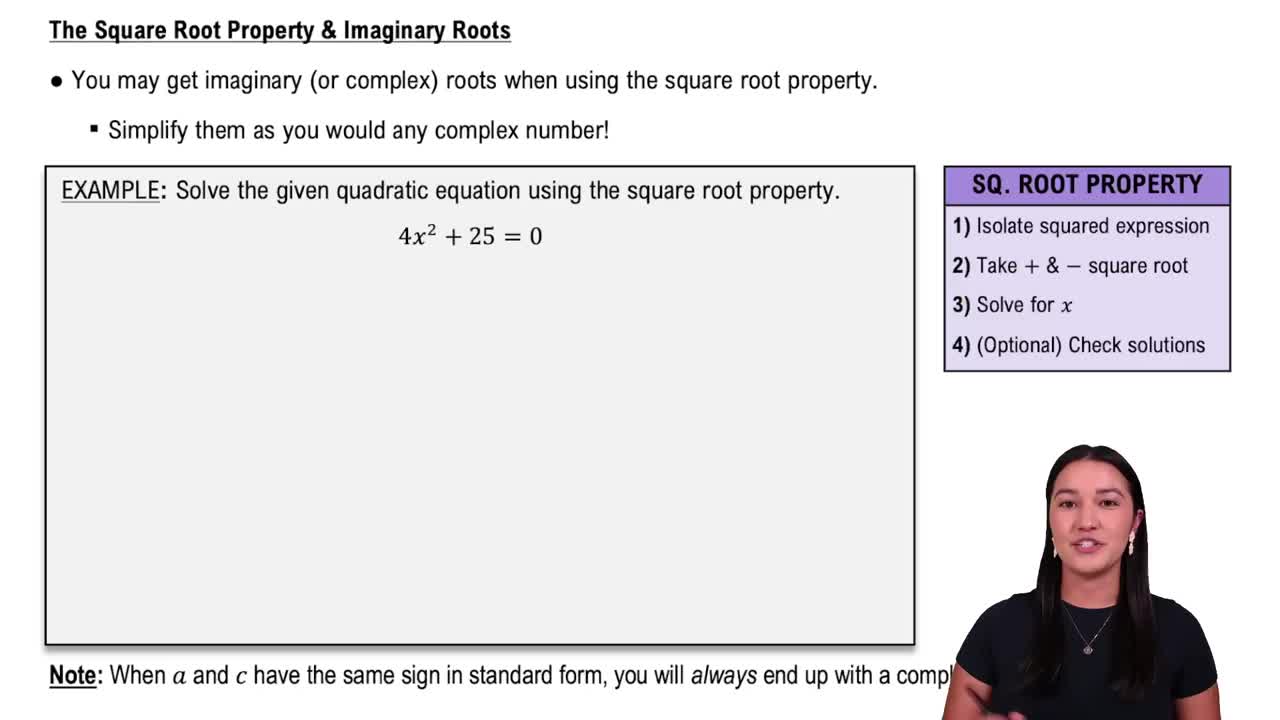
Imaginary Roots with the Square Root Property

Evaluating Function Values

To find the average rate of change, you must evaluate the function at the given points x1 and x2. This involves substituting the x-values into the function to find f(x1) and f(x2), which are then used to compute the difference quotient.
Video consigliato:
4:26
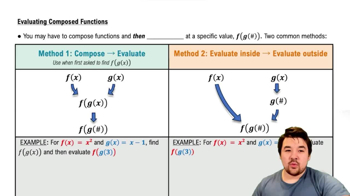
Evaluating Composed Functions