Ch. 3 - Polynomial and Rational Functions
Blitzer - College Algebra 8th Edition
Blitzer8th EditionCollege AlgebraISBN: 9780136970514Non è quello che usi tu?Cambia libro di testo
Capitolo 4, Problema 81

Find the inverse of f(x)=(x−10)/(x+10).

Guida verificata passo dopo passo
1
Start with the function equation: \(y = \frac{x - 10}{x + 10}\).
To find the inverse, swap \(x\) and \(y\): \(x = \frac{y - 10}{y + 10}\).
Multiply both sides by \((y + 10)\) to eliminate the denominator: \(x(y + 10) = y - 10\).
Distribute \(x\): $xy + 10x = y - 10$.
Group all terms involving \(y\) on one side and factor \(y\) out: $xy - y = -10 - 10x$, then \(y(x - 1) = -10(1 + x)\), and finally solve for \(y\): \(y = \frac{-10(1 + x)}{x - 1}\).

Risposta video verificata per un problema simile:

Questa soluzione video è stata consigliata dai nostri tutor come utile per risolvere questo problema.
Durata del video:
3m

Concetti chiave

Ecco i concetti essenziali che devi comprendere per rispondere correttamente alla domanda.

Inverse Functions

An inverse function reverses the effect of the original function, swapping inputs and outputs. If f(x) maps x to y, then its inverse f⁻¹(x) maps y back to x. Finding an inverse involves solving the equation y = f(x) for x in terms of y.
Video consigliato:
4:30
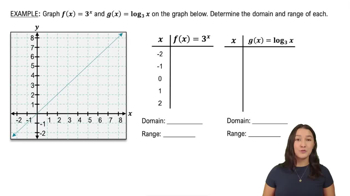
Graphing Logarithmic Functions

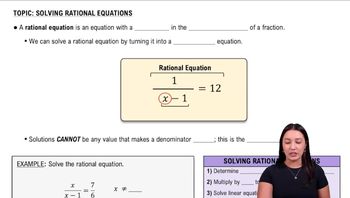
Solving Rational Equations

Rational equations involve ratios of polynomials. To find the inverse of a rational function, you often need to solve for the variable by clearing denominators and isolating terms. This requires careful algebraic manipulation to avoid extraneous solutions.
Video consigliato:
05:56
Introduction to Rational Equations

Domain and Range Considerations

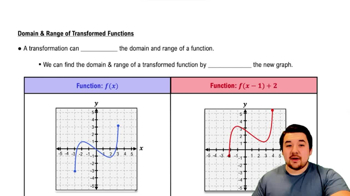
When finding inverses, it's important to consider the domain and range of the original function, as the inverse's domain and range are swapped. For rational functions, restrictions like division by zero must be accounted for to ensure the inverse is valid.
Video consigliato:
4:22
Domain & Range of Transformed Functions