Determine which functions are polynomial functions. For those that are, identify the degree.
Ch. 3 - Polynomial and Rational Functions

Capitolo 4, Problema 3
Use the Rational Zero Theorem to list all possible rational zeros for each given function. f(x)=3x4−11x3−x2+19x+6
Guida verificata passo dopo passo1
Identify the polynomial function: \(f(x) = 3x^{4} - 11x^{3} - x^{2} + 19x + 6\).
Recall the Rational Zero Theorem: any rational zero, expressed as \(\frac{p}{q}\), must have \(p\) as a factor of the constant term and \(q\) as a factor of the leading coefficient.
List the factors of the constant term (6): \(\pm1, \pm2, \pm3, \pm6\).
List the factors of the leading coefficient (3): \(\pm1, \pm3\).
Form all possible rational zeros by taking each factor of 6 over each factor of 3, simplifying if possible, to get the complete list of candidates.

Risposta video verificata per un problema simile:
Questa soluzione video è stata consigliata dai nostri tutor come utile per risolvere questo problema.
Durata del video:
2mConcetti chiave
Ecco i concetti essenziali che devi comprendere per rispondere correttamente alla domanda.
Rational Zero Theorem
The Rational Zero Theorem provides a method to list all possible rational zeros of a polynomial function. It states that any rational zero, expressed as a fraction p/q in lowest terms, must have p as a factor of the constant term and q as a factor of the leading coefficient.
Video consigliato:
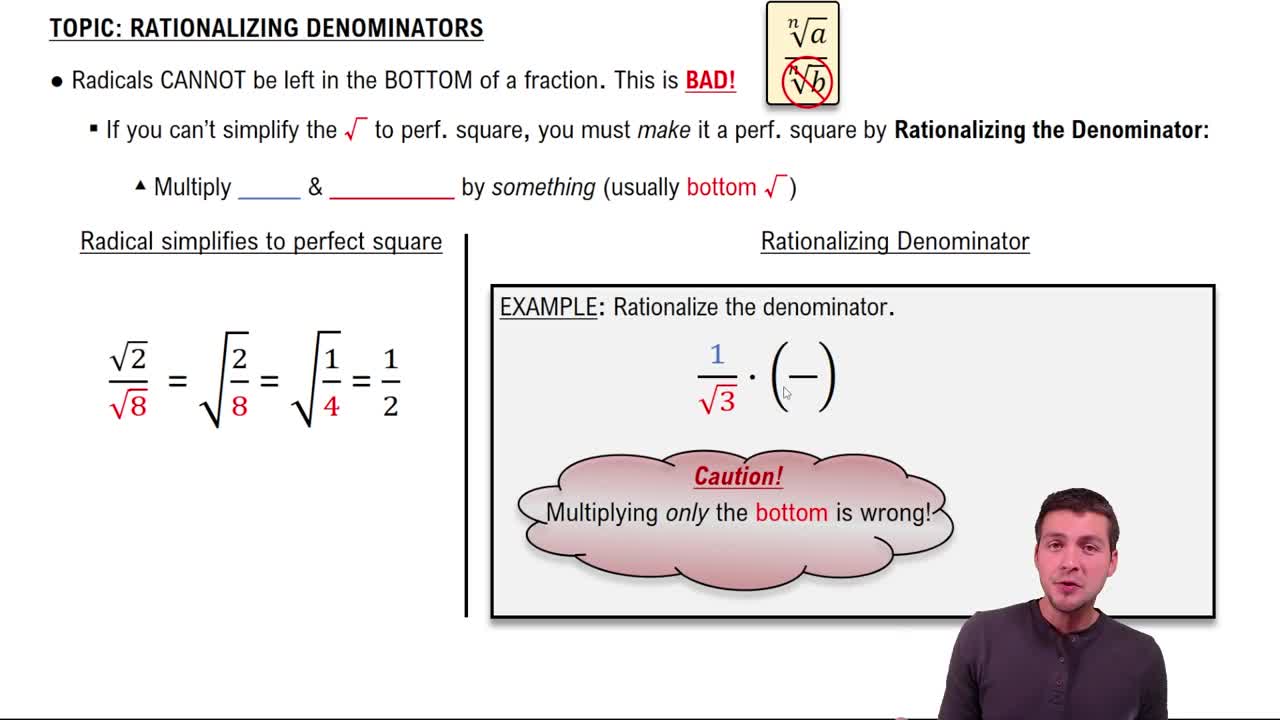
Rationalizing Denominators
Factors of Integers
To apply the Rational Zero Theorem, you need to find all factors of the constant term and the leading coefficient. Factors are integers that divide the number exactly without leaving a remainder, and identifying these helps generate all possible rational zeros.
Video consigliato:
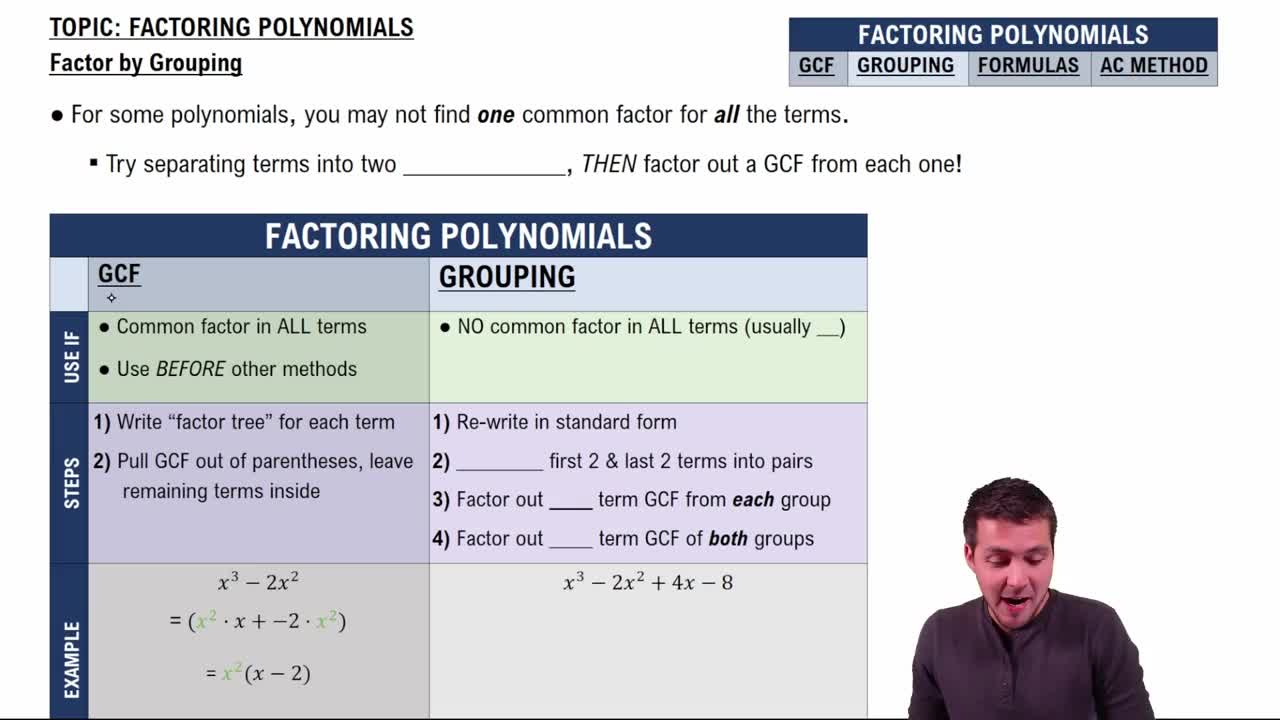
Factor by Grouping
Polynomial Functions and Zeros
A zero of a polynomial function is a value of x that makes the function equal to zero. Understanding how zeros relate to the graph and behavior of polynomials is essential for solving equations and analyzing functions.
Video consigliato:
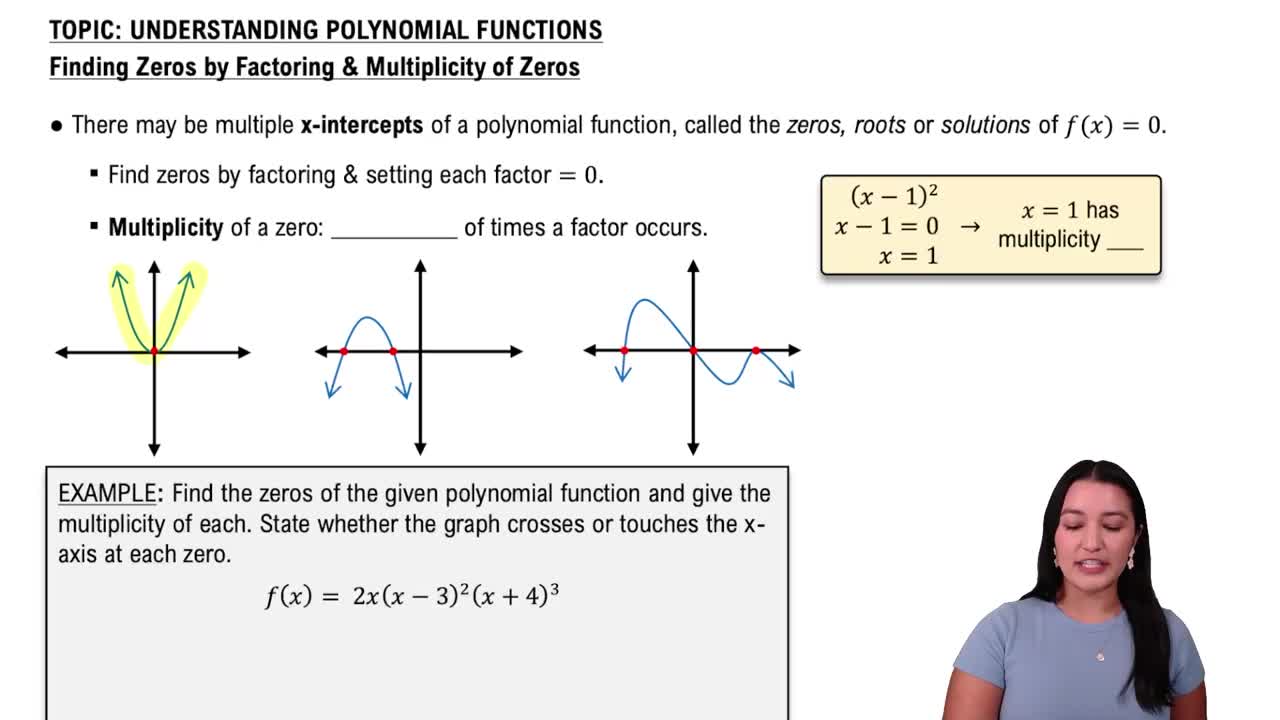
Finding Zeros & Their Multiplicity
Pratica correlata
Domanda del libro di testo
965
views
Domanda del libro di testo
Find the domain of each rational function. g(x)=3x2/(x−5)(x+4)
1115
views
Domanda del libro di testo
In Exercises 1–4, use the vertex and intercepts to sketch the graph of each quadratic function. Give the equation for the parabola's axis of symmetry. Use the graph to determine the function's domain and range.
1381
views
Domanda del libro di testo
The graph of a quadratic function is given. Write the function's equation, selecting from the following options.
1628
views
Domanda del libro di testo
Solve each polynomial inequality in Exercises 1–42 and graph the solution set on a real number line. Express each solution set in interval notation. (x+3)(x−5)>0
543
views
Domanda del libro di testo
Use the four-step procedure for solving variation problems given on page 447 to solve Exercises 1–10. y varies inversely as x. y = 12 when x = 5. Find y when x = 2.
582
views