Ch. 3 - Polynomial and Rational Functions
Blitzer - College Algebra 8th Edition
Blitzer8th EditionCollege AlgebraISBN: 9780136970514Non è quello che usi tu?Cambia libro di testo
Capitolo 4, Problema 25

Use the vertex and intercepts to sketch the graph of each quadratic function. Give the equation of the parabola's axis of symmetry. Use the graph to determine the function's domain and range. f(x)=4−(x−1)2

Guida verificata passo dopo passo
1
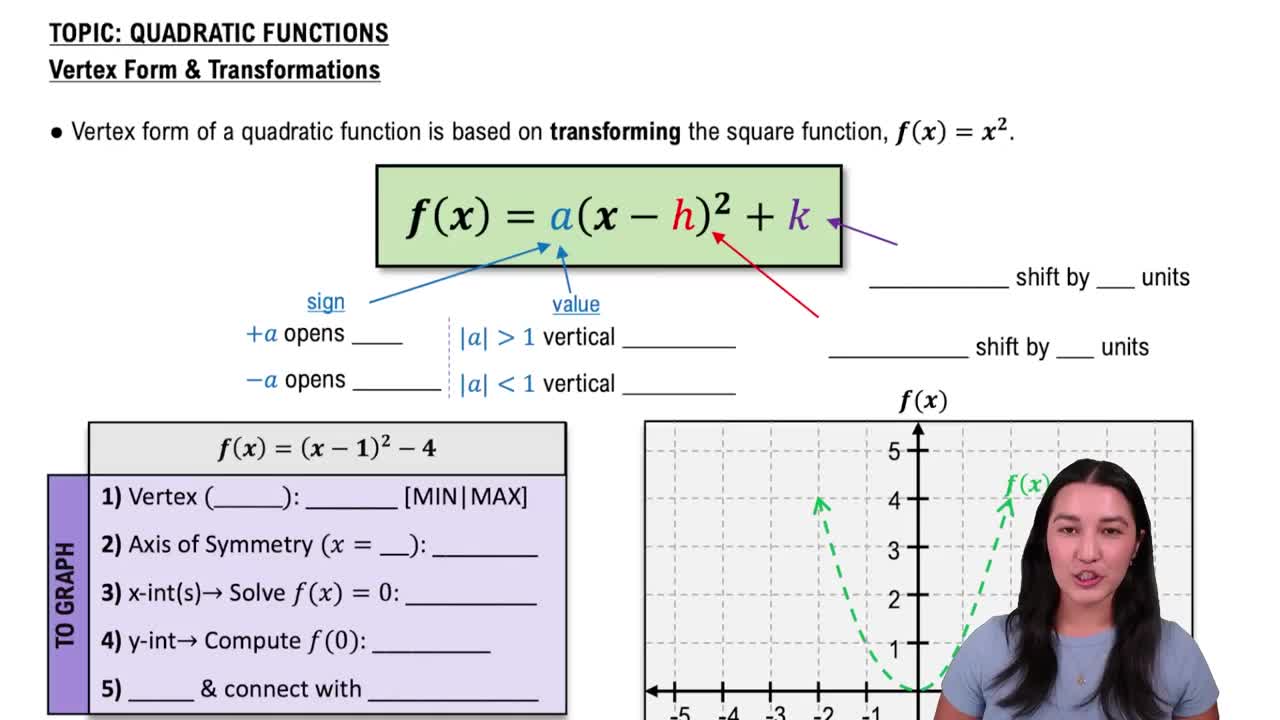
Identify the given quadratic function: \(f(x) = 4 - (x - 1)^2\). Notice it is in vertex form \(f(x) = a(x - h)^2 + k\), where \((h, k)\) is the vertex.
Determine the vertex by comparing: here, \(h = 1\) and \(k = 4\), so the vertex is at the point \((1, 4)\).
Find the axis of symmetry, which is the vertical line passing through the vertex's x-coordinate: \(x = 1\).
Calculate the y-intercept by evaluating \(f(0)\): substitute \(x = 0\) into the function to find the point where the graph crosses the y-axis.
Determine the domain and range: the domain of any quadratic function is all real numbers, \((-\infty, \infty)\). Since the parabola opens downward (because of the negative sign before the squared term), the range is all \(y\) values less than or equal to the vertex's y-value, so \((-\infty, 4]\).

Risposta video verificata per un problema simile:

Questa soluzione video è stata consigliata dai nostri tutor come utile per risolvere questo problema.
Durata del video:
4m

Concetti chiave

Ecco i concetti essenziali che devi comprendere per rispondere correttamente alla domanda.

Vertex of a Quadratic Function

The vertex is the highest or lowest point on the graph of a quadratic function, represented by a parabola. For functions in the form f(x) = a(x - h)^2 + k, the vertex is at (h, k). It helps determine the shape and position of the parabola and is essential for sketching the graph.
Video consigliato:
08:07
Vertex Form

Axis of Symmetry

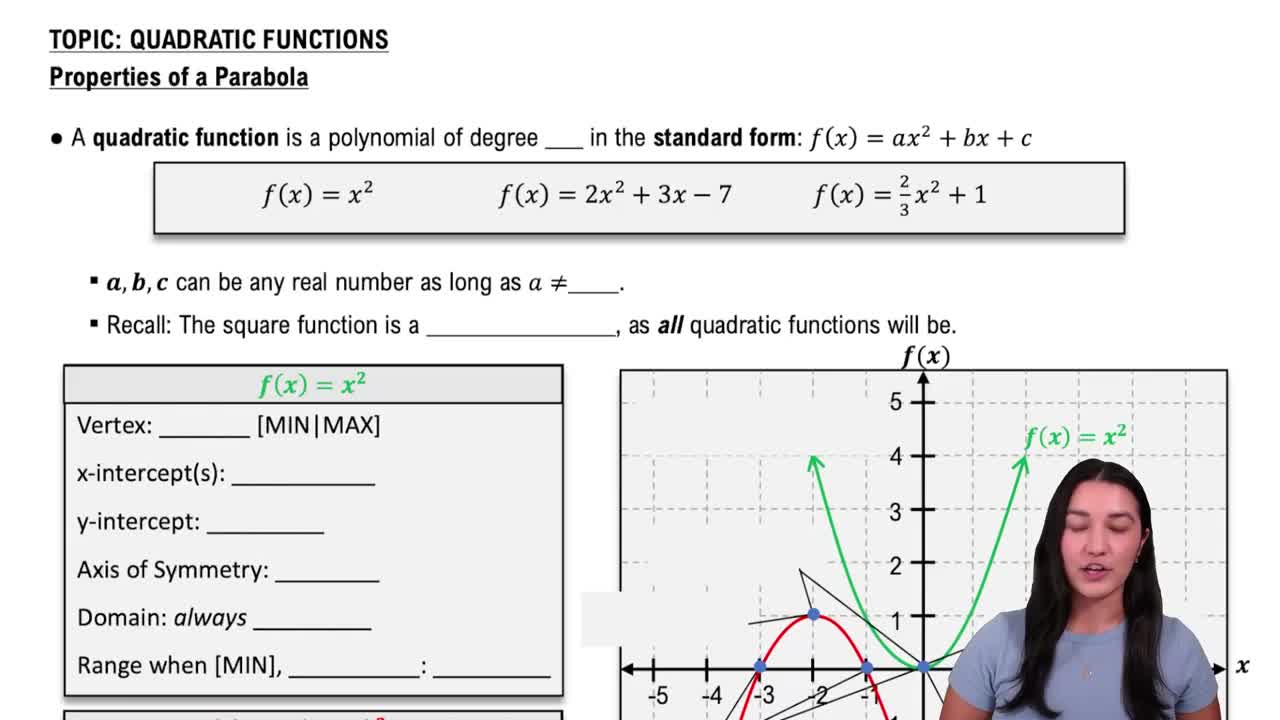
The axis of symmetry is a vertical line that passes through the vertex and divides the parabola into two mirror-image halves. Its equation is x = h, where h is the x-coordinate of the vertex. This line helps in graphing and understanding the parabola's symmetry.
Video consigliato:
07:42
Properties of Parabolas

Domain and Range of Quadratic Functions

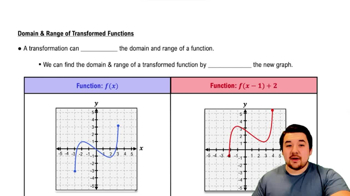
The domain of any quadratic function is all real numbers since x can take any value. The range depends on the vertex and the parabola's direction; if it opens downward, the range is all values less than or equal to the vertex's y-coordinate, and if upward, all values greater than or equal to it.
Video consigliato:
4:22
Domain & Range of Transformed Functions