Use the vertex and intercepts to sketch the graph of each quadratic function. Give the equation of the parabola's axis of symmetry. Use the graph to determine the function's domain and range. f(x)=2(x+2)2−1
Ch. 3 - Polynomial and Rational Functions

Capitolo 4, Problema 21
Find the vertical asymptotes, if any, and the values of x corresponding to holes, if any, of the graph of each rational function. f(x)=x/(x+4)
Guida verificata passo dopo passo1
Identify the rational function given: \(f(x) = \frac{x}{x+4}\).
Determine the values of \(x\) that make the denominator zero, since these are potential vertical asymptotes or holes. Set the denominator equal to zero: \(x + 4 = 0\).
Solve for \(x\): \(x = -4\). This is the value where the function is undefined.
Check if the factor \(x + 4\) cancels with any factor in the numerator. Since the numerator is \(x\), which does not contain \(x + 4\) as a factor, there is no cancellation.
Conclude that \(x = -4\) is a vertical asymptote, and there are no holes in the graph of \(f(x)\).

Risposta video verificata per un problema simile:
Questa soluzione video è stata consigliata dai nostri tutor come utile per risolvere questo problema.
Durata del video:
1mConcetti chiave
Ecco i concetti essenziali che devi comprendere per rispondere correttamente alla domanda.
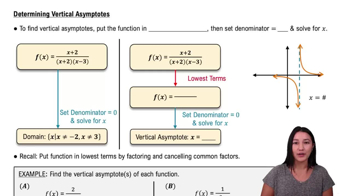
Vertical Asymptotes
Vertical asymptotes occur where a rational function's denominator is zero and the numerator is nonzero, causing the function to approach infinity or negative infinity. To find them, set the denominator equal to zero and solve for x, excluding any values that also make the numerator zero.
Video consigliato:
Determining Vertical Asymptotes
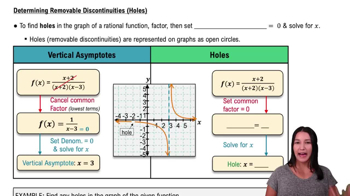
Holes in the Graph
Holes occur in the graph of a rational function when a factor cancels out from both the numerator and denominator, resulting in an undefined point rather than an asymptote. To identify holes, factor both numerator and denominator, cancel common factors, and find the x-values that make these factors zero.
Video consigliato:
Determining Removable Discontinuities (Holes)
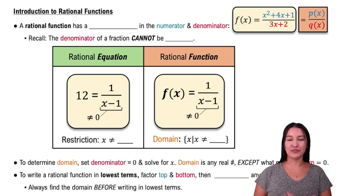
Rational Functions and Domain
A rational function is a ratio of two polynomials. Its domain includes all real numbers except where the denominator is zero, as division by zero is undefined. Understanding the domain helps in identifying points of discontinuity such as vertical asymptotes and holes.
Video consigliato:
Intro to Rational Functions
Pratica correlata
Domanda del libro di testo
691
views
Domanda del libro di testo
Divide using synthetic division. (4x3−3x2+3x−1)÷(x−1)
554
views
Domanda del libro di testo
Solve each polynomial inequality in Exercises 1–42 and graph the solution set on a real number line. Express each solution set in interval notation.
515
views
Domanda del libro di testo
Use the Leading Coefficient Test to determine the end behavior of the graph of the polynomial function. f(x)=11x4−6x2+x+3
1056
views
Domanda del libro di testo
Use the vertex and intercepts to sketch the graph of each quadratic function. Give the equation of the parabola's axis of symmetry. Use the graph to determine the function's domain and range. y−1=(x−3)2
621
views
Domanda del libro di testo
Solve each polynomial inequality in Exercises 1–42 and graph the solution set on a real number line. Express each solution set in interval notation. 3x2 − 5x ≤ 0
564
views