Ch. 3 - Polynomial and Rational Functions
Blitzer - College Algebra 8th Edition
Blitzer8th EditionCollege AlgebraISBN: 9780136970514Non è quello che usi tu?Cambia libro di testo
Capitolo 4, Problema 25

In Exercises 25–26, graph each polynomial function. f(x)=2x2(x−1)3(x+2)f(x) = 2x^2(x - 1)^3(x + 2)

Guida verificata passo dopo passo
1
Identify the degree and leading coefficient of the polynomial function \(f(x) = 2x^2(x - 1)^3(x + 2)\). To do this, first find the degree by adding the exponents of each factor: \$2x^2$ contributes degree 2, $(x - 1)^3$ contributes degree 3, and $(x + 2)$ contributes degree 1. So, total degree = \(2 + 3 + 1\).
Determine the leading term by multiplying the leading terms of each factor: from \$2x^2$ take \$2x^2$, from $(x - 1)^3$ take $x^3$, and from $(x + 2)$ take $x$. Multiply these to get the leading term, which will help understand the end behavior of the graph.
Find the zeros (roots) of the polynomial by setting each factor equal to zero: \(2x^2 = 0\) gives \(x=0\), \((x - 1)^3 = 0\) gives \(x=1\), and \((x + 2) = 0\) gives \(x = -2\). Note the multiplicity of each zero: 2 for \(x=0\), 3 for \(x=1\), and 1 for \(x=-2\).
Analyze the behavior of the graph at each zero based on its multiplicity: if the multiplicity is even, the graph touches the x-axis and turns around; if odd, it crosses the x-axis. So, at \(x=0\) (multiplicity 2) the graph touches and turns, at \(x=1\) (multiplicity 3) it crosses with a flattening effect, and at \(x=-2\) (multiplicity 1) it crosses the x-axis.
Use the leading term and zeros to sketch the graph: start by plotting the zeros on the x-axis, then use the end behavior from the leading term to determine how the graph behaves as \(x \to \pm \infty\). Connect the points smoothly, respecting the behavior at each zero.

Risposta video verificata per un problema simile:

Questa soluzione video è stata consigliata dai nostri tutor come utile per risolvere questo problema.
Durata del video:
6m

Concetti chiave

Ecco i concetti essenziali che devi comprendere per rispondere correttamente alla domanda.

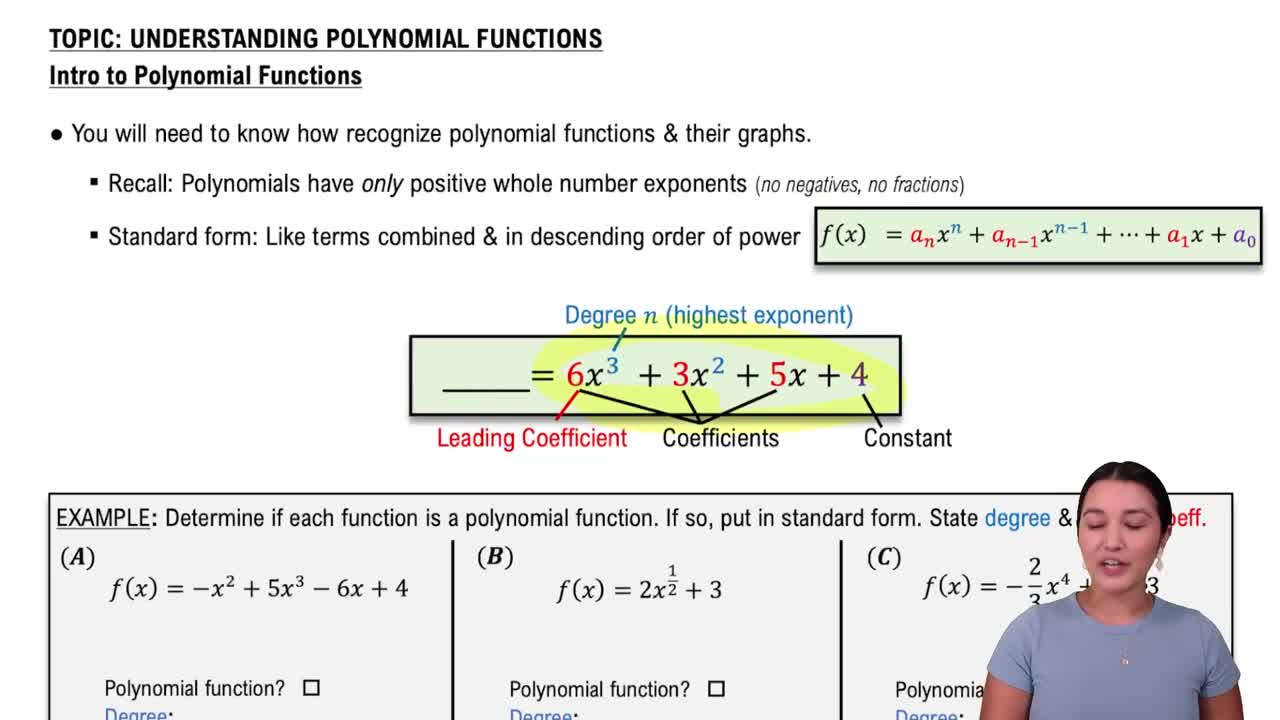
Polynomial Functions and Their Degree

A polynomial function is an expression consisting of variables raised to whole-number exponents and coefficients. The degree of the polynomial is the highest sum of exponents in any term, which determines the general shape and end behavior of the graph. For f(x) = 2x^2(x - 1)^3(x + 2), the degree is 2 + 3 + 1 = 6.
Video consigliato:
06:04
Introduction to Polynomial Functions

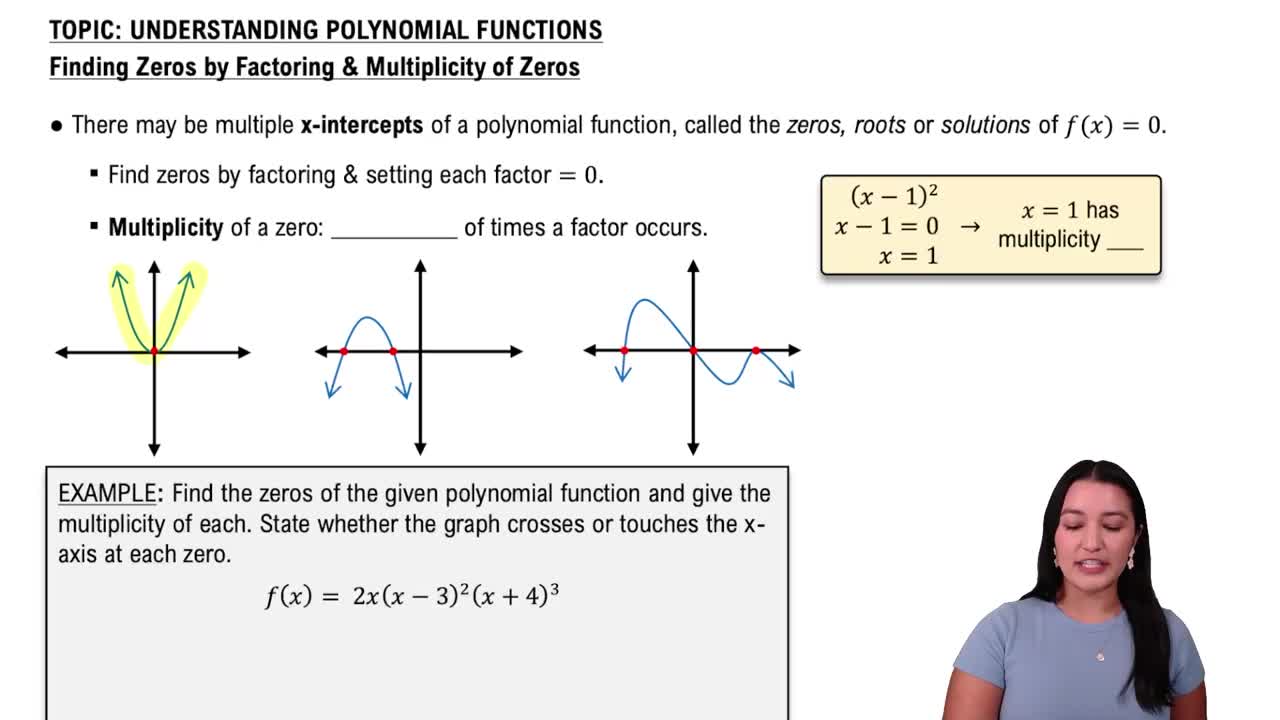
Zeros of a Polynomial and Their Multiplicities

Zeros are the values of x that make the polynomial equal to zero. Each zero's multiplicity (the exponent on its factor) affects the graph's behavior at that point: odd multiplicities cause the graph to cross the x-axis, while even multiplicities cause it to touch and turn around. Here, zeros are x=0 (multiplicity 2), x=1 (multiplicity 3), and x=-2 (multiplicity 1).
Video consigliato:
03:42
Finding Zeros & Their Multiplicity

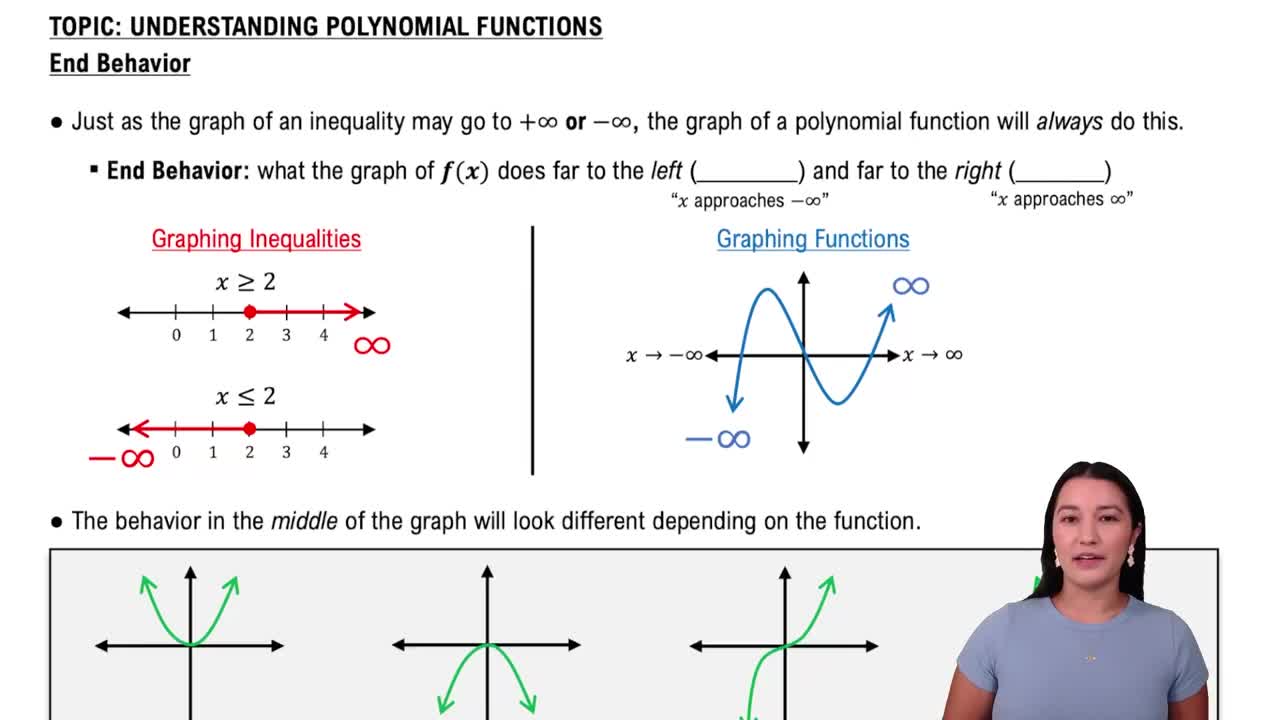
End Behavior of Polynomial Graphs

The end behavior describes how the graph behaves as x approaches positive or negative infinity. It depends on the leading coefficient and the degree of the polynomial. Since the degree is even (6) and the leading coefficient (2) is positive, the graph rises to positive infinity on both ends.
Video consigliato:
06:08
End Behavior of Polynomial Functions