Ch. 3 - Polynomial and Rational Functions
Blitzer - College Algebra 8th Edition
Blitzer8th EditionCollege AlgebraISBN: 9780136970514Non è quello che usi tu?Cambia libro di testo
Capitolo 4, Problema 33

Use Descartes's Rule of Signs to determine the possible number of positive and negative real zeros for each given function. f(x)=x3+2x2+5x+4

Guida verificata passo dopo passo
1
Write down the given polynomial function: \(f(x) = x^{3} + 2x^{2} + 5x + 4\).
To find the possible number of positive real zeros, count the number of sign changes in the coefficients of \(f(x)\). The coefficients are \$1, 2, 5, 4$. Since all are positive, there are no sign changes.
Therefore, according to Descartes's Rule of Signs, the number of positive real zeros is 0 or less by an even number (which means exactly 0 positive real zeros).
Next, to find the possible number of negative real zeros, evaluate \(f(-x)\) by substituting \(-x\) into the function: \(f(-x) = (-x)^{3} + 2(-x)^{2} + 5(-x) + 4\).
Simplify \(f(-x)\) to get the new polynomial and then count the number of sign changes in its coefficients. This will give the possible number of negative real zeros, which is the number of sign changes or less by an even number.

Risposta video verificata per un problema simile:

Questa soluzione video è stata consigliata dai nostri tutor come utile per risolvere questo problema.
Durata del video:
2m

Concetti chiave

Ecco i concetti essenziali che devi comprendere per rispondere correttamente alla domanda.

Descartes's Rule of Signs

Descartes's Rule of Signs is a method used to determine the possible number of positive and negative real zeros of a polynomial function by counting the sign changes in the coefficients. The number of positive real zeros is equal to the number of sign changes in f(x) or less than that by an even number. For negative zeros, the rule is applied to f(-x).
Video consigliato:
6:54
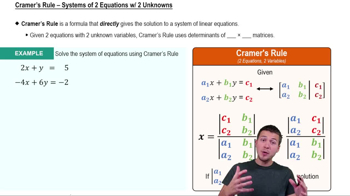
Cramer's Rule - 2 Equations with 2 Unknowns

Polynomial Functions and Their Zeros

A polynomial function is an expression involving variables raised to whole-number exponents with coefficients. The zeros of a polynomial are the values of x that make the function equal to zero. Understanding the degree and coefficients helps predict the number and nature of these zeros.
Video consigliato:
03:42
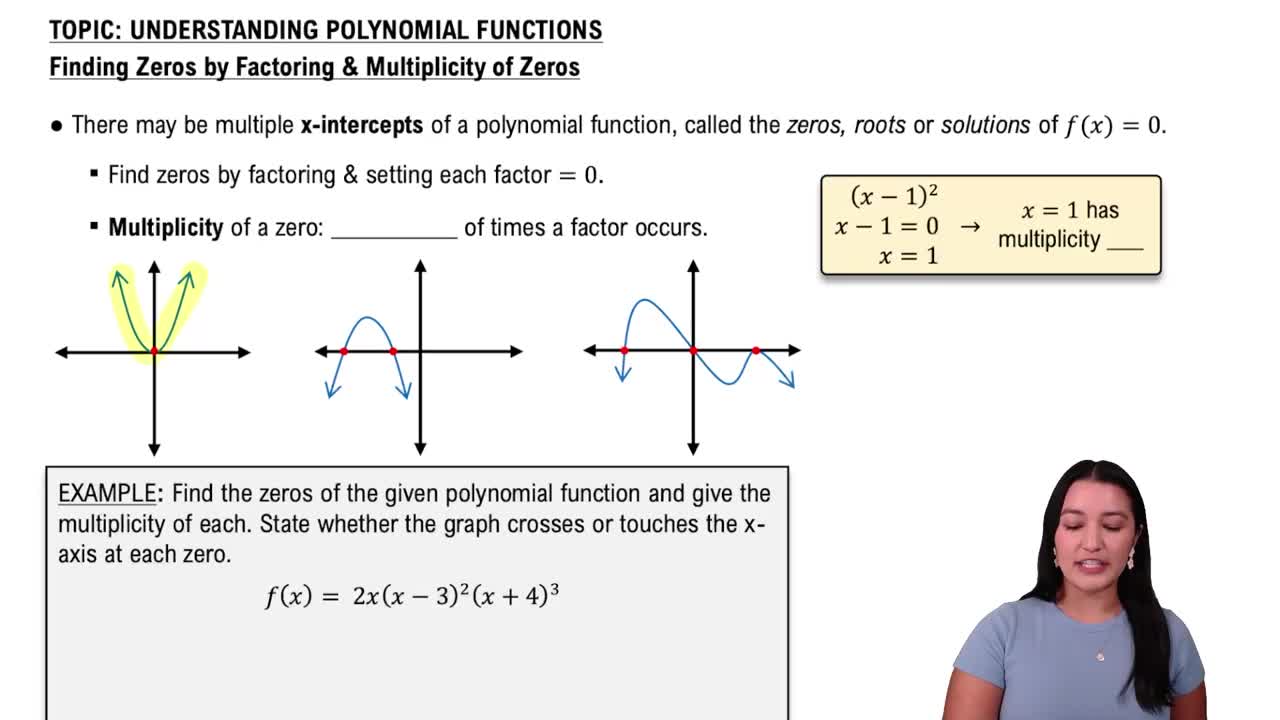
Finding Zeros & Their Multiplicity

Evaluating f(-x) to Find Negative Zeros

To apply Descartes's Rule of Signs for negative zeros, substitute -x into the polynomial to get f(-x). This changes the signs of terms with odd powers. Counting sign changes in f(-x) reveals the possible number of negative real zeros, similar to the process for positive zeros.
Video consigliato:
6:37
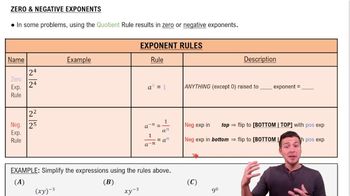
Zero and Negative Rules