Ch. 3 - Polynomial and Rational Functions
Blitzer - College Algebra 8th Edition
Blitzer8th EditionCollege AlgebraISBN: 9780136970514Non è quello che usi tu?Cambia libro di testo
Capitolo 4, Problema 46

In Exercises 45–46, describe in words the variation shown by the given equation. z = kx^2 √y

Guida verificata passo dopo passo
1
Identify the variables and constants in the equation z = k x2 y, where z is the dependent variable, x and y are independent variables, and k is a constant of proportionality.
Recognize that z varies directly with the square of x, meaning if x increases, z increases proportionally to the square of x.
Understand that z also varies directly with the square root of y, so if y increases, z increases proportionally to the square root of y.
Combine these observations to describe the overall variation: z varies jointly as the square of x and the square root of y.
Summarize the variation in words: z increases as x increases squared and as the square root of y increases, scaled by the constant k.

Risposta video verificata per un problema simile:

Questa soluzione video è stata consigliata dai nostri tutor come utile per risolvere questo problema.
Durata del video:
1m

Concetti chiave

Ecco i concetti essenziali che devi comprendere per rispondere correttamente alla domanda.

Direct Variation

Direct variation describes a relationship where one variable increases or decreases proportionally with another. In the equation z = kx^2 √y, z varies directly with x squared and the square root of y, meaning as x or y increase, z changes accordingly based on the constant k.
Video consigliato:
02:44
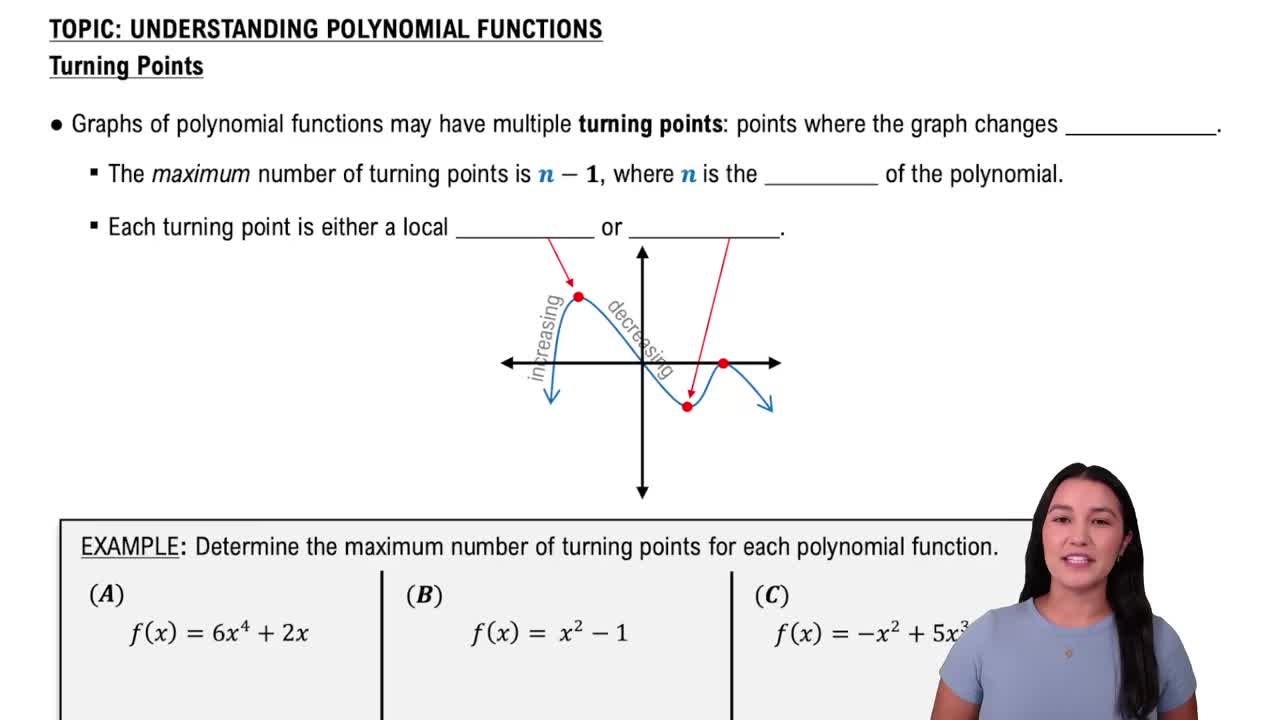
Maximum Turning Points of a Polynomial Function

Exponents and Powers

Exponents indicate repeated multiplication of a base number. Here, x is raised to the power of 2 (x^2), meaning x is multiplied by itself. Understanding how exponents affect variables helps interpret how changes in x influence z.
Video consigliato:
04:10
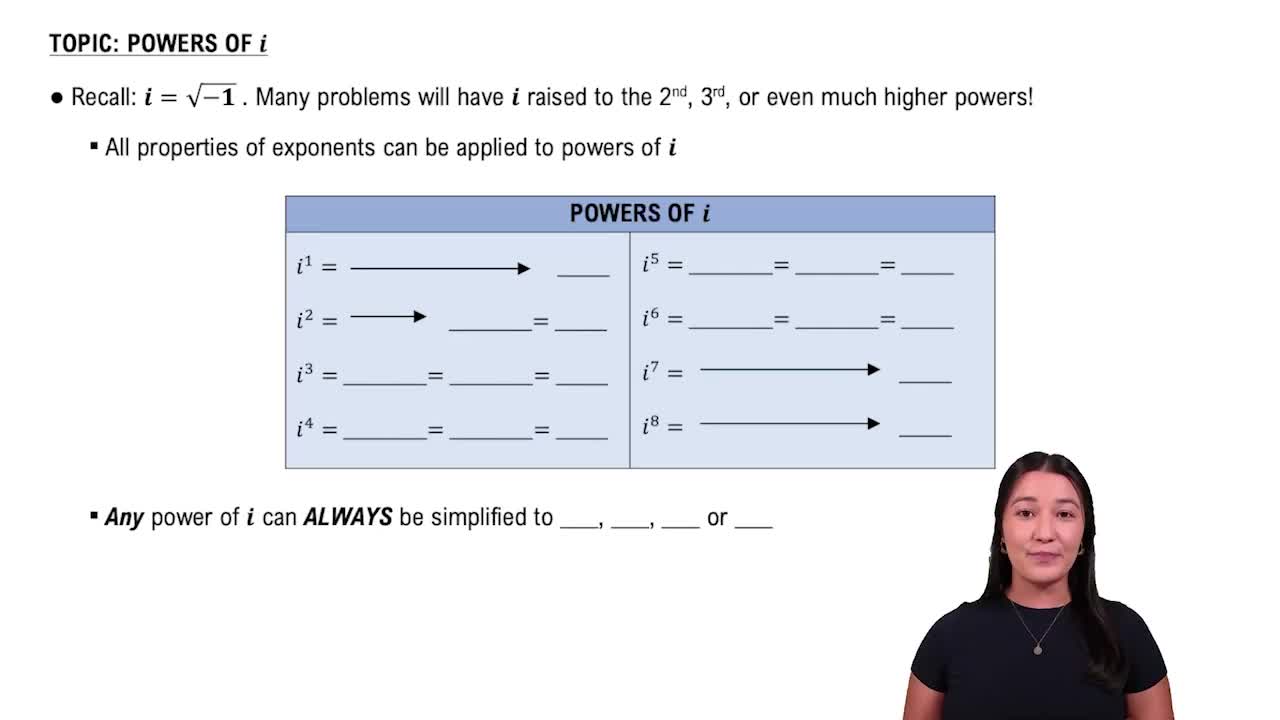
Powers of i

Square Root Function

The square root function, denoted √y, represents a value that when squared returns y. It grows slower than linear functions, so as y increases, √y increases but at a decreasing rate. Recognizing this helps explain how y affects z in the equation.
Video consigliato:
02:20
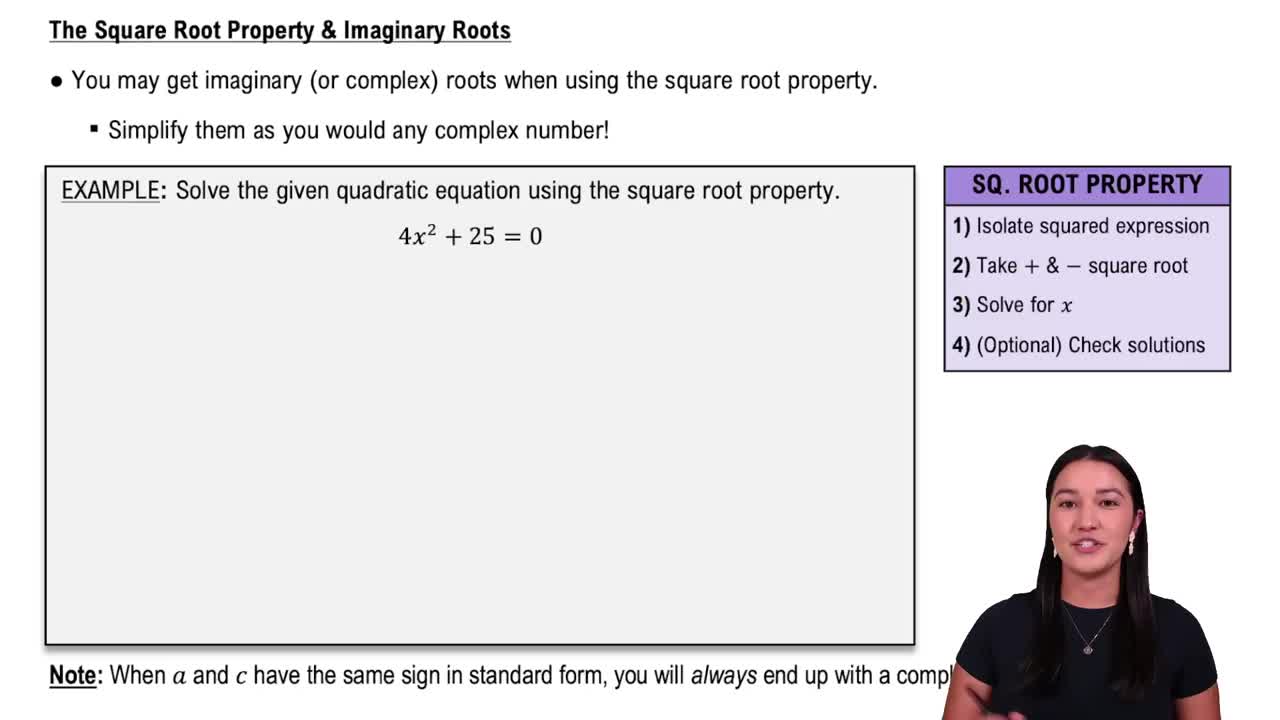
Imaginary Roots with the Square Root Property