Ch. 3 - Polynomial and Rational Functions
Blitzer - College Algebra 8th Edition
Blitzer8th EditionCollege AlgebraISBN: 9780136970514Non è quello che usi tu?Cambia libro di testo
Capitolo 4, Problema 50

In Exercises 49–50, find all the zeros of each polynomial function and write the polynomial as a product of linear factors. g(x) = x^4 - 6x^3 + x^2 + 24x + 16

Guida verificata passo dopo passo
1
Step 1: Use the Rational Root Theorem to list all possible rational roots of the polynomial. The possible rational roots are the factors of the constant term (16) divided by the factors of the leading coefficient (1).
Step 2: Test each possible rational root by substituting them into the polynomial \( g(x) = x^4 - 6x^3 + x^2 + 24x + 16 \) to see which ones are actual roots.
Step 3: Once a root is found, use synthetic division to divide the polynomial by \( x - \text{root} \) to reduce the polynomial's degree.
Step 4: Repeat the process of finding roots and using synthetic division on the resulting polynomial until it is reduced to a quadratic or linear factor.
Step 5: Factor the remaining quadratic polynomial, if necessary, to find all zeros and express the original polynomial as a product of linear factors.

Risposta video verificata per un problema simile:

Questa soluzione video è stata consigliata dai nostri tutor come utile per risolvere questo problema.
Durata del video:
12m

Concetti chiave

Ecco i concetti essenziali che devi comprendere per rispondere correttamente alla domanda.

Polynomial Functions

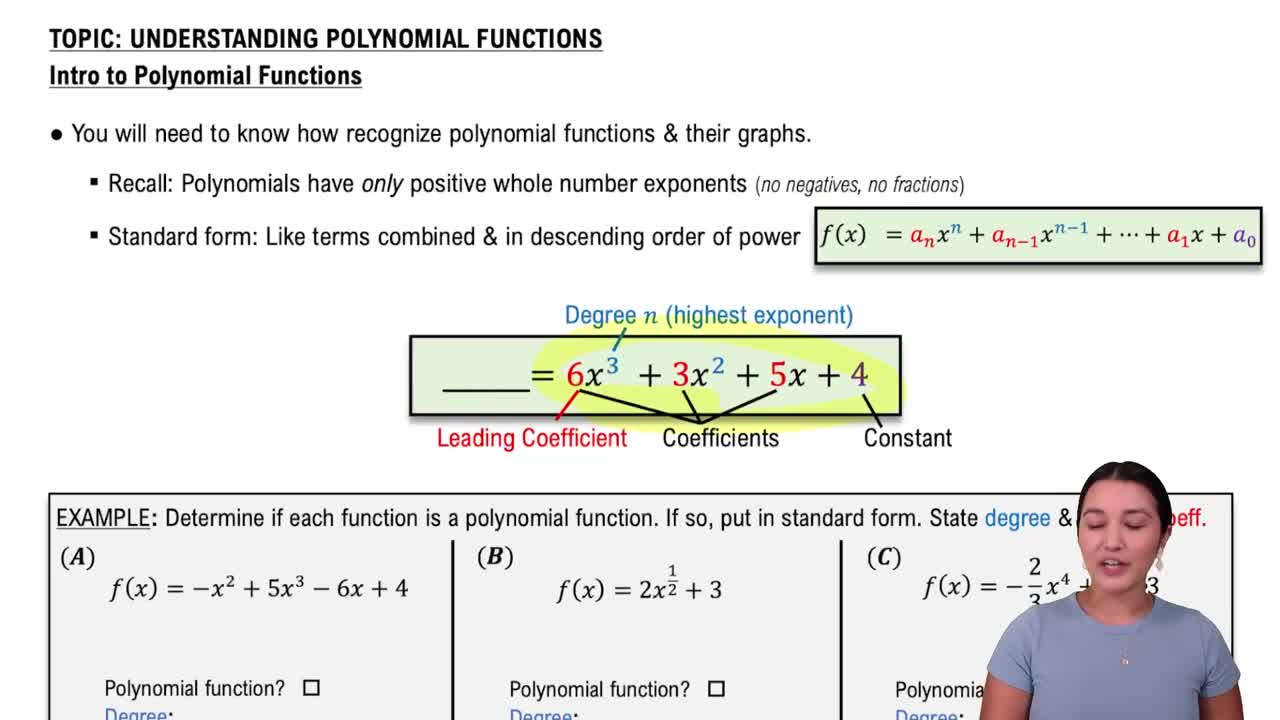
A polynomial function is a mathematical expression involving a sum of powers in one or more variables multiplied by coefficients. The general form is f(x) = a_n*x^n + a_(n-1)*x^(n-1) + ... + a_1*x + a_0, where a_n is not zero. Understanding polynomial functions is crucial for analyzing their behavior, including finding zeros, which are the values of x that make the function equal to zero.
Video consigliato:
06:04
Introduction to Polynomial Functions

Finding Zeros

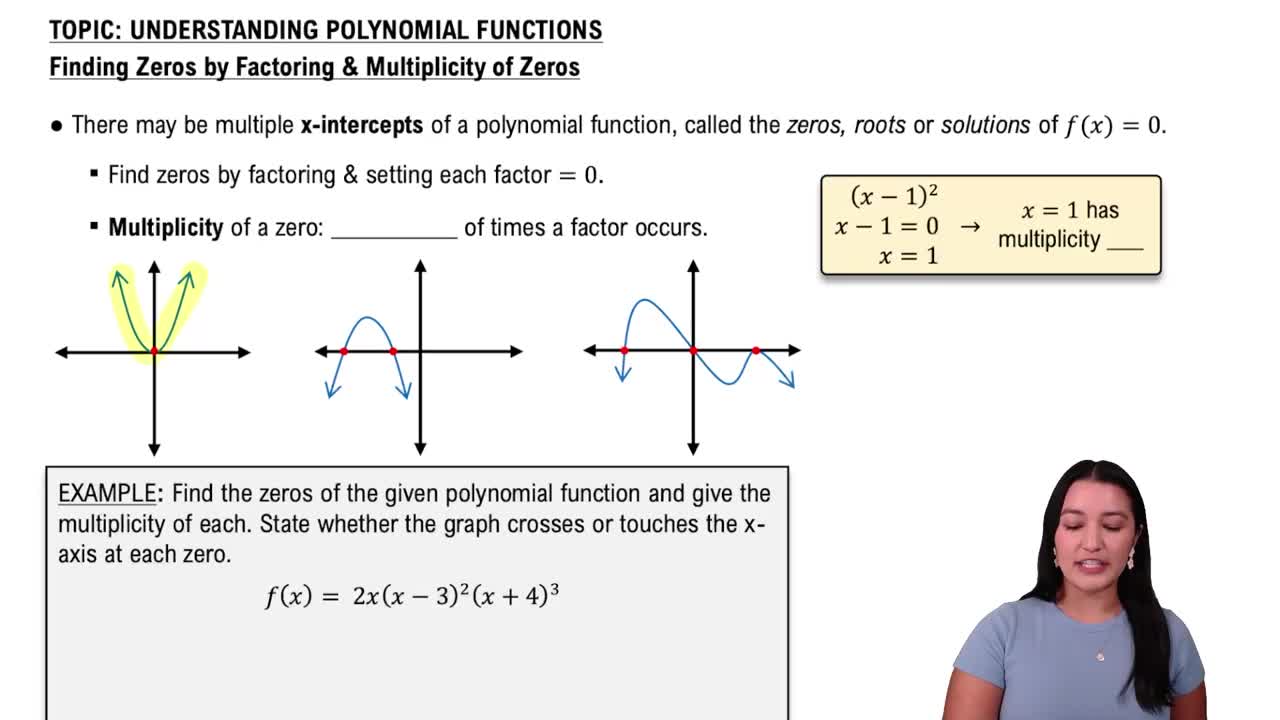
Finding the zeros of a polynomial involves determining the values of x for which the polynomial equals zero. This can be achieved through various methods, including factoring, using the Rational Root Theorem, or applying synthetic division. Zeros are essential as they indicate the x-intercepts of the graph of the polynomial and are key to expressing the polynomial as a product of linear factors.
Video consigliato:
03:42
Finding Zeros & Their Multiplicity

Factoring Polynomials

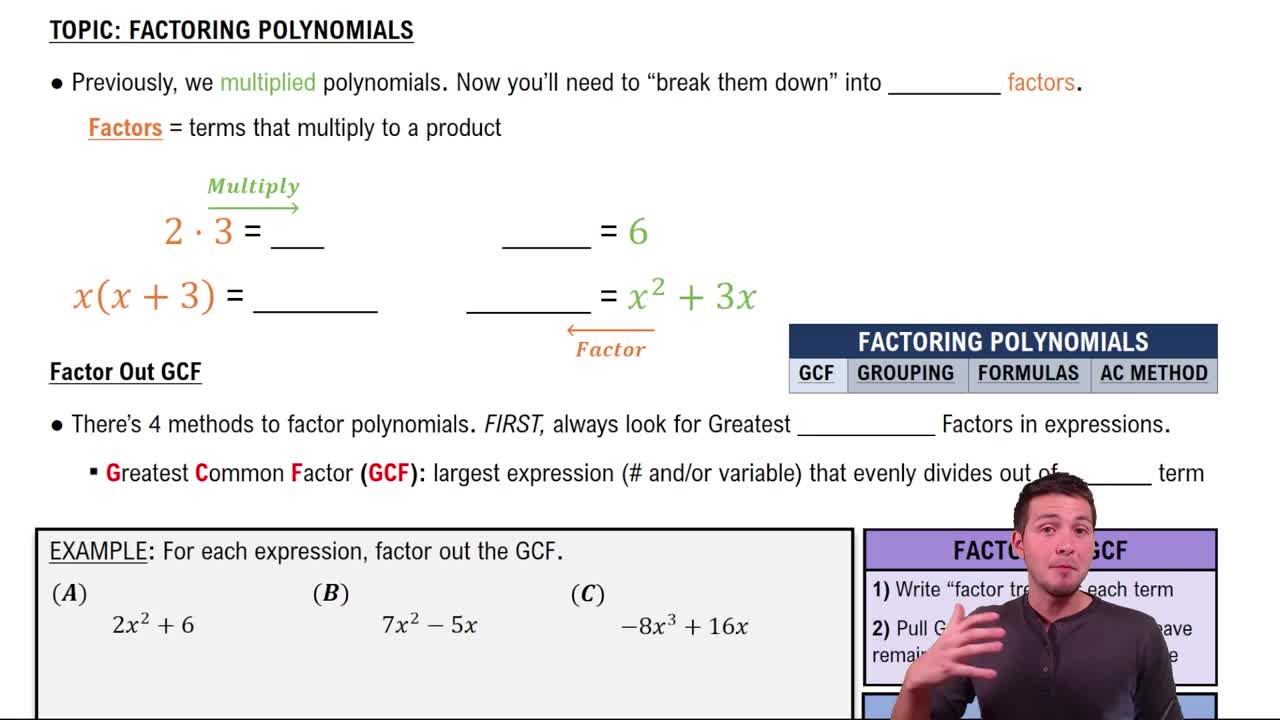
Factoring polynomials is the process of breaking down a polynomial into simpler components, specifically linear factors. For a polynomial of degree n, it can be expressed as a product of n linear factors if it has n zeros. This is important for simplifying expressions and solving equations, as well as for understanding the polynomial's roots and their multiplicities.
Video consigliato:
07:30
Introduction to Factoring Polynomials