Ch. 3 - Polynomial and Rational Functions
Blitzer - College Algebra 8th Edition
Blitzer8th EditionCollege AlgebraISBN: 9780136970514Non è quello che usi tu?Cambia libro di testo
Capitolo 4, Problema 60

In Exercises 57–64, find the vertical asymptotes, if any, the horizontal asymptote, if one exists, and the slant asymptote, if there is one, of the graph of each rational function. Then graph the rational function. r(x) = (x^2 + 4x + 3)/(x + 2)^2

Guida verificata passo dopo passo
1
Step 1: Identify the vertical asymptotes by setting the denominator equal to zero. Solve the equation \( (x + 2)^2 = 0 \) to find the x-values where the function is undefined.
Step 2: Determine the horizontal asymptote by comparing the degrees of the numerator and denominator. The numerator \( x^2 + 4x + 3 \) has degree 2, and the denominator \( (x + 2)^2 \) also has degree 2. When the degrees are equal, the horizontal asymptote is given by the ratio of the leading coefficients of the numerator and denominator.
Step 3: Check for a slant asymptote. A slant asymptote exists if the degree of the numerator is exactly one more than the degree of the denominator. Since the degrees of the numerator and denominator are the same, there is no slant asymptote in this case.
Step 4: Analyze the behavior of the function near the vertical asymptote \( x = -2 \). Substitute values slightly less than and greater than \( x = -2 \) into the function to observe how the function behaves as it approaches the asymptote.
Step 5: Sketch the graph of the rational function by plotting key points, including intercepts, and using the information about the asymptotes to guide the shape of the graph. Ensure the graph approaches the vertical and horizontal asymptotes appropriately.

Risposta video verificata per un problema simile:

Questa soluzione video è stata consigliata dai nostri tutor come utile per risolvere questo problema.
Durata del video:
10m

Concetti chiave

Ecco i concetti essenziali che devi comprendere per rispondere correttamente alla domanda.

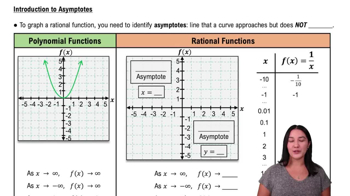
Asymptotes

Asymptotes are lines that a graph approaches but never touches. Vertical asymptotes occur where a function is undefined, typically where the denominator equals zero. Horizontal asymptotes indicate the behavior of a function as x approaches infinity, while slant (or oblique) asymptotes occur when the degree of the numerator is one higher than that of the denominator, indicating a linear behavior at infinity.
Video consigliato:
6:24
Introduction to Asymptotes

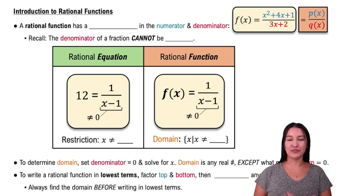
Rational Functions

A rational function is a function represented by the ratio of two polynomials. The general form is r(x) = P(x)/Q(x), where P and Q are polynomials. Understanding the degrees of the polynomials in the numerator and denominator is crucial for determining the behavior of the function, including the existence and type of asymptotes.
Video consigliato:
6:04
Intro to Rational Functions

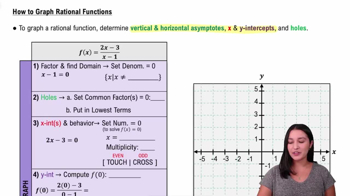
Graphing Rational Functions

Graphing rational functions involves analyzing their asymptotic behavior, intercepts, and overall shape. Key steps include identifying vertical and horizontal asymptotes, finding x- and y-intercepts, and determining the function's end behavior. This comprehensive approach helps in sketching an accurate graph that reflects the function's characteristics.
Video consigliato:
8:19
How to Graph Rational Functions