Ch. 3 - Polynomial and Rational Functions
Blitzer - College Algebra 8th Edition
Blitzer8th EditionCollege AlgebraISBN: 9780136970514Non è quello che usi tu?Cambia libro di testo
Capitolo 4, Problema 62

Find the domain of each function. f(x)=14x2−9x+2f(x) = \(\frac{1}{\sqrt{4x^2 - 9x + 2}\)}

Guida verificata passo dopo passo
1
Identify the function given: \(f(x) = \frac{1}{\sqrt{4x^{2} - 9x + 2}}\). Since the function involves a square root in the denominator, the expression inside the square root must be positive (greater than zero) to avoid division by zero and to keep the function defined.
Set the inequality for the radicand (expression inside the square root) to be greater than zero: \(4x^{2} - 9x + 2 > 0\).
Solve the quadratic inequality by first finding the roots of the quadratic equation \(4x^{2} - 9x + 2 = 0\). Use the quadratic formula: \(x = \frac{-b \pm \sqrt{b^{2} - 4ac}}{2a}\), where \(a=4\), \(b=-9\), and \(c=2\).
Once the roots are found, determine the intervals on the number line where \(4x^{2} - 9x + 2\) is greater than zero by testing values in each interval defined by the roots.
Express the domain of \(f(x)\) as the union of intervals where the inequality holds true, since these are the values of \(x\) for which the function is defined.

Risposta video verificata per un problema simile:

Questa soluzione video è stata consigliata dai nostri tutor come utile per risolvere questo problema.
Durata del video:
3m

Concetti chiave

Ecco i concetti essenziali che devi comprendere per rispondere correttamente alla domanda.

Domain of a Function

The domain of a function is the set of all input values (x-values) for which the function is defined. For rational and root functions, the domain excludes values that cause division by zero or taking the square root of a negative number.
Video consigliato:
3:51
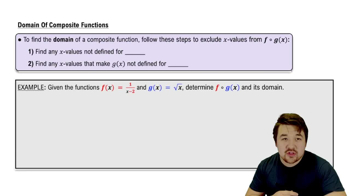
Domain Restrictions of Composed Functions

Square Root Function Restrictions

When a function involves a square root, the expression inside the root (the radicand) must be greater than or equal to zero to produce real number outputs. For denominators, the radicand must be strictly greater than zero to avoid division by zero.
Video consigliato:
02:20
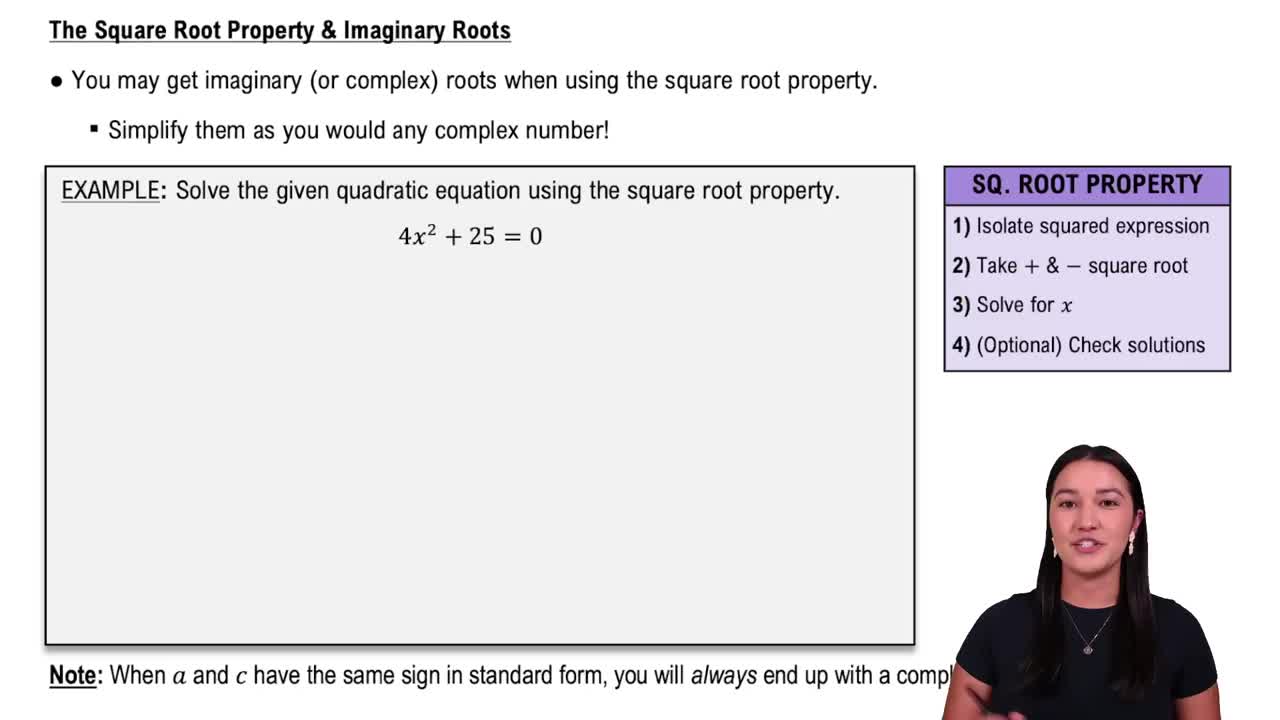
Imaginary Roots with the Square Root Property

Solving Quadratic Inequalities

To find where a quadratic expression is positive or non-negative, solve the quadratic inequality by finding its roots and testing intervals. This helps determine the range of x-values that satisfy the domain restrictions.
Video consigliato:
04:03
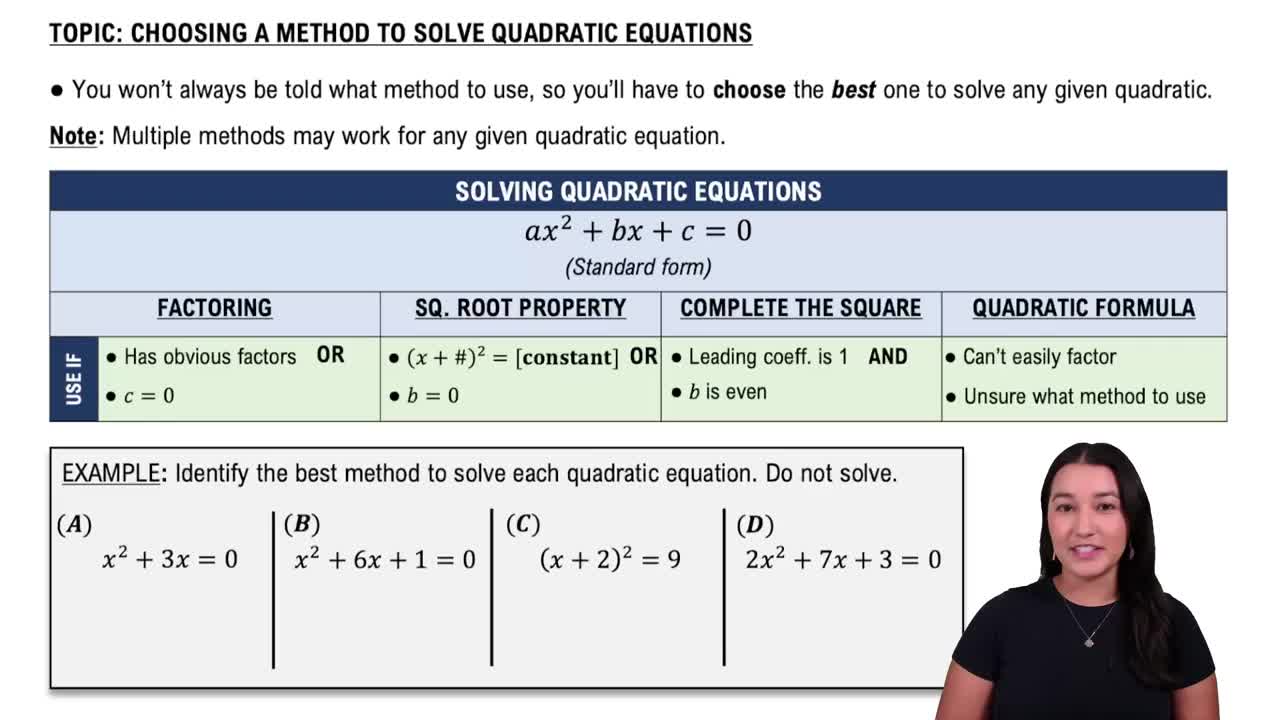
Choosing a Method to Solve Quadratics