Ch. 3 - Polynomial and Rational Functions
Blitzer - College Algebra 8th Edition
Blitzer8th EditionCollege AlgebraISBN: 9780136970514Non è quello che usi tu?Cambia libro di testo
Capitolo 4, Problema 67

Solve each inequality in Exercises 65–70 and graph the solution set on a real number line. 3/(x +3) > 3/(x - 2)

Guida verificata passo dopo passo
1
Start by writing the inequality clearly: \(\frac{3}{x + 3} > \frac{3}{x - 2}\).
Since both sides have a numerator of 3, you can focus on the denominators. However, be careful because multiplying or dividing by expressions involving variables can change the inequality direction depending on the sign of those expressions.
Bring all terms to one side to compare: \(\frac{3}{x + 3} - \frac{3}{x - 2} > 0\). Find a common denominator to combine the fractions: \(\frac{3(x - 2) - 3(x + 3)}{(x + 3)(x - 2)} > 0\).
Simplify the numerator: \(3(x - 2) - 3(x + 3) = 3x - 6 - 3x - 9 = -15\). So the inequality becomes \(\frac{-15}{(x + 3)(x - 2)} > 0\).
Analyze the sign of the fraction \(\frac{-15}{(x + 3)(x - 2)}\). Since -15 is negative, the fraction is positive when the denominator is negative. Determine the intervals where \((x + 3)(x - 2) < 0\) by finding critical points at \(x = -3\) and \(x = 2\), then test intervals between and outside these points.

Risposta video verificata per un problema simile:

Questa soluzione video è stata consigliata dai nostri tutor come utile per risolvere questo problema.
Durata del video:
9m

Concetti chiave

Ecco i concetti essenziali che devi comprendere per rispondere correttamente alla domanda.

Solving Rational Inequalities

Rational inequalities involve expressions with variables in the denominator. To solve them, first bring all terms to one side to form a single rational expression, then determine where the expression is positive or negative by analyzing critical points from the numerator and denominator.
Video consigliato:
02:58
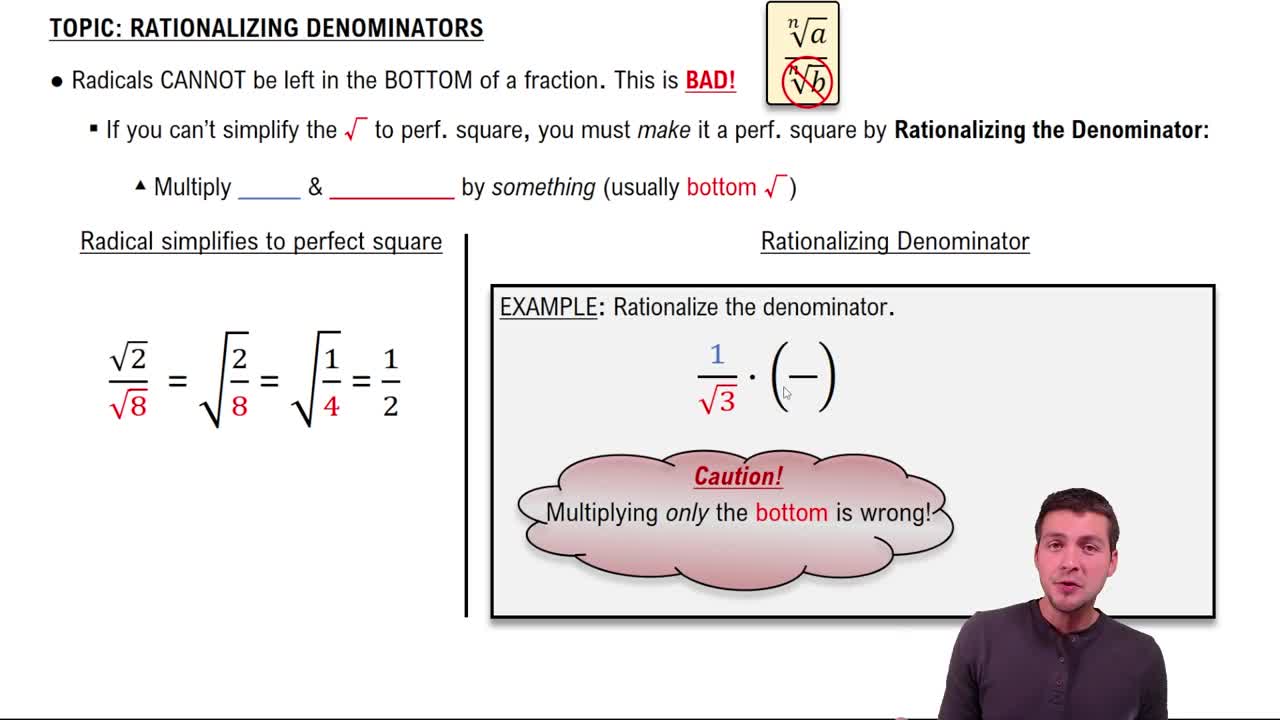
Rationalizing Denominators

Finding Critical Points and Domain Restrictions

Critical points occur where the numerator or denominator equals zero. These points divide the number line into intervals to test. Additionally, values that make the denominator zero are excluded from the solution set because they cause undefined expressions.
Video consigliato:
3:51
Domain Restrictions of Composed Functions

Graphing Solution Sets on the Real Number Line

After determining intervals where the inequality holds, represent the solution set on a number line. Use open circles for excluded points and shading to indicate intervals that satisfy the inequality, providing a visual understanding of the solution.
Video consigliato:
02:35
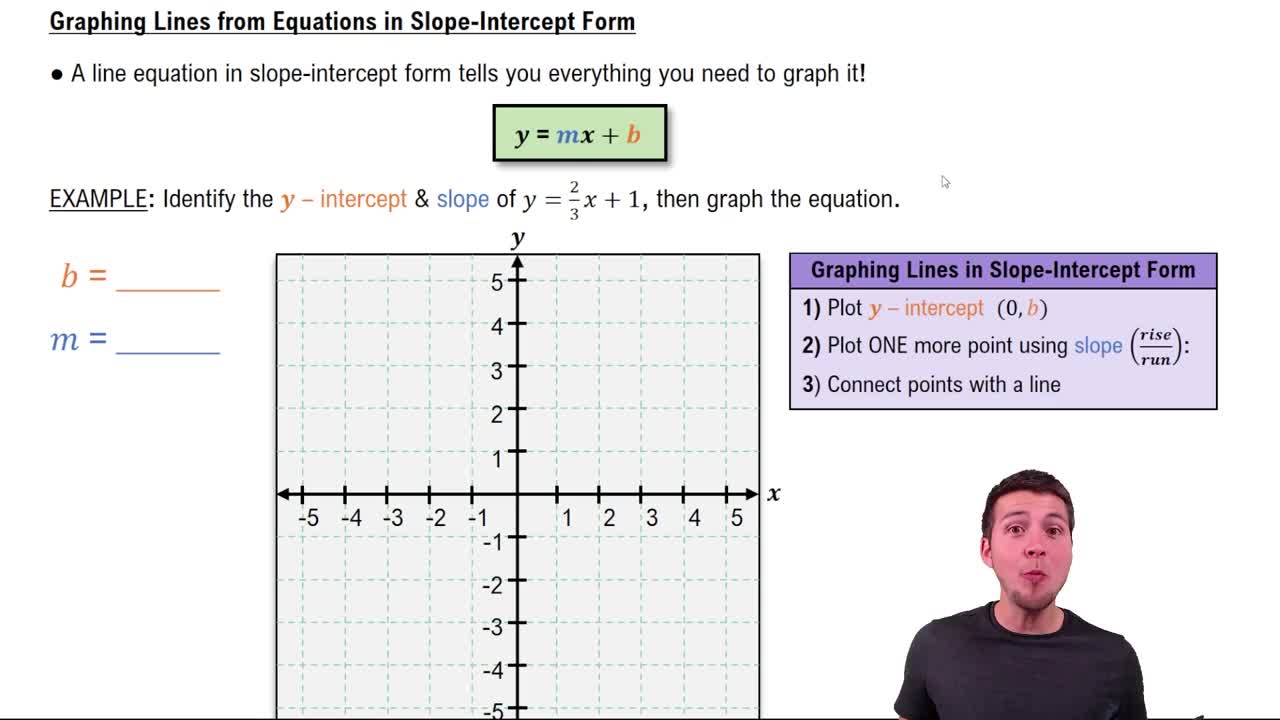
Graphing Lines in Slope-Intercept Form