In Exercises 1–4, use the vertex and intercepts to sketch the graph of each quadratic function. Give the equation for the parabola's axis of symmetry. Use the graph to determine the function's domain and range. f(x) = (x + 4)^2 - 2
Ch. 3 - Polynomial and Rational Functions

Capitolo 4, Problema 1
Solve each polynomial inequality in Exercises 1–42 and graph the solution set on a real number line. Express each solution set in interval notation. (x−4)(x+2)>0
Guida verificata passo dopo passo1
Start by identifying the critical points of the inequality \((x-4)(x+2) > 0\). These are the values of \(x\) that make each factor equal to zero, so set each factor equal to zero: \(x - 4 = 0\) and \(x + 2 = 0\).
Solve each equation to find the critical points: \(x = 4\) and \(x = -2\). These points divide the real number line into three intervals: \((-\infty, -2)\), \((-2, 4)\), and \((4, \infty)\).
Test a value from each interval in the original inequality \((x-4)(x+2) > 0\) to determine if the product is positive or negative in that interval. For example, pick \(x = -3\) for \((-\infty, -2)\), \(x = 0\) for \((-2, 4)\), and \(x = 5\) for \((4, \infty)\).
Determine the sign of the product in each interval by substituting the test values into \((x-4)(x+2)\). If the product is greater than zero, that interval is part of the solution set; if not, it is excluded.
Express the solution set as the union of intervals where the inequality holds true, and write it in interval notation. Also, graph these intervals on the real number line, using open circles at the critical points since the inequality is strict (greater than zero, not greater than or equal to).

Risposta video verificata per un problema simile:
Questa soluzione video è stata consigliata dai nostri tutor come utile per risolvere questo problema.
Durata del video:
4mConcetti chiave
Ecco i concetti essenziali che devi comprendere per rispondere correttamente alla domanda.
Polynomial Inequalities
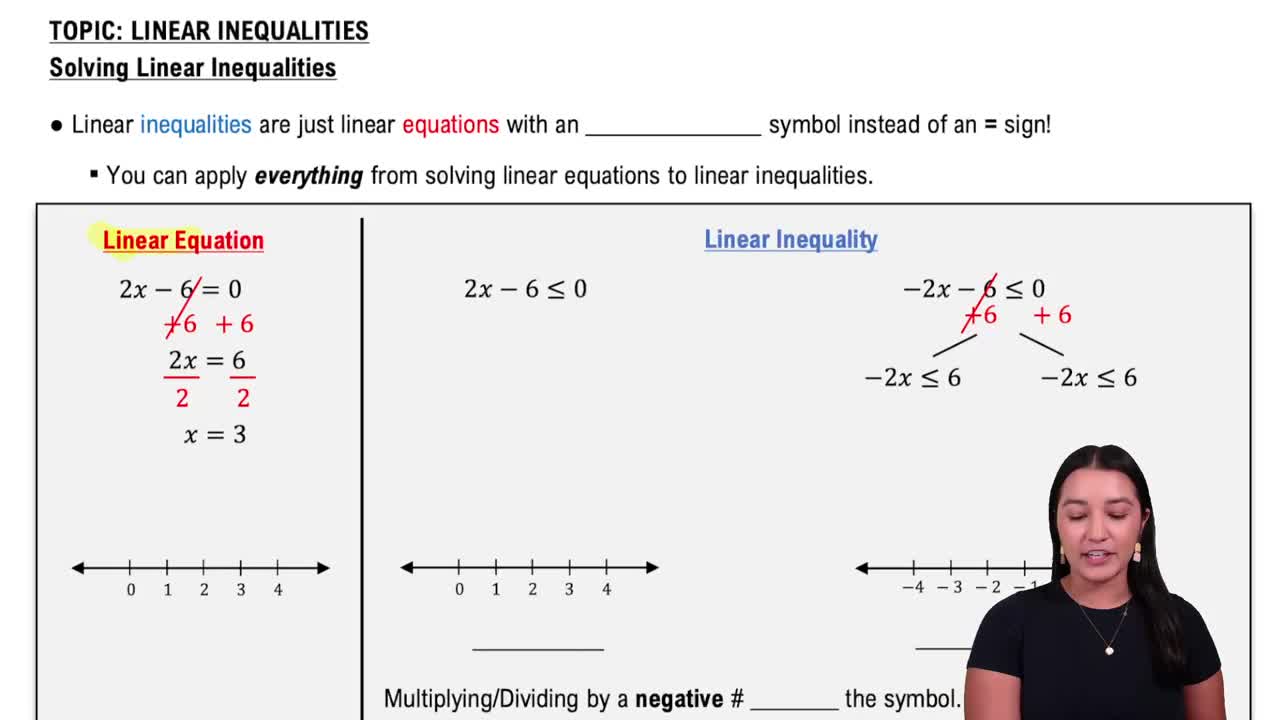
Polynomial inequalities involve expressions where a polynomial is compared to zero or another value using inequality symbols like >, <, ≥, or ≤. Solving them requires finding the values of the variable that make the inequality true, often by analyzing the sign of the polynomial over different intervals.
Video consigliato:
Linear Inequalities
Critical Points and Sign Analysis
Critical points are values of the variable where the polynomial equals zero, dividing the number line into intervals. By testing points in each interval, you determine whether the polynomial is positive or negative there, which helps identify where the inequality holds true.
Video consigliato:
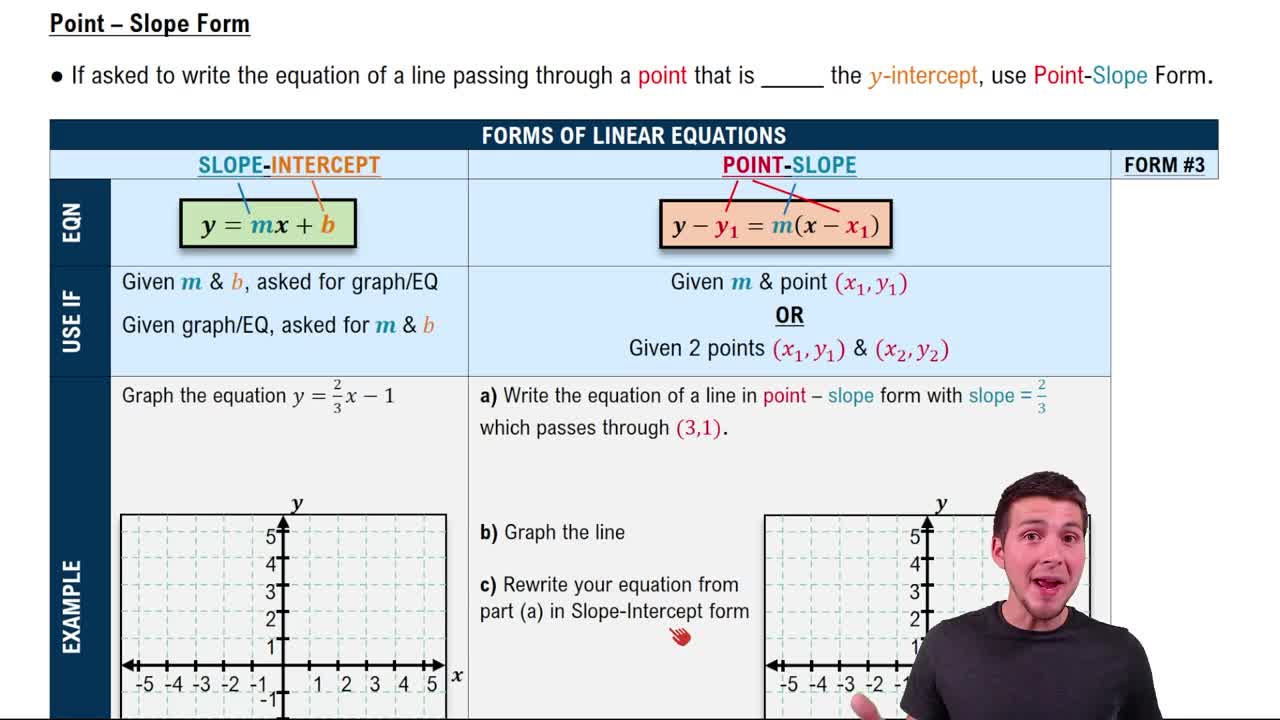
Point-Slope Form
Interval Notation and Graphing on the Number Line
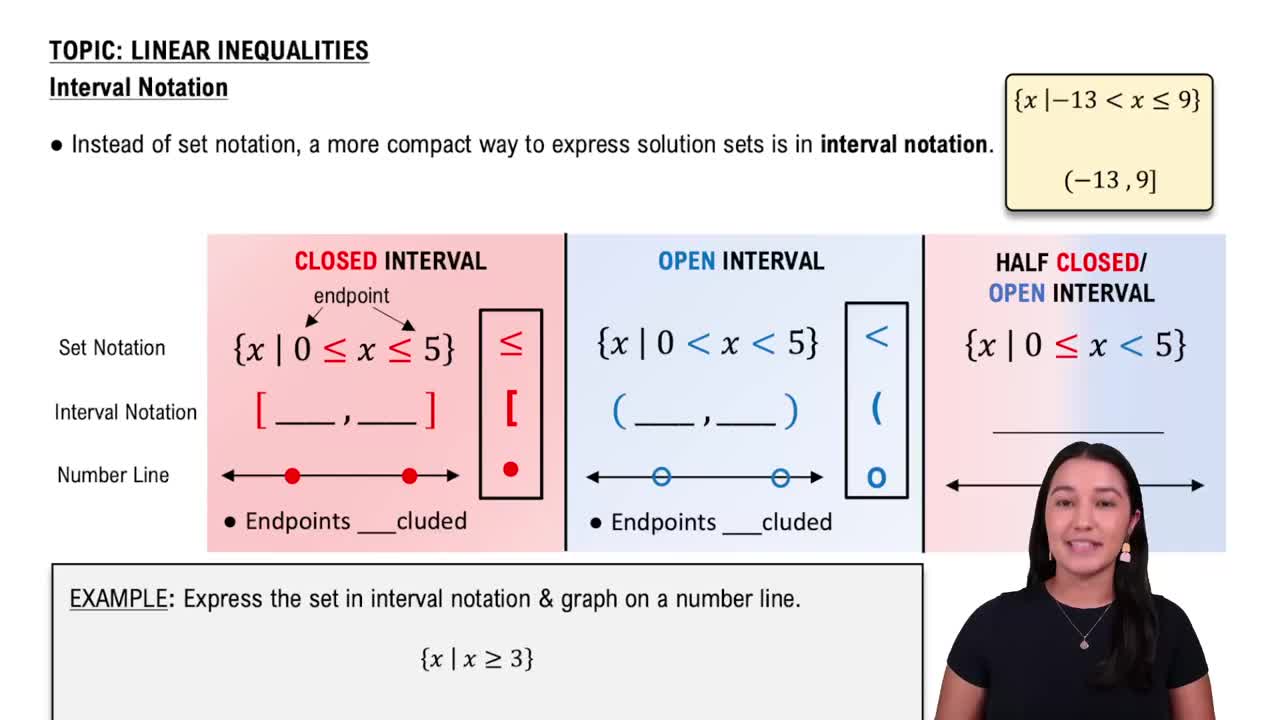
Interval notation expresses solution sets as ranges of values using parentheses and brackets to indicate open or closed intervals. Graphing these solutions on a number line visually represents where the inequality is satisfied, aiding in understanding and communication of the solution.
Video consigliato:
Interval Notation
Pratica correlata
Domanda del libro di testo
1275
views
Domanda del libro di testo
Use the four-step procedure for solving variation problems given on page 447 to solve Exercises 1–10. y varies directly as x. y = 65 when x = 5. Find y when x = 12.
172
views
Domanda del libro di testo
Determine which functions are polynomial functions. For those that are, identify the degree.
1260
views
Domanda del libro di testo
Divide using long division. State the quotient, and the remainder, r(x). (x2+8x+15)÷(x+5)
1275
views
Domanda del libro di testo
In Exercises 1–4, use the vertex and intercepts to sketch the graph of each quadratic function. Give the equation for the parabola's axis of symmetry. Use the graph to determine the function's domain and range.
1109
views
Domanda del libro di testo
Use the Rational Zero Theorem to list all possible rational zeros for each given function. f(x)=x3+x2−4x−4
753
views
