Ch. 3 - Polynomial and Rational Functions
Blitzer - College Algebra 8th Edition
Blitzer8th EditionCollege AlgebraISBN: 9780136970514Non è quello che usi tu?Cambia libro di testo
Capitolo 4, Problema 39

Use Descartes' Rule of Signs to explain why 2x4+6x2+8=02x^4 + 6x^2 + 8 = 0 has no real roots.

Guida verificata passo dopo passo
1
Write down the polynomial: \(2x^4 + 6x^2 + 8 = 0\).
Identify the signs of the coefficients in the polynomial: all coefficients (2, 6, and 8) are positive.
Apply Descartes' Rule of Signs to the polynomial \(f(x)\) by counting the number of sign changes in the sequence of coefficients. Since all coefficients are positive, there are 0 sign changes.
According to Descartes' Rule of Signs, the number of positive real roots is equal to the number of sign changes or less than that by an even number. Here, it means there are 0 positive real roots.
Next, apply Descartes' Rule of Signs to \(f(-x)\) by substituting \(-x\) into the polynomial and checking the signs of the coefficients. Since all powers of \(x\) are even, \(f(-x) = 2x^4 + 6x^2 + 8\) has the same coefficients and no sign changes, so there are 0 negative real roots as well.

Risposta video verificata per un problema simile:

Questa soluzione video è stata consigliata dai nostri tutor come utile per risolvere questo problema.
Durata del video:
2m

Concetti chiave

Ecco i concetti essenziali che devi comprendere per rispondere correttamente alla domanda.

Descartes' Rule of Signs

Descartes' Rule of Signs is a method to determine the possible number of positive and negative real roots of a polynomial by counting the sign changes in its coefficients. The number of positive real roots is either equal to the number of sign changes or less than it by an even number. To find negative roots, the rule is applied to the polynomial with x replaced by -x.
Video consigliato:
6:54
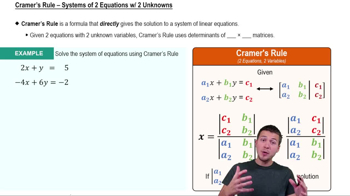
Cramer's Rule - 2 Equations with 2 Unknowns

Polynomial Roots and Real Solutions

A root of a polynomial is a value of x that makes the polynomial equal to zero. Real roots are solutions that are real numbers, as opposed to complex or imaginary roots. Understanding the nature of roots helps in analyzing the behavior of polynomial equations and their graphs.
Video consigliato:
02:20
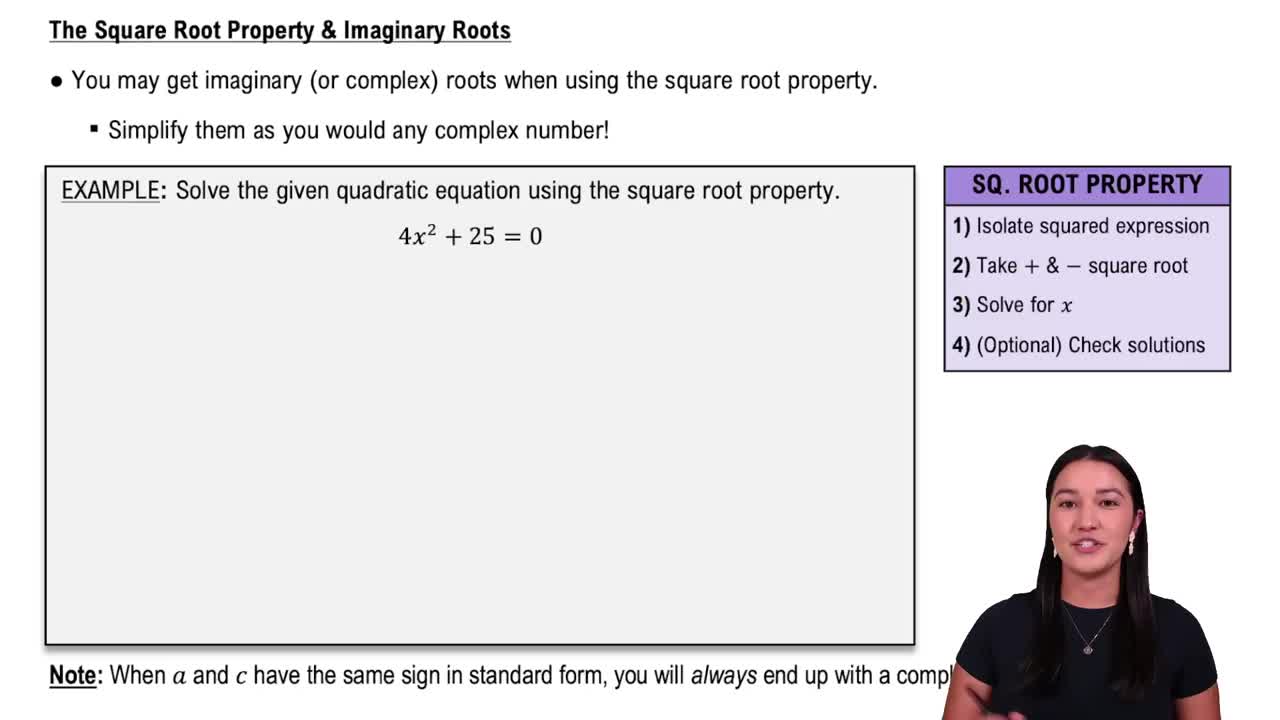
Imaginary Roots with the Square Root Property

Sign Changes in Polynomial Coefficients

Sign changes occur when consecutive coefficients in a polynomial switch from positive to negative or vice versa. Counting these changes is essential in applying Descartes' Rule of Signs, as it directly relates to the maximum number of positive or negative real roots the polynomial can have.
Video consigliato:
05:16
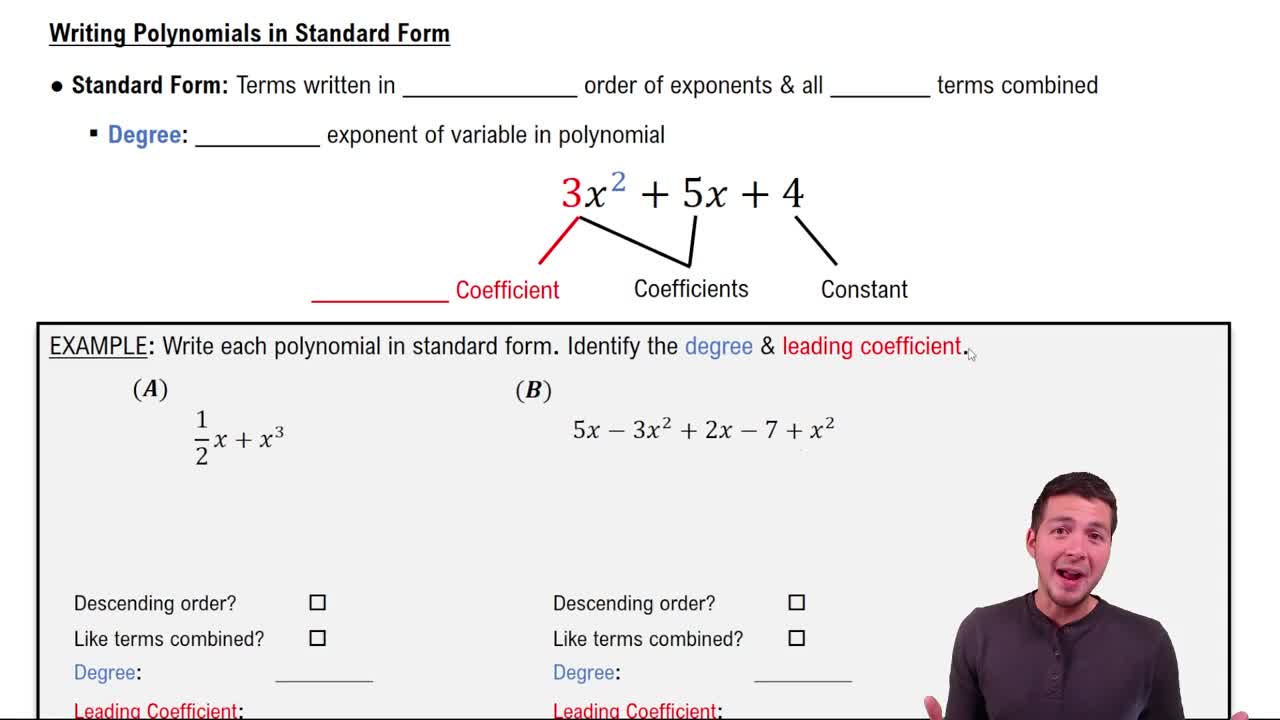
Standard Form of Polynomials