Ch. 3 - Polynomial and Rational Functions
Blitzer - College Algebra 8th Edition
Blitzer8th EditionCollege AlgebraISBN: 9780136970514Non è quello che usi tu?Cambia libro di testo
Capitolo 4, Problema 17

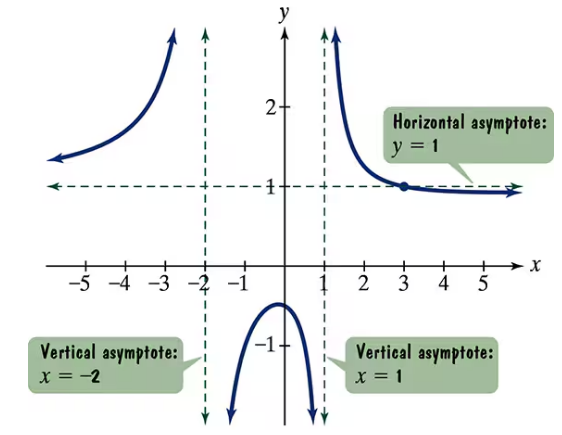
Use the graph of the rational function in the figure shown to complete each statement in Exercises 15–20.

As x→−2+, f(x)→x\(\to\)-2^{+},\(\text{ }\)f(x)\(\to\) __

Guida verificata passo dopo passo
1
Identify the vertical asymptote relevant to the limit as \(x \to -2^+\). From the graph, note the vertical asymptotes are at \(x = -16\) and \(x = -8\), so \(x = -2\) is not a vertical asymptote, but we need to observe the behavior of \(f(x)\) near \(x = -2\) from the right side.
Look closely at the graph near \(x = -2\) from the right side (values slightly greater than -2). Observe the value of \(f(x)\) as \(x\) approaches -2 from the right.
Determine whether \(f(x)\) is increasing or decreasing without bound, or approaching a finite value as \(x \to -2^+\). This will tell us if the function tends to \(+\infty\), \(-\infty\), or a finite number.
Based on the graph, note the trend of the function near $x = -2^+$. If the function approaches a horizontal asymptote or a specific value, that will be the limit.
Conclude the value of \(\lim_{x \to -2^+} f(x)\) by describing the behavior observed in the previous steps.

Risposta video verificata per un problema simile:

Questa soluzione video è stata consigliata dai nostri tutor come utile per risolvere questo problema.
Durata del video:
1m

Concetti chiave

Ecco i concetti essenziali che devi comprendere per rispondere correttamente alla domanda.

Vertical Asymptotes

Vertical asymptotes occur where the function approaches infinity or negative infinity as x approaches a specific value. These are typically values that make the denominator of a rational function zero, causing the function to be undefined. The graph shows vertical asymptotes at x = -16 and y = 17, indicating behavior near these lines.
Video consigliato:
3:12
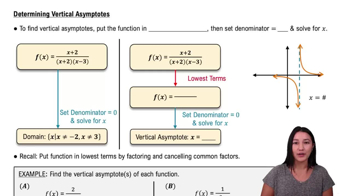
Determining Vertical Asymptotes

Horizontal Asymptotes

Horizontal asymptotes describe the behavior of a function as x approaches positive or negative infinity. They represent a constant value that the function approaches but does not necessarily reach. In the graph, the horizontal asymptote is at x = -8, which is unusual since horizontal asymptotes are usually horizontal lines y = c, suggesting a possible labeling or interpretation detail.
Video consigliato:
4:48
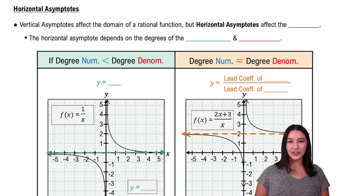
Determining Horizontal Asymptotes

Limit Behavior Near Asymptotes

Understanding the limit of a function as x approaches a value from the left or right is crucial for analyzing asymptotic behavior. For example, as x approaches -2 from the right (x → -2^+), the function's value may approach positive or negative infinity or a finite number. This concept helps predict the function's behavior near discontinuities or asymptotes.
Video consigliato:
6:24
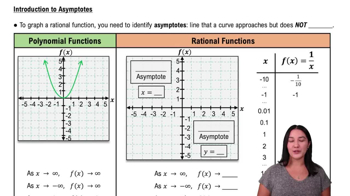
Introduction to Asymptotes