Ch. 4 - Exponential and Logarithmic Functions
Blitzer - College Algebra 8th Edition
Blitzer8th EditionCollege AlgebraISBN: 9780136970514Non è quello che usi tu?Cambia libro di testo
Capitolo 5, Problema 1

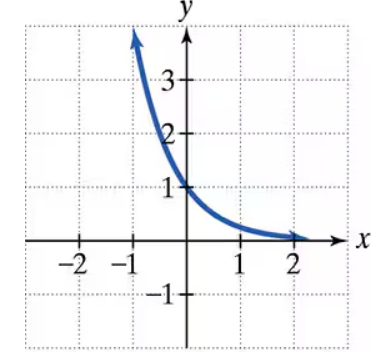
The graph of an exponential function is given. Select the function for each graph from the following options: f(x) = 4x, g(x) = 4-x, h(x) = -4-x, r(x) = -4-x+3
Graph of a decreasing exponential function passing through (0,1) with y-values from 3 to near 0 as x increases.

Guida verificata passo dopo passo
1
Step 1: Identify the point given on the graph, which is (0, 2). This point represents the y-intercept of the function, so when x = 0, y = 2.
Step 2: Evaluate each function option at x = 0 to see which one gives y = 2. Recall that for any base a, a^0 = 1.
Step 3: Calculate f(0) = 4^0 = 1, g(0) = 4^{-0} = 4^0 = 1, h(0) = -4^{-0} = -1, and r(0) = -4^{-0} + 3 = -1 + 3 = 2.
Step 4: Since only r(0) equals 2, the function must be r(x) = -4^{-x} + 3.
Step 5: Confirm the shape of the graph matches the function r(x) = -4^{-x} + 3, which is a reflection and vertical shift of the exponential decay function.

Risposta video verificata per un problema simile:

Questa soluzione video è stata consigliata dai nostri tutor come utile per risolvere questo problema.
Durata del video:
4m

Concetti chiave

Ecco i concetti essenziali che devi comprendere per rispondere correttamente alla domanda.

Exponential Functions and Their Graphs

An exponential function has the form f(x) = a^x, where a > 0 and a ≠ 1. Its graph shows rapid growth if a > 1 and decay if 0 < a < 1. The y-intercept is always at (0,1) for f(x) = a^x, since any number to the zero power is 1, unless the function is transformed.
Video consigliato:
5:46
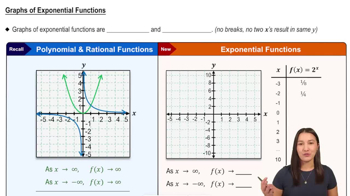
Graphs of Exponential Functions

Transformations of Exponential Functions

Transformations include reflections, shifts, and stretches. For example, f(x) = 4^-x reflects the graph of 4^x across the y-axis, changing growth to decay. Adding or subtracting constants shifts the graph vertically, affecting the y-intercept and horizontal asymptotes.
Video consigliato:
6:16
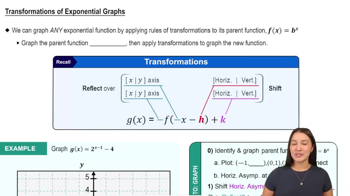
Transformations of Exponential Graphs

Using Points to Identify Functions

Given a point on the graph, such as (0,2), substitute x = 0 into each function to find the corresponding y-value. This helps determine which function matches the graph. For instance, f(0) = a^0 = 1, so if y ≠ 1 at x=0, the function must include vertical shifts or reflections.
Video consigliato:
02:44
Maximum Turning Points of a Polynomial Function