Ch. 4 - Exponential and Logarithmic Functions
Blitzer - College Algebra 8th Edition
Blitzer8th EditionCollege AlgebraISBN: 9780136970514Non è quello che usi tu?Cambia libro di testo
Capitolo 5, Problema 3

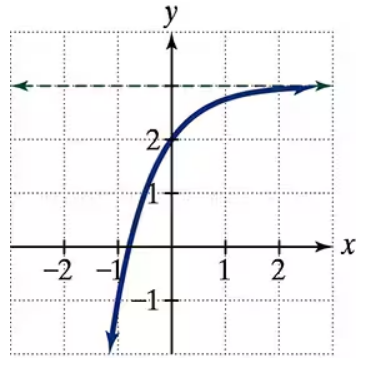
The graph of an exponential function is given. Select the function for each graph from the following options: f(x) = 4x, g(x) = 4-x, h(x) = -4-x, r(x) = -4-x+3

Guida verificata passo dopo passo
1
Identify the horizontal asymptote of the graph. Here, the graph approaches the line \(y = 2\) as \(x\) goes to positive infinity.
Recall that the general form of an exponential function with a horizontal asymptote \(y = k\) is \(y = a \cdot b^x + k\), where \(a\) and \(b\) are constants.
Check the given function options and see which one has a vertical shift of +2 to match the asymptote \(y = 2\). None of the options explicitly show +2, but option \(r(x) = -4^{-x} + 3\) has a vertical shift of +3, which is close but not correct.
Analyze the behavior of the graph: it is increasing and approaches \(y=2\) from below, which suggests the function is of the form \(y = a \cdot 4^{-x} + 2\) with \(a > 0\).
Since none of the given options exactly match the asymptote \(y=2\), consider that the closest match is \(g(x) = 4^{-x}\), which has a horizontal asymptote at \(y=0\). To get the asymptote at \(y=2\), the function would need to be shifted up by 2, which is not shown in the options. Therefore, the best match based on growth and asymptote behavior is \(g(x) = 4^{-x}\).

Risposta video verificata per un problema simile:

Questa soluzione video è stata consigliata dai nostri tutor come utile per risolvere questo problema.
Durata del video:
4m

Concetti chiave

Ecco i concetti essenziali che devi comprendere per rispondere correttamente alla domanda.

Exponential Functions and Their Graphs

Exponential functions have the form f(x) = a^x, where the base a is positive and not equal to 1. Their graphs show rapid growth or decay, depending on the exponent's sign. Understanding the shape and behavior of these graphs helps identify the function from its graph.
Video consigliato:
5:46
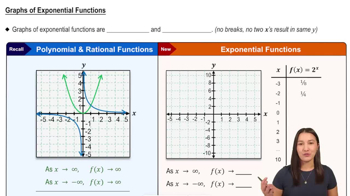
Graphs of Exponential Functions

Horizontal Asymptotes

A horizontal asymptote is a horizontal line that the graph of a function approaches but never touches as x approaches infinity or negative infinity. For exponential functions, the horizontal asymptote indicates the limiting value of the function, often shifted vertically by a constant.
Video consigliato:
4:48
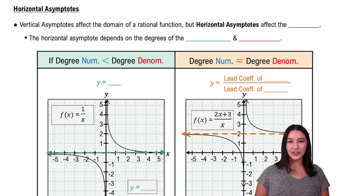
Determining Horizontal Asymptotes

Transformations of Exponential Functions

Transformations include reflections, shifts, and stretches of the basic exponential graph. For example, a negative sign reflects the graph across the x-axis, and adding a constant shifts it vertically. Recognizing these changes helps match a graph to its corresponding function.
Video consigliato:
6:16
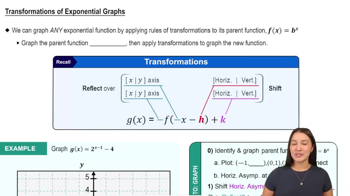
Transformations of Exponential Graphs