Ch. 4 - Exponential and Logarithmic Functions
Blitzer - College Algebra 8th Edition
Blitzer8th EditionCollege AlgebraISBN: 9780136970514Non è quello che usi tu?Cambia libro di testo
Capitolo 5, Problema 109

In Exercises 109–112, find the domain of each logarithmic function. f(x) = ln (x² - x − 2)

Guida verificata passo dopo passo
1
Recall that the domain of a logarithmic function f(x) = ln(g(x)) requires the argument g(x) to be greater than zero, so we need to find where x² - x - 2 > 0.
Set up the inequality: x²-x-2>0.
Factor the quadratic expression: x²-x-2 = (x-2)(x+1).
Determine the critical points by setting each factor equal to zero: x-2=0 gives x=2, and x+1=0 gives x=-1.
Test intervals determined by the critical points (-∞, -1), (-1, 2), and (2, ∞) to find where the product is positive, which will give the domain of the function.

Risposta video verificata per un problema simile:

Questa soluzione video è stata consigliata dai nostri tutor come utile per risolvere questo problema.
Durata del video:
3m

Concetti chiave

Ecco i concetti essenziali che devi comprendere per rispondere correttamente alla domanda.

Domain of a Function

The domain of a function is the set of all input values (x-values) for which the function is defined. For logarithmic functions, the argument inside the logarithm must be positive, so determining the domain involves finding all x-values that make the expression inside the log greater than zero.
Video consigliato:
3:51
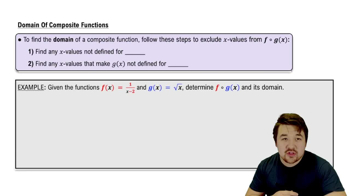
Domain Restrictions of Composed Functions

Properties of Logarithmic Functions

Logarithmic functions, such as the natural logarithm ln(x), are only defined for positive arguments. This means the expression inside the logarithm, here (x² - x - 2), must be greater than zero. Understanding this property is essential to correctly find the domain.
Video consigliato:
5:26
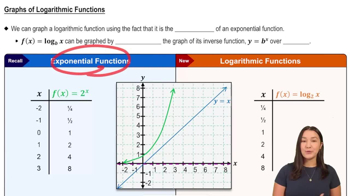
Graphs of Logarithmic Functions

Solving Quadratic Inequalities

To find where the quadratic expression (x² - x - 2) is positive, you solve the inequality x² - x - 2 > 0. This involves factoring the quadratic, finding its roots, and testing intervals to determine where the expression is positive, which helps identify the domain of the logarithmic function.
Video consigliato:
04:03
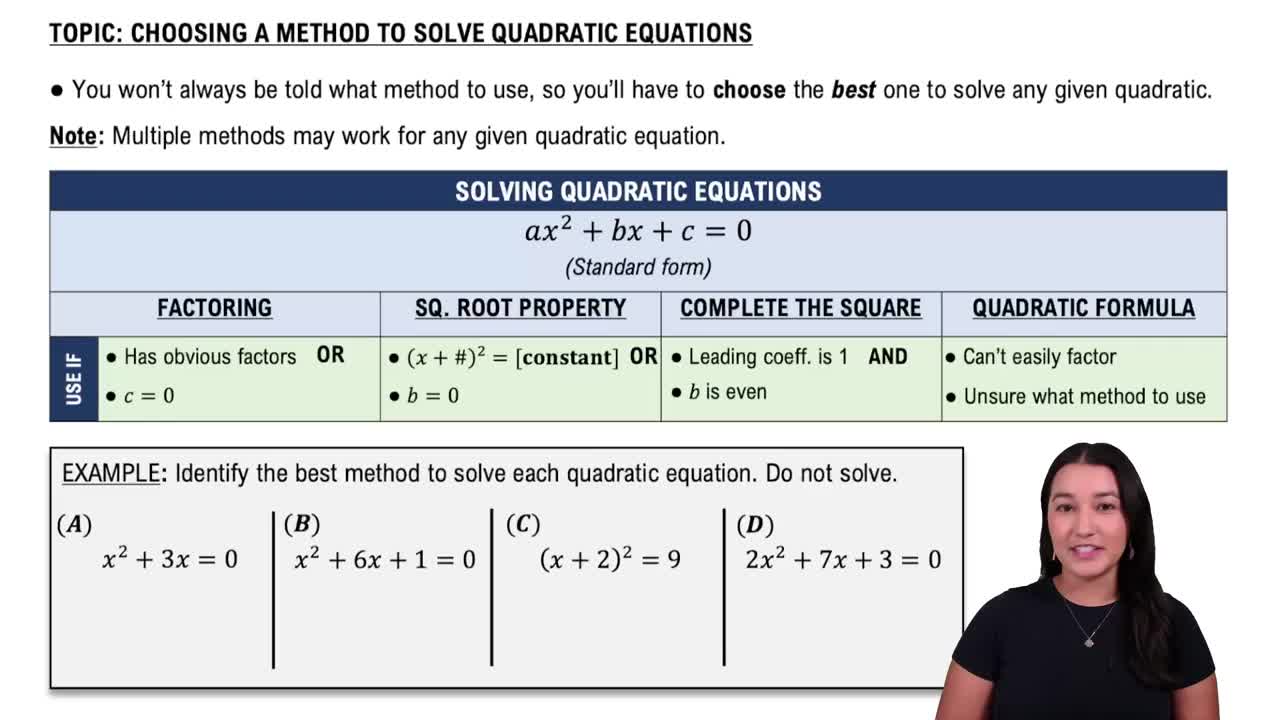
Choosing a Method to Solve Quadratics