Ch. 4 - Exponential and Logarithmic Functions
Blitzer - College Algebra 8th Edition
Blitzer8th EditionCollege AlgebraISBN: 9780136970514Non è quello che usi tu?Cambia libro di testo
Capitolo 5, Problema 33

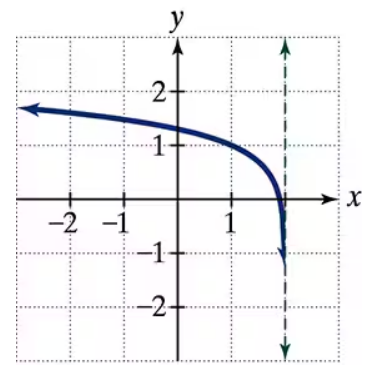
In Exercises 32–35, the graph of a logarithmic function is given. Select the function for each graph from the following options: f(x) = log x, g(x) = log(-x), h(x) = log(2-x), r(x)= 1+log(2-x)

Guida verificata passo dopo passo
1
Identify the domain of each logarithmic function option, since the domain determines where the function is defined and affects the graph's shape. For example, for \(f(x) = \log x\), the domain is \(x > 0\); for \(g(x) = \log(-x)\), the domain is \(x < 0\); for \(h(x) = \log(2 - x)\), the domain is \(x < 2\); and for \(r(x) = 1 + \log(2 - x)\), the domain is also \(x < 2\).
Examine the graph's x-values where the function exists. If the graph only shows values for \(x > 0\), it likely corresponds to \(f(x) = \log x\). If the graph exists only for negative \(x\) values, it could be \(g(x) = \log(-x)\). If the graph exists for \(x < 2\), it could be either \(h(x)\) or \(r(x)\).
Look for vertical shifts in the graph. The function \(r(x) = 1 + \log(2 - x)\) is a vertical shift of \(h(x) = \log(2 - x)\) by 1 unit upwards. If the graph appears shifted up compared to the standard logarithmic shape, it suggests \(r(x)\).
Check the behavior near the vertical asymptote. For \(f(x) = \log x\), the vertical asymptote is at \(x = 0\); for \(h(x)\) and \(r(x)\), it is at \(x = 2\). Confirm where the graph approaches negative infinity to identify the asymptote.
Match the graph's shape and domain with the function options based on the above observations to select the correct function for each graph.

Risposta video verificata per un problema simile:

Questa soluzione video è stata consigliata dai nostri tutor come utile per risolvere questo problema.
Durata del video:
4m

Concetti chiave

Ecco i concetti essenziali che devi comprendere per rispondere correttamente alla domanda.

Logarithmic Functions and Their Domains

A logarithmic function is defined only for positive arguments inside the log. For example, f(x) = log(x) requires x > 0. Understanding the domain restrictions helps identify which function matches a given graph, as the graph exists only where the input to the log is positive.
Video consigliato:
5:26
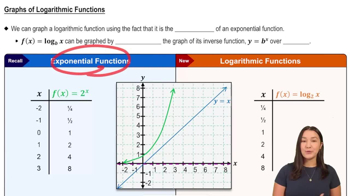
Graphs of Logarithmic Functions

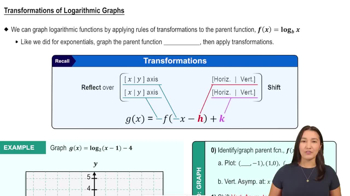
Transformations of Logarithmic Functions

Logarithmic functions can be shifted or reflected by modifying their input or output. For instance, g(x) = log(-x) reflects the graph of log(x) across the y-axis, while h(x) = log(2 - x) shifts and reflects it horizontally. The function r(x) = 1 + log(2 - x) also shifts the graph vertically by 1 unit.
Video consigliato:
4:37
Transformations of Logarithmic Graphs

Interpreting Graphs to Identify Functions

Analyzing key features of the graph, such as domain, intercepts, and asymptotes, helps match it to the correct logarithmic function. For example, vertical asymptotes occur where the argument of the log is zero, and shifts in the graph indicate transformations applied to the basic log function.
Video consigliato:
05:01
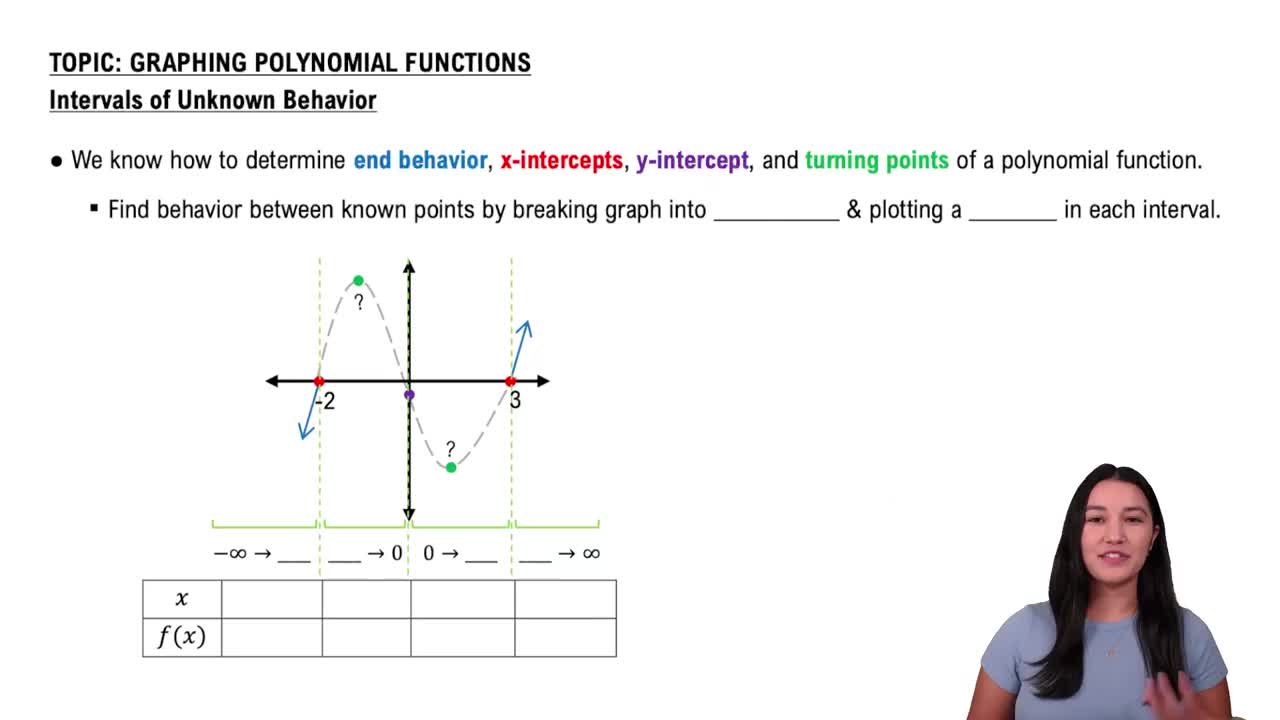
Identifying Intervals of Unknown Behavior
Pratica correlata
Domanda del libro di testo

Begin by graphing f(x) = 2x. Then use transformations of this graph to graph the given function. Be sure to graph and give equations of the asymptotes. Use the graphs to determine each function's domain and range. If applicable, use a graphing utility to confirm your hand-drawn graphs. g(x) = 2.2x

755
views
Domanda del libro di testo

Use properties of logarithms to expand each logarithmic expression as much as possible. Where possible, evaluate logarithmic expressions without using a calculator. log5x2y243\(\log\)_5 \(\sqrt\)[3]{\(\frac{x^2 y}{24}\)}

892
views
Domanda del libro di testo

Use properties of logarithms to expand each logarithmic expression as much as possible. Where possible, evaluate logarithmic expressions without using a calculator. logb(xy3z3)\(\log\)_{b}\(\left\)(\(\frac{\sqrt{x}\)y^3}{z^3}\(\right\))

794
views
Domanda del libro di testo

The figure shows the graph of f(x) = ex. In Exercises 35-46, use transformations of this graph to graph each function. Be sure to give equations of the asymptotes. Use the graphs to determine graphs. each function's domain and range. If applicable, use a graphing utility to confirm your hand-drawn g(x) = ex-1

781
views
Domanda del libro di testo

Solve each exponential equation in Exercises 23–48. Express the solution set in terms of natural logarithms or common logarithms. Then use a calculator to obtain a decimal approximation, correct to two decimal places, for the solution. e(1−5x)=793

724
views
Domanda del libro di testo

Evaluate each expression without using a calculator. log64 8

865
views
1
rank