Ch. 4 - Exponential and Logarithmic Functions
Blitzer - College Algebra 8th Edition
Blitzer8th EditionCollege AlgebraISBN: 9780136970514Non è quello che usi tu?Cambia libro di testo
Capitolo 5, Problema 67

Use properties of logarithms to condense each logarithmic expression. Write the expression as a single logarithm whose coefficient is 1. Where possible, evaluate logarithmic expressions without using a calculator. 13[2ln(x+5)−lnx−ln(x2−4)]\(\frac{1}{3}\) \(\left\)[ 2 \(\ln\)(x + 5) - \(\ln\) x - \(\ln\) (x^2 - 4) \(\right\)]

Guida verificata passo dopo passo
1
Start with the given expression: \(\frac{1}{3} \left[ 2 \ln(x + 5) - \ln x - \ln(x^2 - 4) \right]\).
Use the logarithm power rule to move coefficients inside the logarithms as exponents: \(2 \ln(x + 5) = \ln((x + 5)^2)\).
Rewrite the expression inside the brackets as a single logarithm using the properties of logarithms: \(\ln((x + 5)^2) - \ln x - \ln(x^2 - 4) = \ln \left( \frac{(x + 5)^2}{x (x^2 - 4)} \right)\).
Recall that \(x^2 - 4\) is a difference of squares and can be factored as \((x - 2)(x + 2)\), so rewrite the denominator accordingly: \(x (x - 2)(x + 2)\).
Now apply the outer coefficient \(\frac{1}{3}\) as a power to the entire logarithm: \(\frac{1}{3} \ln \left( \frac{(x + 5)^2}{x (x - 2)(x + 2)} \right) = \ln \left( \left( \frac{(x + 5)^2}{x (x - 2)(x + 2)} \right)^{\frac{1}{3}} \right)\).

Risposta video verificata per un problema simile:

Questa soluzione video è stata consigliata dai nostri tutor come utile per risolvere questo problema.
Durata del video:
5m

Concetti chiave

Ecco i concetti essenziali che devi comprendere per rispondere correttamente alla domanda.

Properties of Logarithms

Properties of logarithms include rules such as the product rule, quotient rule, and power rule. These allow combining or breaking down logarithmic expressions: for example, log(a) + log(b) = log(ab), log(a) - log(b) = log(a/b), and k·log(a) = log(a^k). Understanding these is essential to condense multiple logarithms into a single expression.
Video consigliato:
5:36
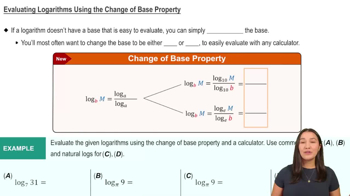
Change of Base Property

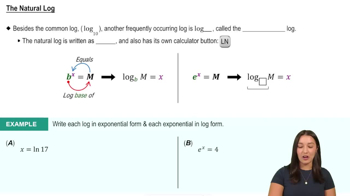
Natural Logarithm (ln)

The natural logarithm, denoted ln, is the logarithm with base e (approximately 2.718). It has the same properties as other logarithms but is commonly used in calculus and algebra. Recognizing ln and its behavior helps in simplifying expressions and evaluating them when possible.
Video consigliato:
2:51
The Natural Log

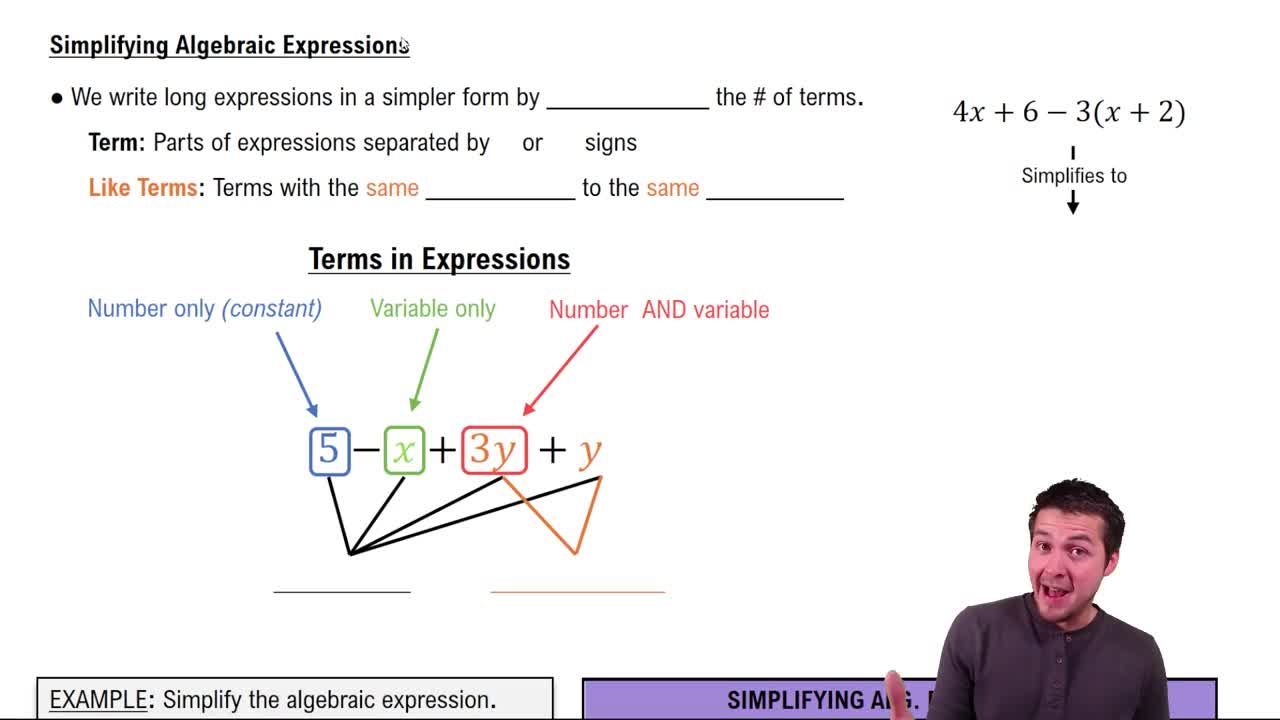
Simplifying Algebraic Expressions Inside Logarithms

Before condensing logarithms, simplify the algebraic expressions inside them, such as factoring or recognizing differences of squares (e.g., x^2 - 4 = (x-2)(x+2)). This simplification aids in combining logarithms correctly and can make evaluation or further manipulation easier.
Video consigliato:
05:07
Simplifying Algebraic Expressions
Pratica correlata
Domanda del libro di testo

In Exercises 64–73, solve each exponential equation. Where necessary, express the solution set in terms of natural or common logarithms and use a calculator to obtain a decimal approximation, correct to two decimal places, for the solution. 8x=121438^x = 12143

832
views
Domanda del libro di testo

The figure shows the graph of f(x) = ln x. In Exercises 65–74, use transformations of this graph to graph each function. Graph and give equations of the asymptotes. Use the graphs to determine each function's domain and range.

h(x) = ln (2x)

1360
views
Domanda del libro di testo

Solve each logarithmic equation in Exercises 49–92. Be sure to reject any value of x that is not in the domain of the original logarithmic expressions. Give the exact answer. Then, where necessary, use a calculator to obtain a decimal approximation, correct to two decimal places, for the solution. log5 x+log5(4x−1)=1

861
views
Domanda del libro di testo

Solve each logarithmic equation in Exercises 49–92. Be sure to reject any value of x that is not in the domain of the original logarithmic expressions. Give the exact answer. Then, where necessary, use a calculator to obtain a decimal approximation, correct to two decimal places, for the solution. log3(x+6)+log3(x+4)=1

1102
views
Domanda del libro di testo

The figure shows the graph of f(x) = ln x. In Exercises 65–74, use transformations of this graph to graph each function. Graph and give equations of the asymptotes. Use the graphs to determine each function's domain and range. h(x) = ln(x/2)

735
views
Domanda del libro di testo

In Exercises 64–73, solve each exponential equation. Where necessary, express the solution set in terms of natural or common logarithms and use a calculator to obtain a decimal approximation, correct to two decimal places, for the solution. 10^x = 7000

1035
views