Ch. 4 - Exponential and Logarithmic Functions
Blitzer - College Algebra 8th Edition
Blitzer8th EditionCollege AlgebraISBN: 9780136970514Non è quello che usi tu?Cambia libro di testo
Capitolo 5, Problema 53

Begin by graphing f(x) = log₂ x. Then use transformations of this graph to graph the given function. What is the vertical asymptote? Use the graphs to determine each function's domain and range. g(x) = log₂ (x + 1)

Guida verificata passo dopo passo
1
Start by understanding the base function: \(f(x) = \log_{2} x\). This function has a vertical asymptote at \(x = 0\), a domain of \((0, \infty)\), and a range of \((-\infty, \infty)\).
Next, analyze the given function \(g(x) = \log_{2} (x + 1)\). Notice that the input to the logarithm is shifted by \(+1\), which means the graph of \(f(x)\) is shifted horizontally to the left by 1 unit.
Determine the new vertical asymptote by setting the inside of the logarithm equal to zero: \(x + 1 = 0\). Solve for \(x\) to find the vertical asymptote at \(x = -1\).
Use the horizontal shift to find the domain of \(g(x)\). Since the logarithm requires the argument to be positive, set \(x + 1 > 0\) and solve for \(x\). This gives the domain as \((-1, \infty)\).
The range of \(g(x)\) remains the same as the base function \(f(x)\) because vertical shifts or horizontal shifts do not affect the range of a logarithmic function. Therefore, the range is \((-\infty, \infty)\).

Risposta video verificata per un problema simile:

Questa soluzione video è stata consigliata dai nostri tutor come utile per risolvere questo problema.
Durata del video:
5m

Concetti chiave

Ecco i concetti essenziali che devi comprendere per rispondere correttamente alla domanda.

Logarithmic Functions and Their Graphs

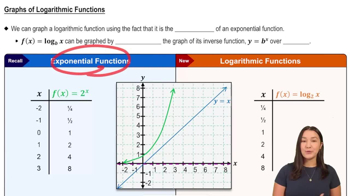
A logarithmic function, such as f(x) = log₂(x), is the inverse of an exponential function. Its graph passes through (1,0) and increases slowly, defined only for positive x-values. Understanding the shape and behavior of the basic log function is essential for applying transformations.
Video consigliato:
5:26
Graphs of Logarithmic Functions

Transformations of Functions

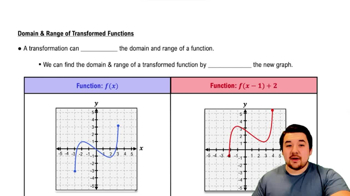
Transformations involve shifting, stretching, or reflecting the graph of a function. For g(x) = log₂(x + 1), the graph of log₂(x) shifts left by 1 unit. Recognizing how inside-the-function changes affect the graph helps identify new asymptotes, domain, and range.
Video consigliato:
4:22
Domain & Range of Transformed Functions

Vertical Asymptotes and Domain of Logarithmic Functions

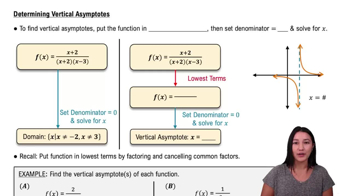
Logarithmic functions have vertical asymptotes where the argument equals zero, since log is undefined for non-positive values. For g(x) = log₂(x + 1), the vertical asymptote is at x = -1, which also defines the domain as all x > -1. The range remains all real numbers.
Video consigliato:
3:12
Determining Vertical Asymptotes
Pratica correlata
Domanda del libro di testo

Graph functions f and g in the same rectangular coordinate system. Graph and give equations of all asymptotes. If applicable, use a graphing utility to confirm your hand-drawn graphs. f(x) = (½)x and g(x) = (½)x-1 + 1

718
views
Domanda del libro di testo

Use properties of logarithms to condense each logarithmic expression. Write the expression as a single logarithm whose coefficient is 1. Where possible, evaluate logarithmic expressions without using a calculator. 2 logb x + 3 logb y

990
views
Domanda del libro di testo

Use the compound interest formulas A = P (1+ r/n)nt and A =Pert to solve exercises 53-56. Round answers to the nearest cent. Find the accumulated value of an investment of \$10,000 for 5 years at an interest rate of 1.32% if the money is a. compounded semiannually

1106
views
Domanda del libro di testo

Solve each logarithmic equation in Exercises 49–92. Be sure to reject any value of x that is not in the domain of the original logarithmic expressions. Give the exact answer. Then, where necessary, use a calculator to obtain a decimal approximation, correct to two decimal places, for the solution. log4(x+5)=3

952
views
Domanda del libro di testo

Solve each logarithmic equation in Exercises 49–92. Be sure to reject any value of x that is not in the domain of the original logarithmic expressions. Give the exact answer. Then, where necessary, use a calculator to obtain a decimal approximation, correct to two decimal places, for the solution. ln x=2

850
views
Domanda del libro di testo

In Exercises 50–53, use properties of logarithms to expand each logarithmic expression as much as possible. Where possible, evaluate logarithmic expressions without using a calculator. lnxe3\(\ln\)\(\sqrt\)[3]{\(\frac{x}{e}\)}

1064
views