Ch. 4 - Exponential and Logarithmic Functions
Blitzer - College Algebra 8th Edition
Blitzer8th EditionCollege AlgebraISBN: 9780136970514Non è quello che usi tu?Cambia libro di testo
Capitolo 5, Problema 75

Find the domain of each logarithmic function. f(x) = log5(x+4)

Guida verificata passo dopo passo
1
Recall that the domain of a logarithmic function \( f(x) = \log_b(g(x)) \) consists of all values of \( x \) for which the argument \( g(x) \) is positive, because the logarithm of zero or a negative number is undefined.
Identify the argument of the logarithm in the given function: \( f(x) = \log_5(x+4) \). Here, the argument is \( x + 4 \).
Set up the inequality to find where the argument is positive: \( x + 4 > 0 \).
Solve the inequality for \( x \): subtract 4 from both sides to get \( x > -4 \).
Conclude that the domain of \( f(x) = \log_5(x+4) \) is all real numbers \( x \) such that \( x > -4 \).

Risposta video verificata per un problema simile:

Questa soluzione video è stata consigliata dai nostri tutor come utile per risolvere questo problema.
Durata del video:
1m

Concetti chiave

Ecco i concetti essenziali che devi comprendere per rispondere correttamente alla domanda.

Domain of a Function

The domain of a function is the set of all input values (x-values) for which the function is defined. For logarithmic functions, the domain is restricted because the argument inside the log must be positive. Identifying the domain involves finding all x-values that make the expression inside the logarithm greater than zero.
Video consigliato:
3:51
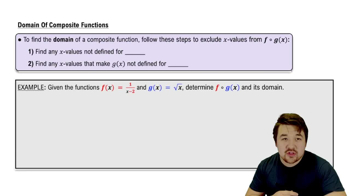
Domain Restrictions of Composed Functions

Properties of Logarithmic Functions

A logarithmic function log_b(x) is defined only for positive arguments x > 0, where b is the base and b > 0, b ≠ 1. This means the expression inside the log must be strictly greater than zero to avoid undefined values or complex numbers.
Video consigliato:
5:26
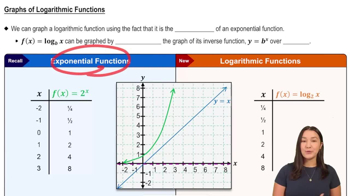
Graphs of Logarithmic Functions

Inequalities and Solving for Domain

To find the domain of f(x) = log_5(x+4), solve the inequality x + 4 > 0. This involves basic algebraic manipulation to isolate x, resulting in the domain expressed as an interval. Understanding how to solve inequalities is essential for determining valid input values.
Video consigliato:
06:07
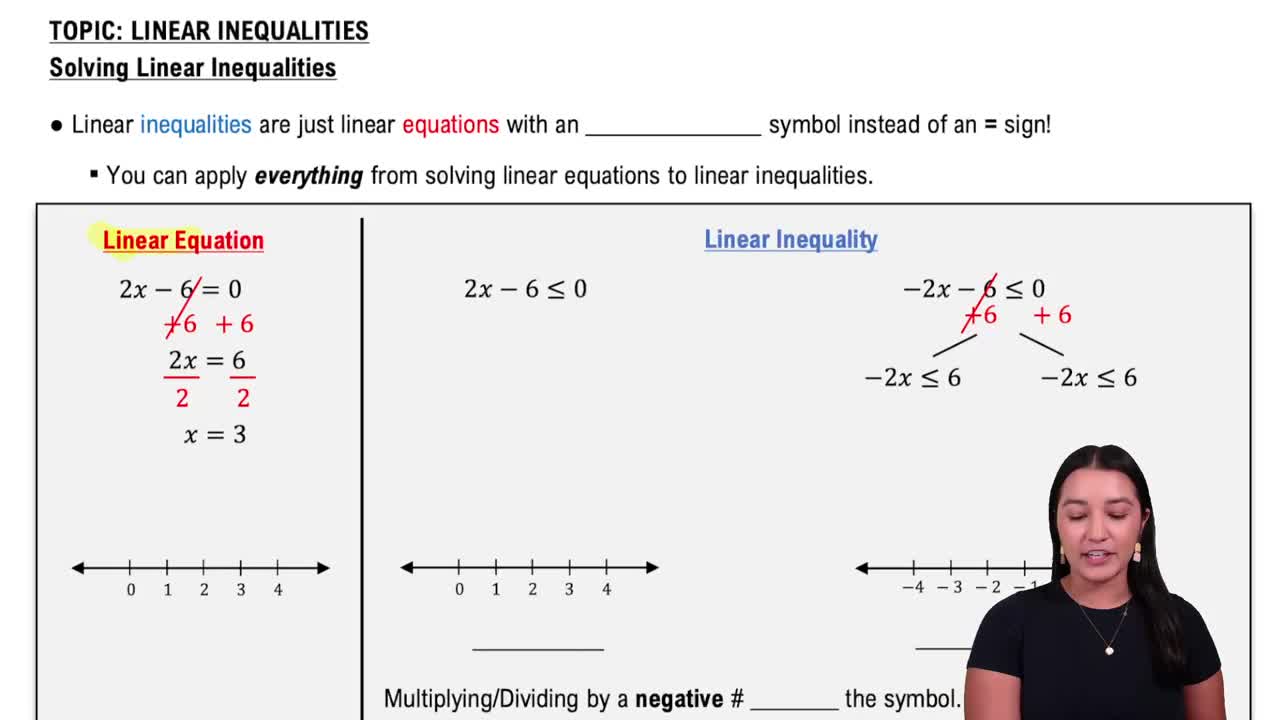
Linear Inequalities
Pratica correlata
Domanda del libro di testo

In Exercises 71–78, use common logarithms or natural logarithms and a calculator to evaluate to four decimal places. log0.1 17

804
views
Domanda del libro di testo

Solve each logarithmic equation in Exercises 49–92. Be sure to reject any value of x that is not in the domain of the original logarithmic expressions. Give the exact answer. Then, where necessary, use a calculator to obtain a decimal approximation, correct to two decimal places, for the solution. log2(x+2)−log2(x−5)=3

839
views
Domanda del libro di testo

Solve each logarithmic equation in Exercises 49–92. Be sure to reject any value of x that is not in the domain of the original logarithmic expressions. Give the exact answer. Then, where necessary, use a calculator to obtain a decimal approximation, correct to two decimal places, for the solution. 2 log3(x+4)=log3 9 + 2

706
views
Domanda del libro di testo

In Exercises 74–79, solve each logarithmic equation. log2 (x+3) + log2 (x-3) =4

1163
views
Domanda del libro di testo

Solve each logarithmic equation in Exercises 49–92. Be sure to reject any value of x that is not in the domain of the original logarithmic expressions. Give the exact answer. Then, where necessary, use a calculator to obtain a decimal approximation, correct to two decimal places, for the solution. log2(x−6)+log2(x−4)−log2 x=2

831
views
Domanda del libro di testo

In Exercises 71–78, use common logarithms or natural logarithms and a calculator to evaluate to four decimal places. log14 87.5

803
views