Ch. 4 - Exponential and Logarithmic Functions
Blitzer - College Algebra 8th Edition
Blitzer8th EditionCollege AlgebraISBN: 9780136970514Non è quello che usi tu?Cambia libro di testo
Capitolo 5, Problema 99

Determine whether each equation is true or false. Where possible, show work to support your conclusion. If the statement is false, make the necessary change(s) to produce a true statement. log6(x−1x2+4)=log6(x−1)−log6(x2+4)\(\log\)_6 \(\left\)( \(\frac{x - 1}{x^2 + 4}\) \(\right\)) = \(\log\)_6 (x - 1) - \(\log\)_6 (x^2 + 4)

Guida verificata passo dopo passo
1
Recall the logarithmic property that states: \(\log_b \left( \frac{M}{N} \right) = \log_b M - \log_b N\), where \(b > 0\), \(b \neq 1\), and \(M, N > 0\).
Identify the components in the given equation: the left side is \(\log_6 \left( \frac{x - 1}{x^2 + 4} \right)\), and the right side is \(\log_6 (x - 1) - \log_6 (x^2 + 4)\).
Check the domain restrictions for the logarithms: since the arguments must be positive, set \(x - 1 > 0\) and \(x^2 + 4 > 0\). Note that \(x^2 + 4\) is always positive for all real \(x\), so the main restriction is \(x > 1\).
Since the domain restrictions are satisfied and the logarithmic property applies, conclude that the equation is true for \(x > 1\).
If the problem required a change and the equation was false, you would adjust the right side to match the logarithmic property, but in this case, the equation is already correctly stated.

Risposta video verificata per un problema simile:

Questa soluzione video è stata consigliata dai nostri tutor come utile per risolvere questo problema.
Durata del video:
1m

Concetti chiave

Ecco i concetti essenziali che devi comprendere per rispondere correttamente alla domanda.

Properties of Logarithms

Logarithmic properties, such as the product, quotient, and power rules, allow us to simplify or expand logarithmic expressions. The quotient rule states that log_b(A/B) = log_b(A) - log_b(B), which is essential for verifying the given equation.
Video consigliato:
5:36
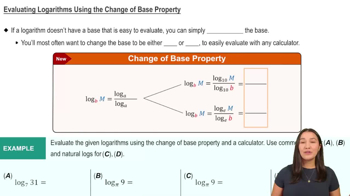
Change of Base Property

Domain of Logarithmic Functions

The domain of a logarithmic function includes all input values for which the argument is positive. For log_b(f(x)) to be defined, f(x) must be greater than zero. Checking domain restrictions ensures the expressions inside the logs are valid.
Video consigliato:
5:26
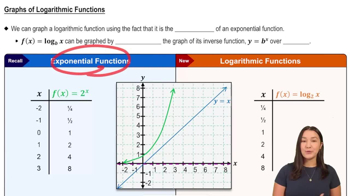
Graphs of Logarithmic Functions

Equation Verification and Transformation

To determine if an equation involving logarithms is true, one must verify equality by applying logarithmic rules and simplifying both sides. If false, adjusting terms or expressions to satisfy the properties of logarithms can produce a true statement.
Video consigliato:
5:25
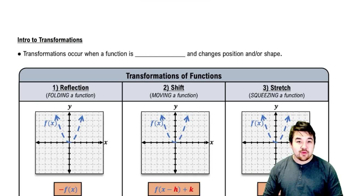
Intro to Transformations