Ch. 4 - Exponential and Logarithmic Functions
Blitzer - College Algebra 8th Edition
Blitzer8th EditionCollege AlgebraISBN: 9780136970514Non è quello che usi tu?Cambia libro di testo
Capitolo 5, Problema 92

n Exercises 92–93, rewrite the equation in terms of base e. Express the answer in terms of a natural logarithm and then round to three decimal places. y = 73(2.6)^x

Guida verificata passo dopo passo
1
Rewrite the given equation y = 73(2.6)^x in terms of base e. To do this, recall that any exponential expression a^x can be rewritten as e^(x * ln(a)), where ln(a) is the natural logarithm of a.
Apply the property to rewrite (2.6)^x as e^(x * ln(2.6)). The equation now becomes y = 73 * e^(x * ln(2.6)).
To isolate x, divide both sides of the equation by 73, resulting in y / 73 = e^(x * ln(2.6)).
Take the natural logarithm (ln) of both sides to eliminate the exponential. This gives ln(y / 73) = x * ln(2.6).
Solve for x by dividing both sides of the equation by ln(2.6). The final expression is x = ln(y / 73) / ln(2.6).

Risposta video verificata per un problema simile:

Questa soluzione video è stata consigliata dai nostri tutor come utile per risolvere questo problema.
Durata del video:
2m

Concetti chiave

Ecco i concetti essenziali che devi comprendere per rispondere correttamente alla domanda.

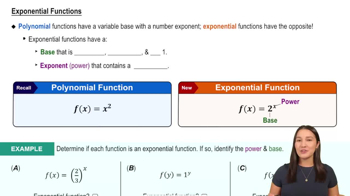
Exponential Functions

Exponential functions are mathematical expressions in the form y = a(b^x), where 'a' is a constant, 'b' is the base, and 'x' is the exponent. In this context, the function y = 73(2.6)^x represents an exponential growth model, where the output increases rapidly as 'x' increases. Understanding the properties of exponential functions is crucial for rewriting them in different bases.
Video consigliato:
6:13
Exponential Functions

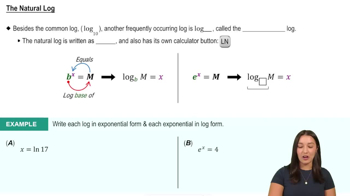
Natural Logarithm

The natural logarithm, denoted as ln(x), is the logarithm to the base 'e', where 'e' is approximately equal to 2.71828. It is the inverse operation of the exponential function with base 'e'. When rewriting an exponential equation in terms of base 'e', the natural logarithm is used to express the exponent in a more manageable form, facilitating easier calculations and interpretations.
Video consigliato:
2:51
The Natural Log

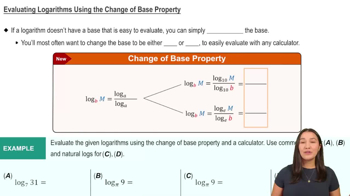
Change of Base Formula

The change of base formula allows us to convert logarithms from one base to another. It states that log_b(a) = log_k(a) / log_k(b) for any positive 'k'. This concept is essential when rewriting the given exponential equation in terms of base 'e', as it enables the transformation of the base from 2.6 to 'e', allowing for the use of natural logarithms in the solution.
Video consigliato:
5:36
Change of Base Property