Ch. 4 - Exponential and Logarithmic Functions
Blitzer - College Algebra 8th Edition
Blitzer8th EditionCollege AlgebraISBN: 9780136970514Non è quello che usi tu?Cambia libro di testo
Capitolo 5, Problema 7

Solve each exponential equation in Exercises 1–22 by expressing each side as a power of the same base and then equating exponents. 42x−1=64

Guida verificata passo dopo passo
1
Recognize that the equation is \(4^{2x - 1} = 64\). The goal is to express both sides as powers of the same base.
Rewrite the base 4 and 64 as powers of 2, since \(4 = 2^2\) and \(64 = 2^6\).
Substitute these expressions back into the equation to get \((2^2)^{2x - 1} = 2^6\).
Use the power of a power property: \((a^m)^n = a^{m \cdot n}\), so rewrite the left side as \(2^{2(2x - 1)}\).
Since the bases are the same (base 2), set the exponents equal: \(2(2x - 1) = 6\). Then solve this linear equation for \(x\).

Risposta video verificata per un problema simile:

Questa soluzione video è stata consigliata dai nostri tutor come utile per risolvere questo problema.
Durata del video:
2m

Concetti chiave

Ecco i concetti essenziali che devi comprendere per rispondere correttamente alla domanda.

Exponential Equations

An exponential equation is one in which variables appear as exponents. Solving these equations often involves rewriting both sides with the same base to compare the exponents directly.
Video consigliato:
5:47
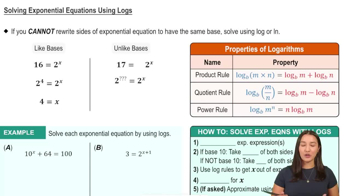
Solving Exponential Equations Using Logs

Expressing Numbers as Powers of the Same Base

To solve exponential equations, rewrite each side as a power of the same base. For example, 64 can be expressed as 4³ since 4³ = 64. This allows the exponents to be set equal to each other.
Video consigliato:
05:10
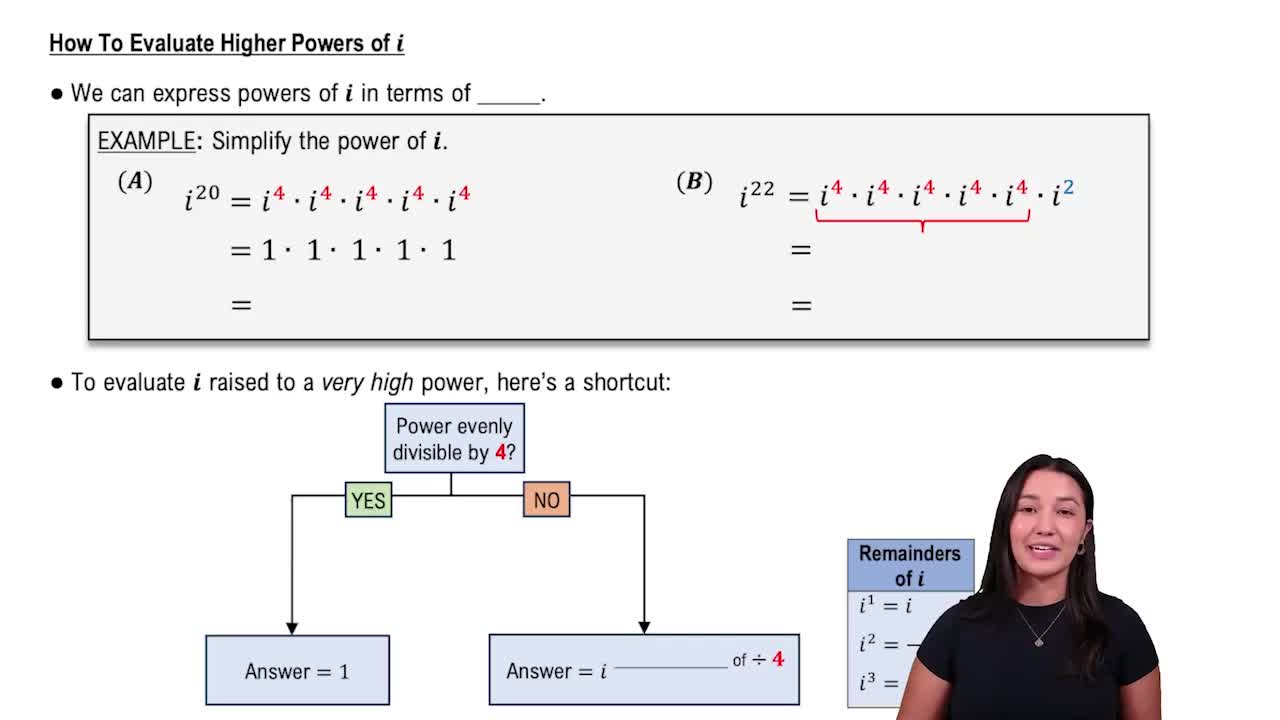
Higher Powers of i

Equating Exponents

Once both sides of an equation have the same base, their exponents can be set equal. This transforms the problem into a simpler algebraic equation, which can be solved using standard methods.
Video consigliato:
04:06
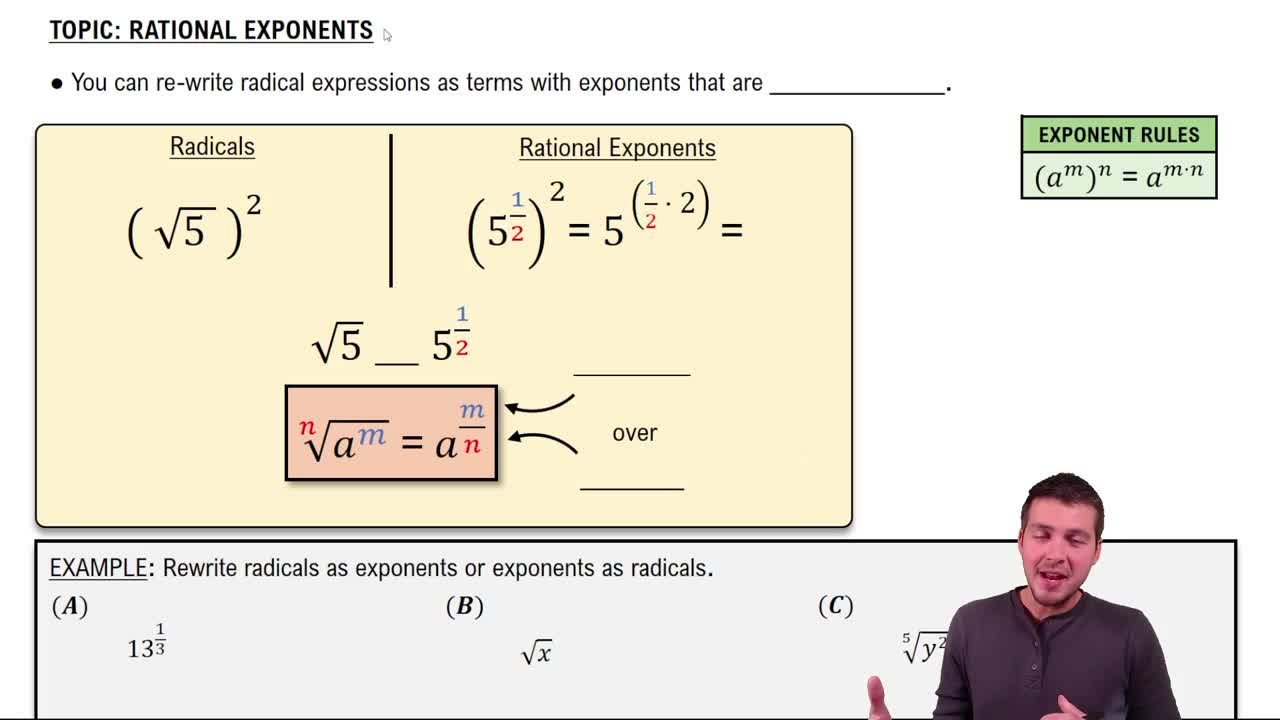
Rational Exponents