Ch. 4 - Exponential and Logarithmic Functions
Blitzer - College Algebra 8th Edition
Blitzer8th EditionCollege AlgebraISBN: 9780136970514Non è quello che usi tu?Cambia libro di testo
Capitolo 5, Problema 63

Solve each logarithmic equation in Exercises 49–92. Be sure to reject any value of x that is not in the domain of the original logarithmic expressions. Give the exact answer. Then, where necessary, use a calculator to obtain a decimal approximation, correct to two decimal places, for the solution. 6+2 ln x=5

Guida verificata passo dopo passo
1
Start with the given equation: \(6 + 2 \ln x = 5\).
Isolate the logarithmic term by subtracting 6 from both sides: \(2 \ln x = 5 - 6\).
Simplify the right side: \(2 \ln x = -1\).
Divide both sides by 2 to solve for \(\ln x\): \(\ln x = \frac{-1}{2}\).
Rewrite the equation in exponential form to solve for \(x\): \(x = e^{\frac{-1}{2}}\).

Risposta video verificata per un problema simile:

Questa soluzione video è stata consigliata dai nostri tutor come utile per risolvere questo problema.
Durata del video:
2m

Concetti chiave

Ecco i concetti essenziali che devi comprendere per rispondere correttamente alla domanda.

Properties of Logarithms

Understanding the properties of logarithms, such as the natural logarithm (ln) and its relationship to exponents, is essential. For example, ln(x) is the power to which e must be raised to get x. These properties help in isolating the logarithmic term and simplifying the equation.
Video consigliato:
5:36
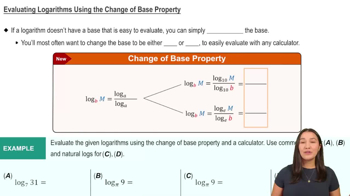
Change of Base Property

Domain of Logarithmic Functions

The domain of a logarithmic function ln(x) is x > 0 because the logarithm of zero or a negative number is undefined. When solving logarithmic equations, it is crucial to check that the solutions fall within this domain to reject extraneous or invalid answers.
Video consigliato:
5:26
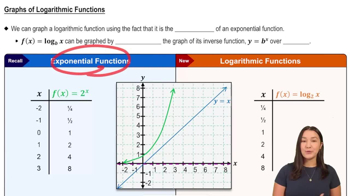
Graphs of Logarithmic Functions

Solving Logarithmic Equations

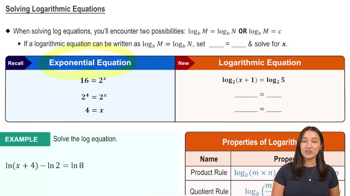
Solving logarithmic equations often involves isolating the logarithm, rewriting the equation in exponential form, and then solving for the variable. After finding potential solutions, verify them against the domain restrictions to ensure they are valid.
Video consigliato:
5:02
Solving Logarithmic Equations
Pratica correlata
Domanda del libro di testo

Give the equation of each exponential function whose graph is shown.

944
views
Domanda del libro di testo

The figure shows the graph of f(x) = ln x. In Exercises 65–74, use transformations of this graph to graph each function. Graph and give equations of the asymptotes. Use the graphs to determine each function's domain and range. g(x) = ln (x+2)

826
views
Domanda del libro di testo

In Exercises 64–73, solve each exponential equation. Where necessary, express the solution set in terms of natural or common logarithms and use a calculator to obtain a decimal approximation, correct to two decimal places, for the solution. 2^(4x-2) = 64

970
views
Domanda del libro di testo

The figure shows the graph of f(x) = log x. In Exercises 59–64, use transformations of this graph to graph each function. Graph and give equations of the asymptotes. Use the graphs to determine each function's domain and range.

g(x) = 1-log x

1364
views
Domanda del libro di testo

Solve each logarithmic equation in Exercises 49–92. Be sure to reject any value of xx that is not in the domain of the original logarithmic expressions. Give the exact answer. Then, where necessary, use a calculator to obtain a decimal approximation, correct to two decimal places, for the solution. lnx+3=1\(\ln\)\(\sqrt{x+3}\)=1

938
views
Domanda del libro di testo

Use properties of logarithms to condense each logarithmic expression. Write the expression as a single logarithm whose coefficient is 1. Where possible, evaluate logarithmic expressions without using a calculator. (1/2)(log x + log y)

794
views