Ch. 4 - Exponential and Logarithmic Functions
Blitzer - College Algebra 8th Edition
Blitzer8th EditionCollege AlgebraISBN: 9780136970514Non è quello che usi tu?Cambia libro di testo
Capitolo 5, Problema 84

Use the formula for continuous compounding to solve Exercises 84–85. How long, to the nearest tenth of a year, will it take \$50,000 to triple in value at an annual rate of 7.5% compounded continuously?

Guida verificata passo dopo passo
1
Identify the formula for continuous compounding: \( A = P e^{rt} \), where \( A \) is the future value, \( P \) is the principal, \( r \) is the annual interest rate (in decimal form), \( t \) is the time in years, and \( e \) is the base of the natural logarithm.
Substitute the known values into the formula: \( A = 3P \) (since the value triples), \( P = 50000 \), and \( r = 0.075 \). The equation becomes \( 3(50000) = 50000 e^{0.075t} \).
Simplify the equation by dividing both sides by \( 50000 \): \( 3 = e^{0.075t} \).
Take the natural logarithm (\( \ln \)) of both sides to isolate \( t \): \( \ln(3) = 0.075t \).
Solve for \( t \) by dividing both sides by \( 0.075 \): \( t = \frac{\ln(3)}{0.075} \). This will give the time in years to the nearest tenth.

Risposta video verificata per un problema simile:

Questa soluzione video è stata consigliata dai nostri tutor come utile per risolvere questo problema.
Durata del video:
4m

Concetti chiave

Ecco i concetti essenziali che devi comprendere per rispondere correttamente alla domanda.

Continuous Compounding

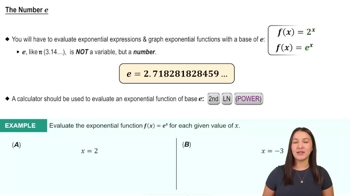
Continuous compounding refers to the process of earning interest on an investment at every possible moment, rather than at discrete intervals. The formula used for continuous compounding is A = Pe^(rt), where A is the amount of money accumulated after time t, P is the principal amount, r is the annual interest rate, and e is the base of the natural logarithm. This method allows for the maximum growth of an investment over time.
Video consigliato:
4:47
The Number e

Exponential Growth

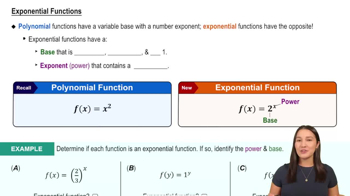
Exponential growth occurs when the growth rate of a value is proportional to its current value, leading to rapid increases over time. In the context of finance, this is often modeled using the exponential function, which reflects how investments grow when interest is compounded continuously. Understanding this concept is crucial for predicting how long it will take for an investment to reach a certain value.
Video consigliato:
6:13
Exponential Functions

Natural Logarithm

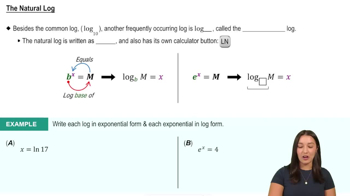
The natural logarithm, denoted as ln, is the logarithm to the base e (approximately 2.71828). It is particularly useful in solving equations involving exponential growth, such as those found in continuous compounding. When determining the time required for an investment to grow to a specific amount, the natural logarithm helps isolate the variable t in the continuous compounding formula.
Video consigliato:
2:51
The Natural Log