Ch. 5 - Systems of Equations and Inequalities
Blitzer - College Algebra 8th Edition
Blitzer8th EditionCollege AlgebraISBN: 9780136970514Non è quello che usi tu?Cambia libro di testo
Capitolo 6, Problema 5

Graph each inequality. y≤(1/3)x

Guida verificata passo dopo passo
1
Identify the inequality given: \(y \leq \frac{1}{3}x\). This means we are looking for all points \((x, y)\) where the \(y\)-value is less than or equal to one-third of the \(x\)-value.
Start by graphing the boundary line \(y = \frac{1}{3}x\). This is a straight line with slope \(\frac{1}{3}\) passing through the origin \((0,0)\).
Since the inequality is \(\leq\) (less than or equal to), the boundary line should be drawn as a solid line to indicate that points on the line satisfy the inequality.
Next, choose a test point not on the line, commonly \((0,0)\) if it is not on the boundary line, to determine which side of the line to shade. Substitute the test point into the inequality to check if it satisfies \(y \leq \frac{1}{3}x\).
Shade the region of the coordinate plane where the inequality holds true based on the test point result. This shaded area represents all solutions to the inequality.

Risposta video verificata per un problema simile:

Questa soluzione video è stata consigliata dai nostri tutor come utile per risolvere questo problema.
Durata del video:
5m

Concetti chiave

Ecco i concetti essenziali che devi comprendere per rispondere correttamente alla domanda.

Graphing Linear Inequalities

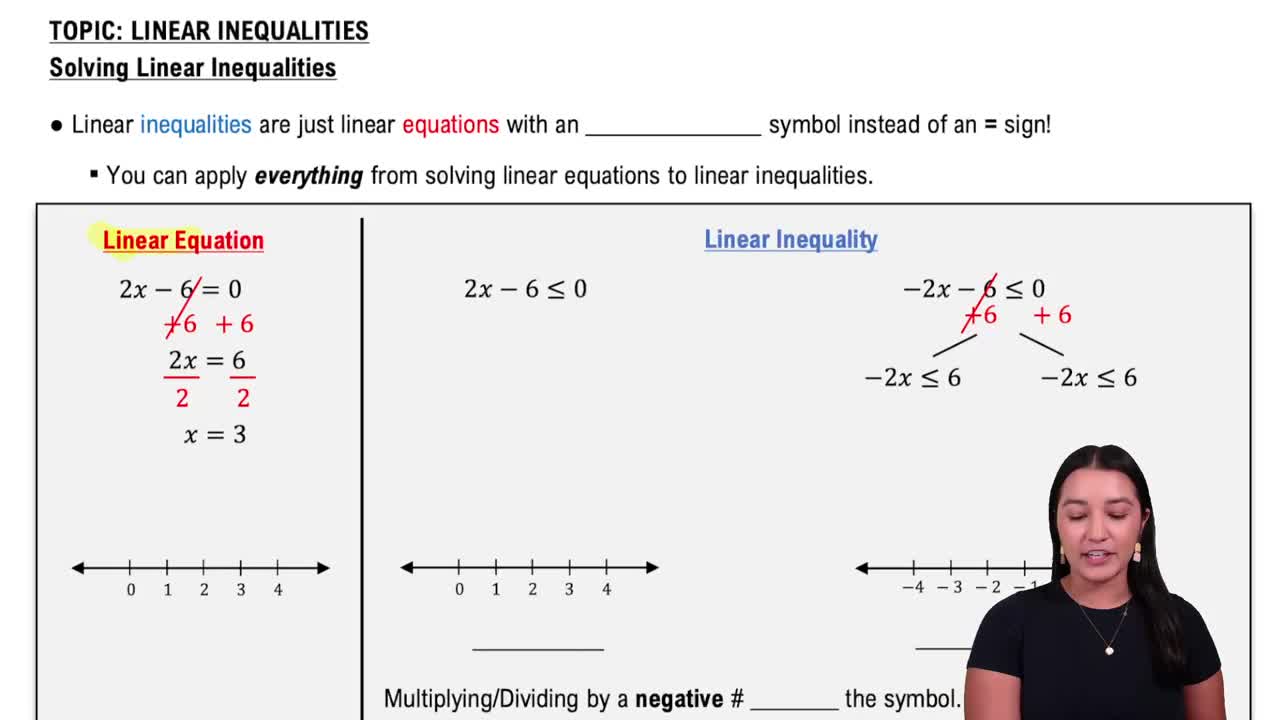
Graphing linear inequalities involves plotting the boundary line of the related equation and then shading the region that satisfies the inequality. For y ≤ (1/3)x, the boundary line is y = (1/3)x, and the area below or on this line is shaded to represent all solutions.
Video consigliato:
06:07
Linear Inequalities

Slope-Intercept Form

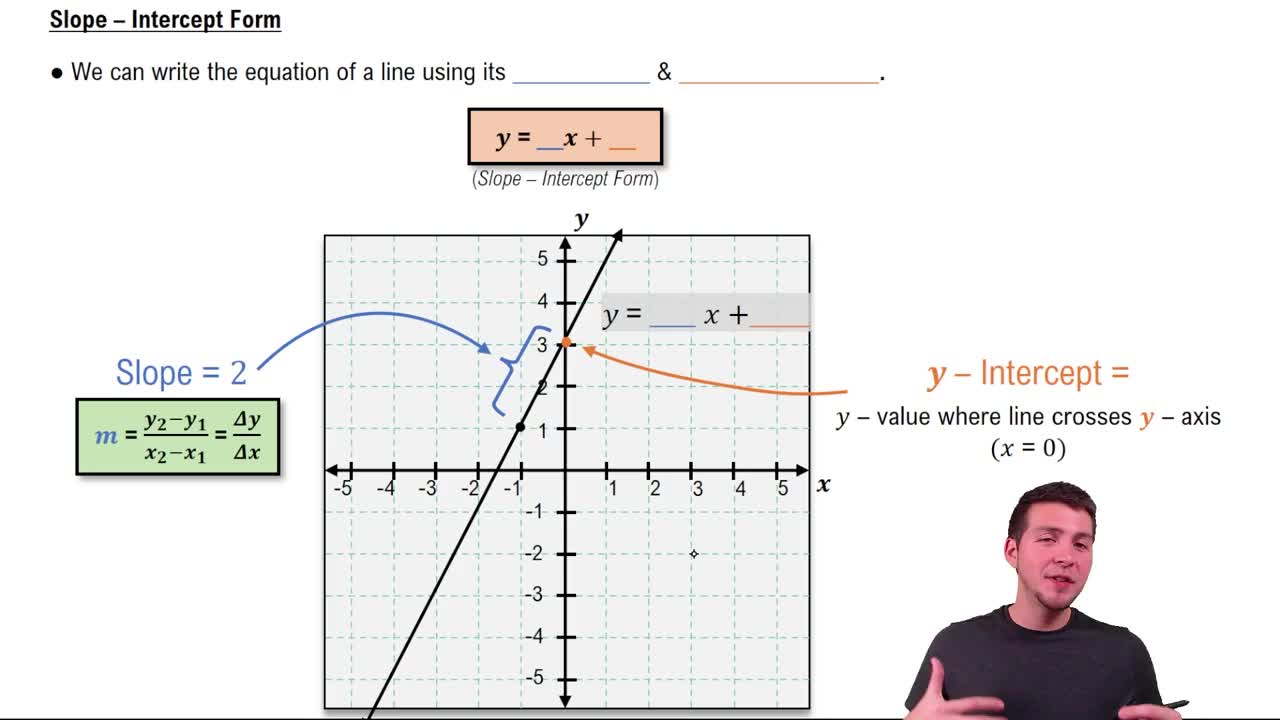
The slope-intercept form of a line is y = mx + b, where m is the slope and b is the y-intercept. In y ≤ (1/3)x, the slope is 1/3 and the y-intercept is 0, which helps in accurately drawing the boundary line on the coordinate plane.
Video consigliato:
03:56
Slope-Intercept Form

Solid vs. Dashed Boundary Lines

When graphing inequalities, a solid line is used if the inequality includes equality (≤ or ≥), indicating points on the line satisfy the inequality. A dashed line is used for strict inequalities (< or >), meaning points on the line are not included.
Video consigliato:
07:52
Parallel & Perpendicular Lines
Pratica correlata
Domanda del libro di testo

In Exercises 5–18, solve each system by the substitution method. {x+3y=8y=2x−9\(\begin{cases}\) x + 3y = 8 \\ y = 2x - 9 \(\end{cases}\)

774
views
Domanda del libro di testo

An objective function and a system of linear inequalities representing constraints are given. a. Graph the system of inequalities representing the constraints. b. Find the value of the objective function at each corner of the graphed region. c. Use the values in part (b) to determine the maximum value of the objective function and the values of x and y for which the maximum occurs.

626
views
Domanda del libro di testo

Solve each system in Exercises 5–18.

{x+y+2z=11x+y+3z=14x+2y−z=5\(\begin{cases}\) x + y + 2z = 11 \\ x + y + 3z = 14 \\ x + 2y - z = 5 \(\end{cases}\)

629
views
Domanda del libro di testo

Write the form of the partial fraction decomposition of the rational expression. It is not necessary to solve for the constants. 5x2−6x+7(x−1)(x2+1)\(\frac{5x^2 - 6x + 7}{(x - 1)(x^2 + 1)}\)

703
views
Domanda del libro di testo

An objective function and a system of linear inequalities representing constraints are given. a. Graph the system of inequalities representing the constraints. b. Find the value of the objective function at each corner of the graphed region. c. Use the values in part (b) to determine the maximum value of the objective function and the values of x and y for which the maximum occurs.

578
views
Domanda del libro di testo

In Exercises 1–18, solve each system by the substitution method. {y=x2−4x−10y=−x2−2x+14\(\begin{cases}\) y = x^2 - 4x - 10 \\ y = -x^2 - 2x + 14 \(\end{cases}\)

546
views