Ch. 5 - Systems of Equations and Inequalities
Blitzer - College Algebra 8th Edition
Blitzer8th EditionCollege AlgebraISBN: 9780136970514Non è quello che usi tu?Cambia libro di testo
Capitolo 6, Problema 1

Solve by the method of your choice. Identify systems with no solution and systems with infinitely many solutions, using set notation to express their solution sets.
{y=4x+13x+2y=13\(\begin{cases}\) y = 4x + 1 \\ 3x + 2y = 13 \(\end{cases}\)

Guida verificata passo dopo passo
1
Identify the system of equations you need to solve. Typically, this will be two or more equations involving the same variables.
Choose a method to solve the system: substitution, elimination, or graphing. For substitution, solve one equation for one variable and substitute into the other. For elimination, add or subtract equations to eliminate one variable.
Perform the chosen method step-by-step to reduce the system to a single equation with one variable. Solve this equation for that variable.
Substitute the found value back into one of the original equations to find the value of the other variable(s).
Analyze the results: if you get a true statement with no variables (like 0=0), the system has infinitely many solutions; if you get a false statement (like 0=5), the system has no solution; otherwise, write the solution as an ordered pair or set notation representing the solution set.

Risposta video verificata per un problema simile:

Questa soluzione video è stata consigliata dai nostri tutor come utile per risolvere questo problema.
Durata del video:
2m

Concetti chiave

Ecco i concetti essenziali che devi comprendere per rispondere correttamente alla domanda.

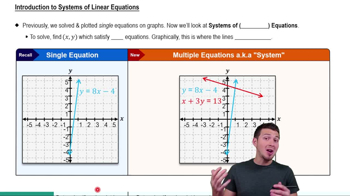
Systems of Linear Equations

A system of linear equations consists of two or more linear equations with the same variables. The goal is to find values for the variables that satisfy all equations simultaneously. Understanding how to represent and interpret these systems is fundamental to solving them.
Video consigliato:
4:27
Introduction to Systems of Linear Equations

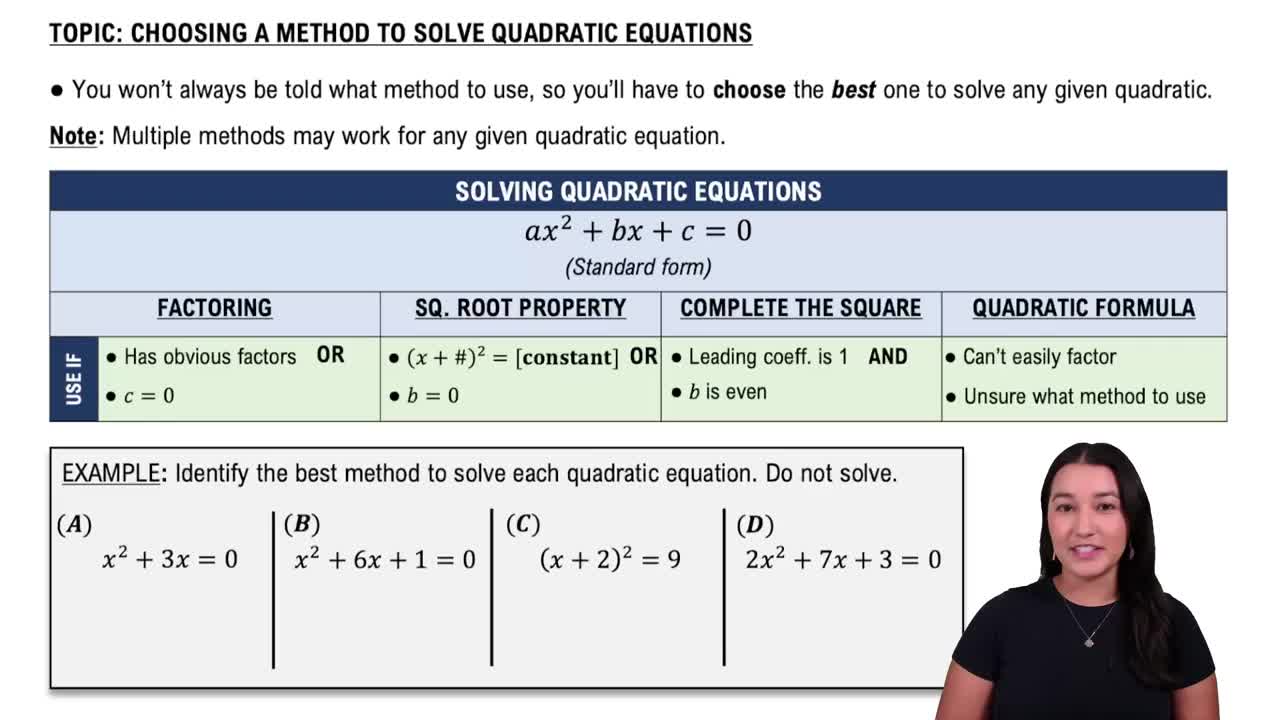
Methods for Solving Systems

Common methods to solve systems include substitution, elimination, and graphing. Each method provides a way to find the solution set by manipulating the equations or visualizing their graphs. Choosing an appropriate method depends on the system's complexity and form.
Video consigliato:
04:03
Choosing a Method to Solve Quadratics

Types of Solutions and Set Notation

Systems can have one solution, no solution, or infinitely many solutions. No solution means the lines are parallel and never intersect; infinitely many solutions mean the equations represent the same line. Solutions are expressed using set notation to clearly define all possible solutions.
Video consigliato:
05:18
Interval Notation