Ch. 5 - Systems of Equations and Inequalities
Blitzer - College Algebra 8th Edition
Blitzer8th EditionCollege AlgebraISBN: 9780136970514Non è quello che usi tu?Cambia libro di testo
Capitolo 6, Problema 2

Solve by the method of your choice. Identify systems with no solution and systems with infinitely many solutions, using set notation to express their solution sets.
{x+4y=142x−y=1\(\begin{cases}\) x + 4y = 14 \\ 2x - y = 1 \(\end{cases}\)

Guida verificata passo dopo passo
1
Identify the system of equations you need to solve. Typically, this will be two or more equations involving the same variables.
Choose a method to solve the system: substitution, elimination, or graphing. For algebraic clarity, substitution or elimination is often preferred.
If using substitution, solve one equation for one variable in terms of the other(s), then substitute this expression into the other equation(s) to reduce the system to one equation with one variable.
If using elimination, manipulate the equations (by multiplying if necessary) so that adding or subtracting them eliminates one variable, allowing you to solve for the remaining variable.
After finding the value(s) of the variable(s), substitute back into one of the original equations to find the other variable(s). Then, analyze the system: if you get a true statement with no variables, the system has infinitely many solutions; if you get a false statement, the system has no solution; otherwise, write the solution set in set notation, for example, \(\{(x,y) \mid x = a, y = b\}\).

Risposta video verificata per un problema simile:

Questa soluzione video è stata consigliata dai nostri tutor come utile per risolvere questo problema.
Durata del video:
2m

Concetti chiave

Ecco i concetti essenziali che devi comprendere per rispondere correttamente alla domanda.

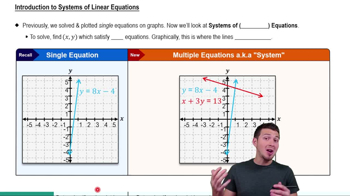
Systems of Linear Equations

A system of linear equations consists of two or more linear equations with the same variables. The goal is to find values for the variables that satisfy all equations simultaneously. Solutions can be a single point, no solution, or infinitely many solutions depending on the relationships between the equations.
Video consigliato:
4:27
Introduction to Systems of Linear Equations

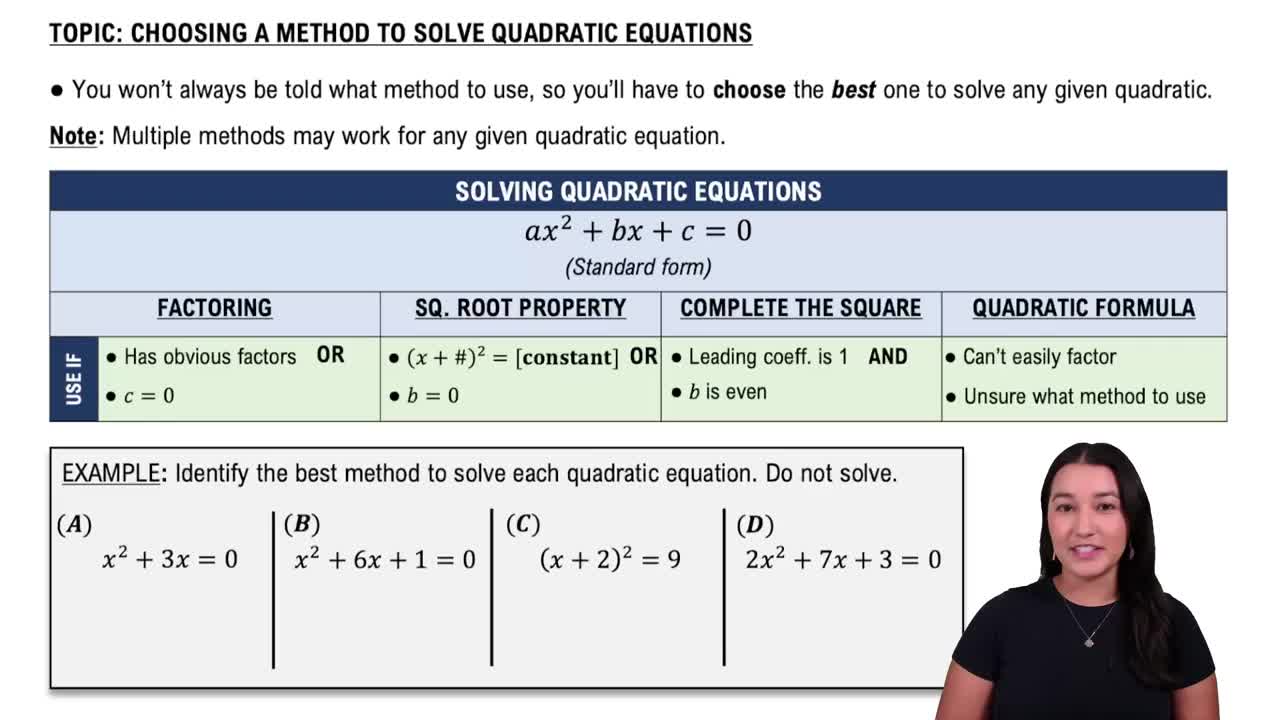
Methods for Solving Systems

Common methods to solve systems include substitution, elimination, and graphing. Substitution involves solving one equation for a variable and substituting into another. Elimination adds or subtracts equations to eliminate a variable. Graphing visualizes solutions as intersection points of lines.
Video consigliato:
04:03
Choosing a Method to Solve Quadratics

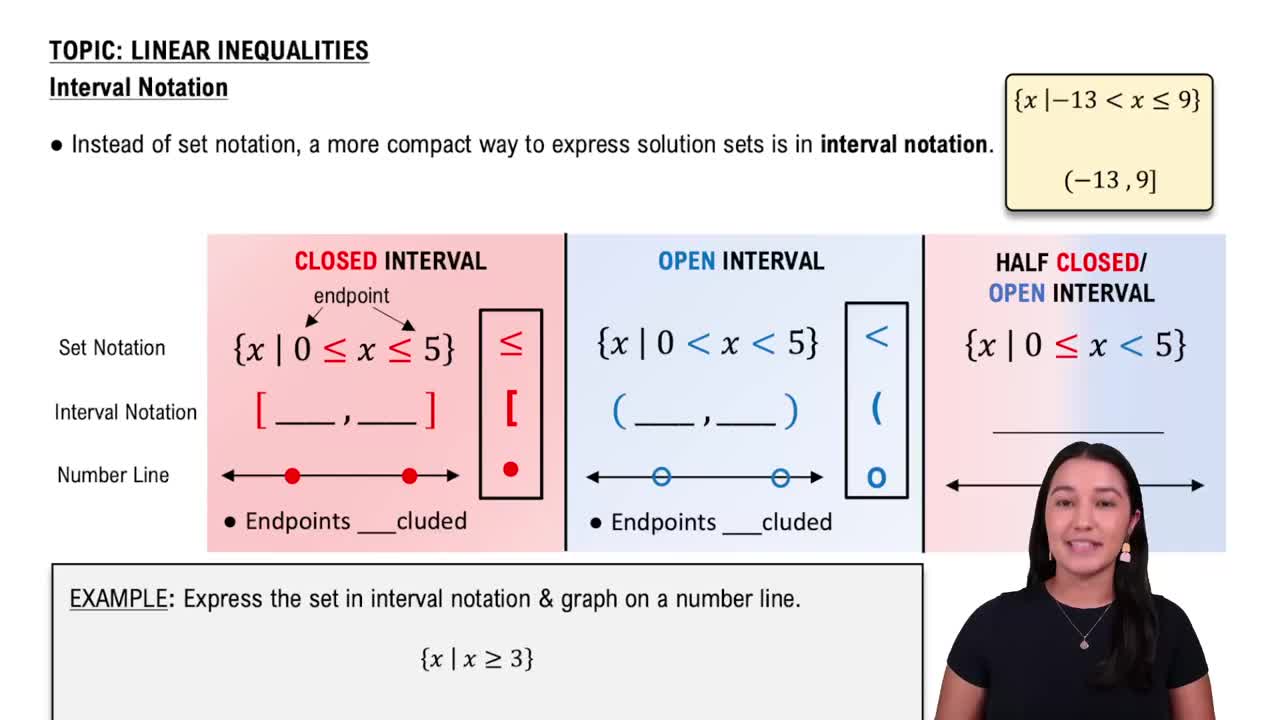
Types of Solutions and Set Notation

Systems can have one solution (intersecting lines), no solution (parallel lines), or infinitely many solutions (coincident lines). No solution means the system is inconsistent. Solutions are expressed using set notation, such as {(x, y) | x = 2, y = 3} for a single solution or {(x, y) | y = 2x + 1} for infinite solutions.
Video consigliato:
05:18
Interval Notation