In Exercises 47–52, solve each system by the method of your choice.
Ch. 5 - Systems of Equations and Inequalities

Capitolo 6, Problema 47
In Exercises 47–48, solve each system by the method of your choice. (x + 2)/2 - (y + 4)/3 = 3 (x + y)/5 = (x - y)/2 - 5/2

Guida verificata passo dopo passo1
Start by rewriting each equation to eliminate the fractions for easier manipulation. For the first equation, multiply both sides by the least common multiple (LCM) of the denominators 2 and 3, which is 6, to clear the fractions.
For the first equation: multiply both sides by 6 to get: 6 * ((x + 2)/2 - (y + 4)/3) = 6 * 3. This simplifies to 3(x + 2) - 2(y + 4) = 18.
For the second equation, multiply both sides by the LCM of 5 and 2, which is 10, to clear the fractions: 10 * ((x + y)/5) = 10 * ((x - y)/2 - 5/2). This simplifies to 2(x + y) = 5(x - y) - 25.
Next, simplify both equations by distributing and combining like terms: For the first equation, expand 3(x + 2) and -2(y + 4). For the second equation, expand 2(x + y) and 5(x - y).
After simplification, you will have a system of two linear equations in standard form. Use either substitution or elimination method to solve for x and y.

Risposta video verificata per un problema simile:
Questa soluzione video è stata consigliata dai nostri tutor come utile per risolvere questo problema.
Durata del video:
6mConcetti chiave
Ecco i concetti essenziali che devi comprendere per rispondere correttamente alla domanda.
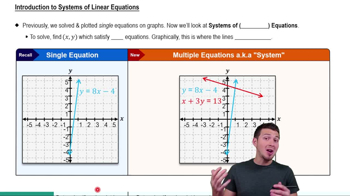
Systems of Linear Equations
A system of linear equations consists of two or more linear equations involving the same set of variables. The goal is to find values for the variables that satisfy all equations simultaneously. Solutions can be a single point, infinitely many points, or no solution, depending on the system's consistency.
Video consigliato:
Introduction to Systems of Linear Equations
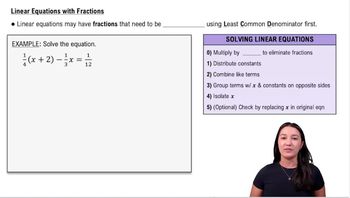
Clearing Fractions in Equations
Clearing fractions involves multiplying both sides of an equation by the least common denominator to eliminate denominators. This simplifies the equation into a standard linear form, making it easier to manipulate and solve. It is especially useful when equations contain fractional expressions.
Video consigliato:
Solving Linear Equations with Fractions
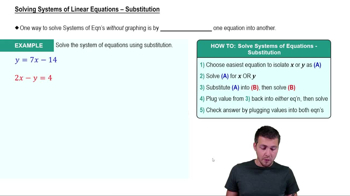
Methods for Solving Systems (Substitution, Elimination, or Graphing)
Common methods to solve systems include substitution (solving one equation for a variable and substituting into the other), elimination (adding or subtracting equations to eliminate a variable), and graphing (finding the intersection point of lines). Choosing the method depends on the system's form and complexity.
Video consigliato:
Solving Systems of Equations - Substitution
Pratica correlata
Domanda del libro di testo
479
views
Domanda del libro di testo
Graph the solution set of each system of inequalities or indicate that the system has no solution.
591
views
Domanda del libro di testo
In Exercises 47–48, solve each system by the method of your choice. (x - y)/3 = (x + y)/2 - 1/2 (x + 2)/2 - 4 = (y + 4)/3
739
views
Domanda del libro di testo
In Exercises 46–55, graph the solution set of each system of inequalities or indicate that the system has no solution.
This
is a piecewise function. Refer to the textbook.
577
views
Domanda del libro di testo
Perform each long division and write the partial fraction decomposition of the remainder term. (x4-x2+2)/(x3-x2)
753
views
Domanda del libro di testo
In Exercises 46–55, graph the solution set of each system of inequalities or indicate that the system has no solution.
This
is a piecewise function. Refer to the textbook.
603
views