Ch. 5 - Systems of Equations and Inequalities
Blitzer - College Algebra 8th Edition
Blitzer8th EditionCollege AlgebraISBN: 9780136970514Non è quello che usi tu?Cambia libro di testo
Capitolo 6, Problema 19

Write the partial fraction decomposition of each rational expression. 4x2 - 7x - 3/(x3 -x)

Guida verificata passo dopo passo
1
First, factor the denominator \(x^3 - x\). Notice that you can factor out an \(x\) to get \(x(x^2 - 1)\).
Recognize that \(x^2 - 1\) is a difference of squares, so factor it further as \(x(x - 1)(x + 1)\).
Set up the partial fraction decomposition with unknown constants for each factor in the denominator: \(\frac{4x^2 - 7x - 3}{x(x - 1)(x + 1)} = \frac{A}{x} + \frac{B}{x - 1} + \frac{C}{x + 1}\).
Multiply both sides of the equation by the common denominator \(x(x - 1)(x + 1)\) to clear the fractions, resulting in: \(4x^2 - 7x - 3 = A(x - 1)(x + 1) + B x (x + 1) + C x (x - 1)\).
Expand the right side and collect like terms to form a polynomial equation. Then, equate the coefficients of corresponding powers of \(x\) on both sides to create a system of equations to solve for \(A\), \(B\), and \(C\).

Risposta video verificata per un problema simile:

Questa soluzione video è stata consigliata dai nostri tutor come utile per risolvere questo problema.
Durata del video:
14m

Concetti chiave

Ecco i concetti essenziali che devi comprendere per rispondere correttamente alla domanda.

Partial Fraction Decomposition

Partial fraction decomposition is a method used to express a rational function as a sum of simpler fractions with denominators that are factors of the original denominator. This technique simplifies integration and other algebraic operations by breaking down complex fractions into manageable parts.
Video consigliato:
4:07
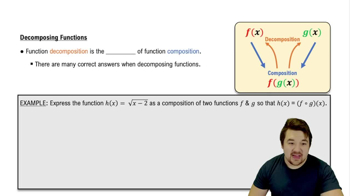
Decomposition of Functions

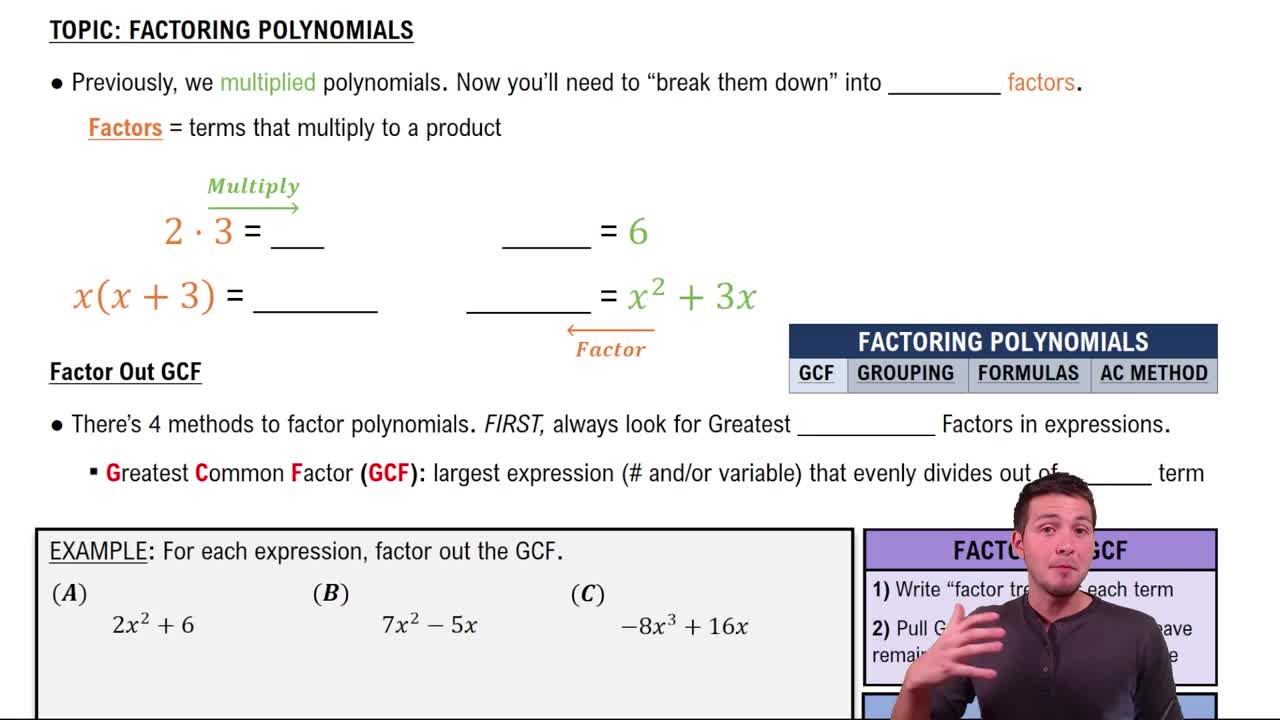
Factoring Polynomials

Factoring polynomials involves rewriting a polynomial as a product of its factors. For partial fractions, factoring the denominator completely into linear and/or irreducible quadratic factors is essential to set up the correct form of the decomposition.
Video consigliato:
07:30
Introduction to Factoring Polynomials

Setting Up and Solving Equations for Coefficients

After expressing the rational function as a sum of partial fractions, you equate the original numerator to the combined numerator of the decomposed fractions. This leads to a system of equations for the unknown coefficients, which you solve to find the values that complete the decomposition.
Video consigliato:
5:02
Solving Logarithmic Equations