Ch. 5 - Systems of Equations and Inequalities
Blitzer - College Algebra 8th Edition
Blitzer8th EditionCollege AlgebraISBN: 9780136970514Non è quello che usi tu?Cambia libro di testo
Capitolo 6, Problema 81

Solve: x4+2x3−x2−4x−2=0

Guida verificata passo dopo passo
1
Start by examining the polynomial equation x4 + 2x3 - x2 - 4x - 2 = 0 to see if it can be factored by grouping or by using substitution.
Try to group terms to factor: group the first two terms and the last three terms separately, like this: (x4 + 2x3) + (- x2 - 4x - 2). Then factor out the greatest common factor (GCF) from each group.
After factoring by grouping, check if the resulting expression can be factored further into the product of two quadratic polynomials, such as (x^2 + ax + b)(x^2 + cx + d) = 0. Set up equations by expanding and matching coefficients to find the values of a, b, c, and d.
Once the polynomial is factored into two quadratics, set each quadratic equal to zero: x^2 + ax + b = 0 and x^2 + cx + d = 0. Solve each quadratic equation using the quadratic formula: x = \(\frac{-B \pm \sqrt{B^2 - 4AC}\)}{2A}, where A, B, and C are the coefficients of the quadratic.
Write down all the solutions obtained from the quadratic equations. These solutions are the roots of the original quartic equation.

Risposta video verificata per un problema simile:

Questa soluzione video è stata consigliata dai nostri tutor come utile per risolvere questo problema.
Durata del video:
6m

Concetti chiave

Ecco i concetti essenziali che devi comprendere per rispondere correttamente alla domanda.

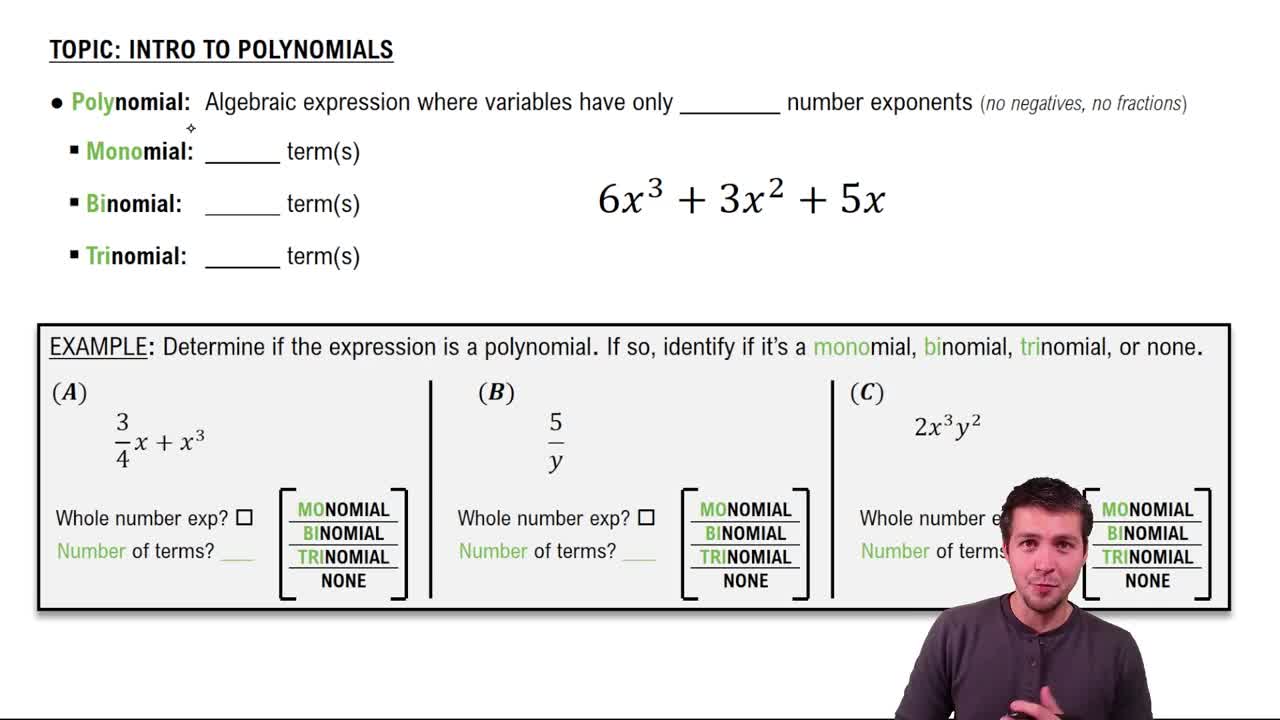
Polynomial Equations

Polynomial equations involve expressions with variables raised to whole-number exponents and coefficients. Solving these equations means finding all values of the variable that make the equation true. Understanding the degree of the polynomial helps determine the maximum number of possible solutions.
Video consigliato:
05:13
Introduction to Polynomials

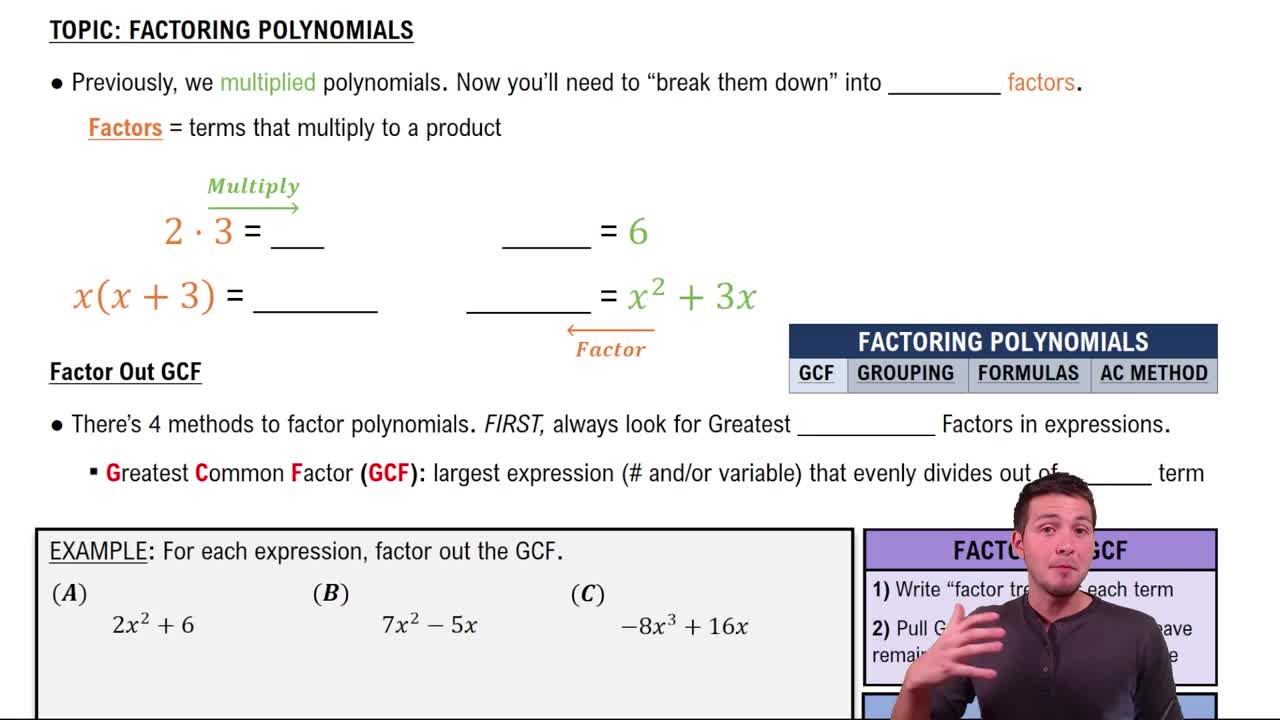
Factoring Polynomials

Factoring is the process of rewriting a polynomial as a product of simpler polynomials. This technique is essential for solving polynomial equations because setting each factor equal to zero helps find the roots. Common methods include grouping, synthetic division, and recognizing special products.
Video consigliato:
07:30
Introduction to Factoring Polynomials

Rational Root Theorem and Root Testing

The Rational Root Theorem provides possible rational roots based on factors of the constant and leading coefficients. Testing these candidates by substitution or synthetic division helps identify actual roots, simplifying the polynomial and making it easier to solve completely.
Video consigliato:
02:20
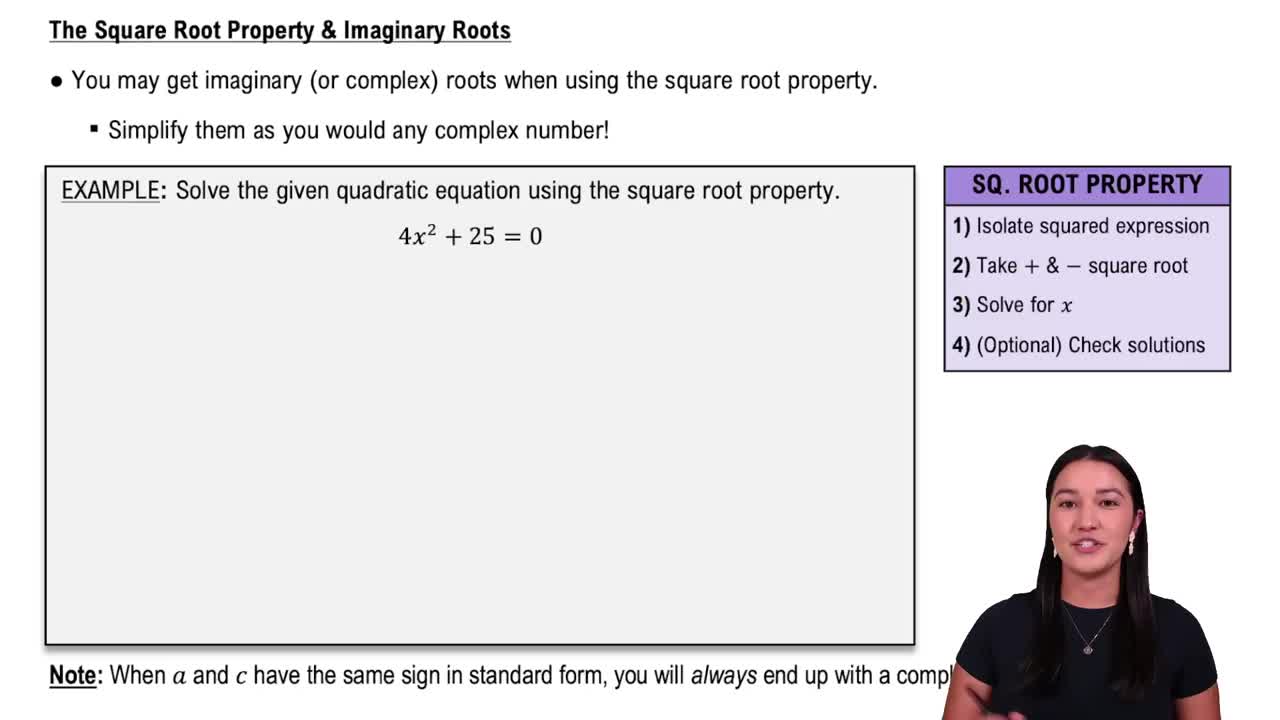
Imaginary Roots with the Square Root Property