Ch. 6 - Matrices and Determinants
Blitzer - College Algebra 8th Edition
Blitzer8th EditionCollege AlgebraISBN: 9780136970514Non è quello che usi tu?Cambia libro di testo
Capitolo 7, Problema 11

In Exercises 1 - 24, use Gaussian Elimination to find the complete solution to each system of equations, or show that none exists. {2w+x−y=3w−3x+2y=−43w+x−3y+z=1w+2x−4y−z=−2\(\begin{cases}\) 2w + x - y = 3 \\ w - 3x + 2y = -4 \\ 3w + x - 3y + z = 1 \\ w + 2x - 4y - z = -2 \(\end{cases}\)

Guida verificata passo dopo passo
1
Write the system of equations as an augmented matrix. Each row corresponds to an equation, and each column corresponds to the coefficients of variables w, x, y, z, and the constants on the right side: \[\begin{bmatrix} 2 & 1 & -1 & 0 & | & 3 \\ 1 & -3 & 2 & 0 & | & -4 \\ 3 & 1 & -3 & 1 & | & 1 \\ 1 & 2 & -4 & -1 & | & -2 \end{bmatrix}\]
Use row operations to create zeros below the leading 1 in the first column (pivot position). For example, use the second row (which has a 1 in the first column) to eliminate the w-terms in the first, third, and fourth rows by appropriate row replacements.
Move to the second column and create a leading 1 in the second row, second column position if necessary. Then use this pivot to eliminate the x-terms in the rows below it by row operations, creating zeros below the pivot.
Continue this process for the third and fourth columns, creating leading 1s (pivots) and zeros below them, transforming the matrix into an upper triangular (row echelon) form.
Once in row echelon form, use back substitution to solve for the variables starting from the bottom row up, expressing each variable in terms of constants or previously found variables to find the complete solution.

Risposta video verificata per un problema simile:

Questa soluzione video è stata consigliata dai nostri tutor come utile per risolvere questo problema.
Durata del video:
12m

Concetti chiave

Ecco i concetti essenziali che devi comprendere per rispondere correttamente alla domanda.

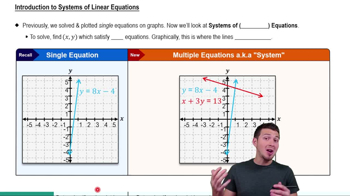
Systems of Linear Equations

A system of linear equations consists of multiple linear equations involving the same set of variables. The goal is to find values for these variables that satisfy all equations simultaneously. Understanding how to represent and interpret these systems is fundamental before applying solution methods.
Video consigliato:
4:27
Introduction to Systems of Linear Equations

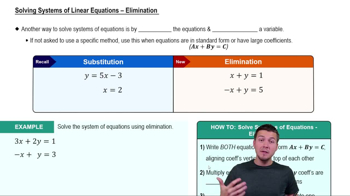
Gaussian Elimination

Gaussian elimination is a systematic method for solving systems of linear equations by transforming the system's augmented matrix into row-echelon form using row operations. This process simplifies the system, making it easier to solve through back substitution or to determine if no solution exists.
Video consigliato:
6:48
Solving Systems of Equations - Elimination

Row Operations and Row-Echelon Form

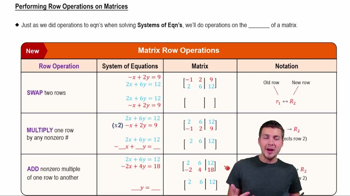
Row operations include swapping rows, multiplying a row by a nonzero scalar, and adding multiples of one row to another. These operations are used to convert the augmented matrix into row-echelon form, where the matrix has a stair-step pattern of leading coefficients, facilitating the solution of the system.
Video consigliato:
8:38
Performing Row Operations on Matrices