Ch. 7 - Conic Sections
Blitzer - College Algebra 8th Edition
Blitzer8th EditionCollege AlgebraISBN: 9780136970514Non è quello che usi tu?Cambia libro di testo
Capitolo 8, Problema 26

Explain why it is not possible for a hyperbola to have foci at (0,-2) and (0,2) and vertices at (0,-3) and (0,3).

Guida verificata passo dopo passo
1
A hyperbola is defined as the set of all points where the absolute difference of the distances to two fixed points (the foci) is constant. The vertices of the hyperbola are points on the hyperbola that lie along the transverse axis, which is the axis that passes through the foci.
For a hyperbola centered at the origin with a vertical transverse axis, the standard equation is: y2a2 - x2b2 = 1, where a is the distance from the center to each vertex, and c is the distance from the center to each focus. The relationship between these values is given by c^2 = a^2 + b^2.
In this problem, the foci are at (0, -2) and (0, 2), so the distance from the center (0, 0) to each focus is c = 2. The vertices are at (0, -3) and (0, 3), so the distance from the center to each vertex is a = 3.
Using the relationship c^2 = a^2 + b^2, substitute c = 2 and a = 3: 2^2 = 3^2 + b^2. Simplify this equation to find b^2.
After simplifying, you will find that b^2 becomes negative, which is not possible because b^2 represents the square of a real number. This contradiction indicates that the given configuration of foci and vertices is not possible for a hyperbola.

Risposta video verificata per un problema simile:

Questa soluzione video è stata consigliata dai nostri tutor come utile per risolvere questo problema.
Durata del video:
2m

Concetti chiave

Ecco i concetti essenziali che devi comprendere per rispondere correttamente alla domanda.

Definition of a Hyperbola

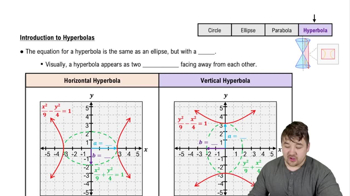
A hyperbola is a type of conic section formed by the intersection of a plane and a double cone. It consists of two separate curves called branches, which are mirror images of each other. The standard form of a hyperbola can be expressed as (y^2/a^2) - (x^2/b^2) = 1 for vertical hyperbolas, where 'a' represents the distance from the center to the vertices, and 'c' represents the distance from the center to the foci.
Video consigliato:
6:15
Introduction to Hyperbolas

Foci and Vertices Relationship

In a hyperbola, the distance from the center to the foci (denoted as 'c') must always be greater than the distance from the center to the vertices (denoted as 'a'). This relationship is expressed mathematically as c^2 = a^2 + b^2. If the foci and vertices are positioned incorrectly, it can lead to contradictions in this fundamental relationship, making the configuration impossible.
Video consigliato:
5:30
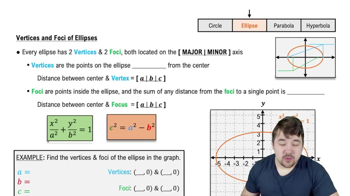
Foci and Vertices of an Ellipse

Geometric Configuration of Foci and Vertices

For a hyperbola centered at the origin with vertical transverse axis, the foci and vertices must lie along the same line, specifically the y-axis in this case. Given the foci at (0,-2) and (0,2) and vertices at (0,-3) and (0,3), the distance from the center to the foci is 2, while the distance to the vertices is 3. This violates the necessary condition that the distance to the foci must exceed that to the vertices, confirming that such a hyperbola cannot exist.
Video consigliato:
5:30
Foci and Vertices of an Ellipse