Ch. 7 - Conic Sections
Blitzer - College Algebra 8th Edition
Blitzer8th EditionCollege AlgebraISBN: 9780136970514Non è quello che usi tu?Cambia libro di testo
Capitolo 8, Problema 59

Convert each equation to standard form by completing the square on x and y. Then graph the ellipse and give the location of its foci. 36x2 +9y2 - 216x = 0

Guida verificata passo dopo passo
1
Start with the given equation: \(36x^{2} + 9y^{2} - 216x = 0\).
Group the \(x\) terms and the \(y\) terms together: \(36x^{2} - 216x + 9y^{2} = 0\).
Factor out the coefficients of the squared terms to make completing the square easier: \(36(x^{2} - 6x) + 9y^{2} = 0\).
Complete the square for the \(x\) terms inside the parentheses. Take half of the coefficient of \(x\) (which is \(-6\)), square it, and add inside the parentheses, remembering to balance the equation by adding the equivalent value outside: half of \(-6\) is \(-3\), and \((-3)^{2} = 9\). So add and subtract \(9\) inside the parentheses: \(36(x^{2} - 6x + 9 - 9) + 9y^{2} = 0\).
Rewrite the completed square and simplify the constants: \$36(x - 3)^{2} - 36 imes 9 + 9y^{2} = 0$. Then move the constant term to the other side and divide the entire equation by the constant to get the ellipse in standard form.

Risposta video verificata per un problema simile:

Questa soluzione video è stata consigliata dai nostri tutor come utile per risolvere questo problema.
Durata del video:
9m

Concetti chiave

Ecco i concetti essenziali che devi comprendere per rispondere correttamente alla domanda.

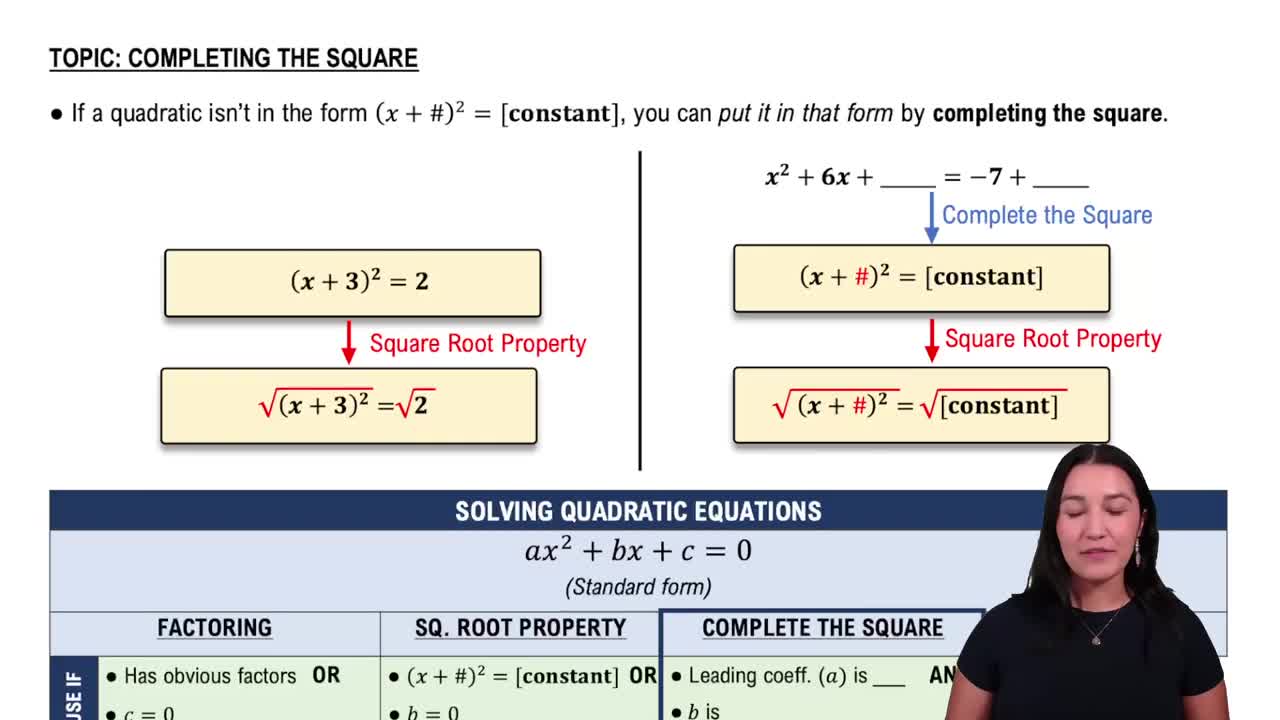
Completing the Square

Completing the square is a method used to rewrite quadratic expressions in the form (x - h)² or (y - k)² by adding and subtracting appropriate constants. This technique helps transform the given equation into a recognizable conic section form, such as the standard form of an ellipse.
Video consigliato:
06:24
Solving Quadratic Equations by Completing the Square

Standard Form of an Ellipse

The standard form of an ellipse equation is (x - h)²/a² + (y - k)²/b² = 1, where (h, k) is the center, and a and b are the lengths of the semi-major and semi-minor axes. Converting to this form allows easy identification of the ellipse's size, shape, and position.
Video consigliato:
5:12
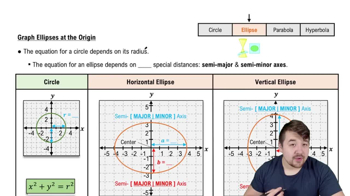
Graph Ellipses at Origin

Foci of an Ellipse

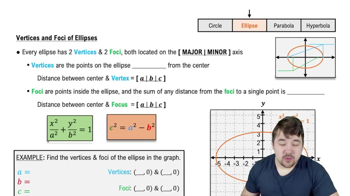
The foci are two fixed points inside the ellipse such that the sum of distances from any point on the ellipse to the foci is constant. Their locations depend on the values of a, b, and the center, and are found using c² = |a² - b²|, where c is the distance from the center to each focus.
Video consigliato:
5:30
Foci and Vertices of an Ellipse
Pratica correlata
Domanda del libro di testo

In Exercises 57–62, use the vertex and the direction in which the parabola opens to determine the relation's domain and range. Is the relation a function?

x=−4(y−1)2+3x = - 4(y - 1)^2 + 3


736
views
Domanda del libro di testo

Convert each equation to standard form by completing the square on x and y. Then graph the ellipse and give the location of its foci. 25x²+4y² – 150x + 32y + 189 = 0

827
views
Domanda del libro di testo

Use the vertex and the direction in which the parabola opens to determine the relation's domain and range. Is the relation a function? y2 + 6y - x + 5 = 0

892
views
Domanda del libro di testo

Find the solution set for each system by graphing both of the system's equations in the same rectangular coordinate system and finding points of intersection. Check all solutions in both equations.

{x2+y2=1x2+9y2=9\(\begin{cases}\) x^2 + y^2 = 1 \\ x^2 + 9y^2 = 9 \(\end{cases}\)

812
views
Domanda del libro di testo

In Exercises 57–62, use the vertex and the direction in which the parabola opens to determine the relation's domain and range. Is the relation a function?

y=−x2+4x−3y=-x^2+4x-3


732
views
Domanda del libro di testo

In Exercises 63–68, find the solution set for each system by graphing both of the system's equations in the same rectangular coordinate system and finding points of intersection. Check all solutions in both equations.

{(y−2)2 =x+4y=−(12)x\(\left\)\{\(\begin{array}{l}\)\(\left\)(y-2\(\right\))^2\(\text{ }\)=x+4\\ y=-\(\text{(}\[\frac\)12\(\text{)}\)x\(\end{array}\]\right\).

650
views