Ch. 8 - Sequences, Induction, and Probability
Blitzer - College Algebra 8th Edition
Blitzer8th EditionCollege AlgebraISBN: 9780136970514Non è quello che usi tu?Cambia libro di testo
Capitolo 9, Problema 89

A die is rolled. Find the probability of getting a number less than 5.

Guida verificata passo dopo passo
1
Step 1: Understand the problem. A standard die has 6 faces numbered 1 through 6. The goal is to find the probability of rolling a number less than 5.
Step 2: Identify the favorable outcomes. Numbers less than 5 on a die are 1, 2, 3, and 4. This gives us 4 favorable outcomes.
Step 3: Determine the total possible outcomes. Since a die has 6 faces, there are 6 possible outcomes in total.
Step 4: Use the probability formula: \( P(E) = \frac{\text{Number of favorable outcomes}}{\text{Total number of outcomes}} \). Substitute the values: \( P(E) = \frac{4}{6} \).
Step 5: Simplify the fraction if necessary. \( \frac{4}{6} \) can be simplified to \( \frac{2}{3} \). This represents the probability of rolling a number less than 5.

Risposta video verificata per un problema simile:

Questa soluzione video è stata consigliata dai nostri tutor come utile per risolvere questo problema.
Durata del video:
1m

Concetti chiave

Ecco i concetti essenziali che devi comprendere per rispondere correttamente alla domanda.

Probability

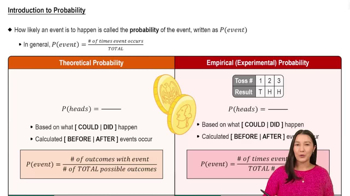
Probability is a measure of the likelihood that a particular event will occur, expressed as a number between 0 and 1. An event with a probability of 0 means it will not happen, while a probability of 1 means it will certainly happen. In this context, we are interested in the probability of rolling a number less than 5 on a standard six-sided die.
Video consigliato:
5:37
Introduction to Probability

Sample Space

The sample space is the set of all possible outcomes of a random experiment. For a single roll of a six-sided die, the sample space consists of the numbers {1, 2, 3, 4, 5, 6}. Understanding the sample space is crucial for calculating probabilities, as it provides the total number of outcomes against which specific events can be measured.
Video consigliato:
5:37
Introduction to Probability

Favorable Outcomes

Favorable outcomes refer to the specific outcomes in the sample space that satisfy the condition of the event we are interested in. In this case, the favorable outcomes for rolling a number less than 5 are {1, 2, 3, 4}, which totals four outcomes. The probability of the event is calculated by dividing the number of favorable outcomes by the total number of outcomes in the sample space.
Video consigliato:
4:23
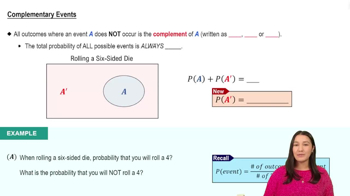
Complementary Events