Ch. 8 - Sequences, Induction, and Probability
Blitzer - College Algebra 8th Edition
Blitzer8th EditionCollege AlgebraISBN: 9780136970514Non è quello che usi tu?Cambia libro di testo
Capitolo 9, Problema 39

Find 1+2+3+4+...+ 100, the sum of the first 100 natural numbers.

Guida verificata passo dopo passo
1
Recognize that the problem asks for the sum of the first 100 natural numbers, which is an arithmetic series where the first term \(a_1 = 1\) and the last term \(a_n = 100\).
Recall the formula for the sum of the first \(n\) natural numbers: \(S_n = \frac{n(n+1)}{2}\), where \(n\) is the number of terms.
Identify that in this problem, \(n = 100\) because we are summing from 1 to 100.
Substitute \(n = 100\) into the formula to set up the expression: \(S_{100} = \frac{100(100+1)}{2}\).
Simplify the expression step-by-step to find the sum, but do not calculate the final numeric value as per instructions.

Risposta video verificata per un problema simile:

Questa soluzione video è stata consigliata dai nostri tutor come utile per risolvere questo problema.
Durata del video:
3m

Concetti chiave

Ecco i concetti essenziali che devi comprendere per rispondere correttamente alla domanda.

Arithmetic Series

An arithmetic series is the sum of the terms of an arithmetic sequence, where each term increases by a constant difference. In this problem, the numbers 1, 2, 3, ..., 100 form an arithmetic sequence with a common difference of 1.
Video consigliato:
5:17
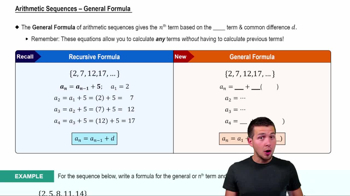
Arithmetic Sequences - General Formula

Formula for the Sum of the First n Natural Numbers

The sum of the first n natural numbers can be found using the formula S = n(n + 1)/2. This formula provides a quick way to calculate the sum without adding each number individually.
Video consigliato:
06:36
Solving Quadratic Equations Using The Quadratic Formula

Natural Numbers

Natural numbers are the set of positive integers starting from 1 (1, 2, 3, ...). Understanding that the problem involves the first 100 natural numbers helps identify the sequence and apply the appropriate summation formula.
Video consigliato:
2:51
The Natural Log