Use the formula for nCr to solve Exercises 49–56. To win at LOTTO in the state of Florida, one must correctly select 6 numbers from a collection of 53 numbers (1 through 53). The order in which the selection is made does not matter. How many different selections are possible?
Ch. 8 - Sequences, Induction, and Probability

Capitolo 9, Problema 55
Find the middle term in the expansion of (3/x + x/3)10
Guida verificata passo dopo passo1
Identify the binomial expression and the exponent: the expression is \(\left( \frac{3}{x} + \frac{x}{3} \right)^{10}\), where \(n = 10\).
Recall the general term in the binomial expansion of \((a + b)^n\) is given by \(T_{k+1} = \binom{n}{k} a^{n-k} b^k\), where \(k\) ranges from 0 to \(n\).
Determine the middle term: since \(n = 10\) is even, the middle term is the \(\left( \frac{n}{2} + 1 \right)\)-th term, which is the 6th term (where \(k = 5\)).
Substitute \(a = \frac{3}{x}\), \(b = \frac{x}{3}\), \(n = 10\), and \(k = 5\) into the general term formula:
\(T_6 = \binom{10}{5} \left( \frac{3}{x} \right)^{10-5} \left( \frac{x}{3} \right)^5\).
Simplify the powers and combine like terms carefully, paying attention to the exponents of \(x\) and the constants, to express the middle term in its simplest form.

Risposta video verificata per un problema simile:
Questa soluzione video è stata consigliata dai nostri tutor come utile per risolvere questo problema.
Durata del video:
6mConcetti chiave
Ecco i concetti essenziali che devi comprendere per rispondere correttamente alla domanda.
Binomial Theorem
The Binomial Theorem provides a formula to expand expressions of the form (a + b)^n into a sum involving terms with binomial coefficients. Each term is given by C(n, k) * a^(n-k) * b^k, where C(n, k) is the combination of n items taken k at a time.
Video consigliato:
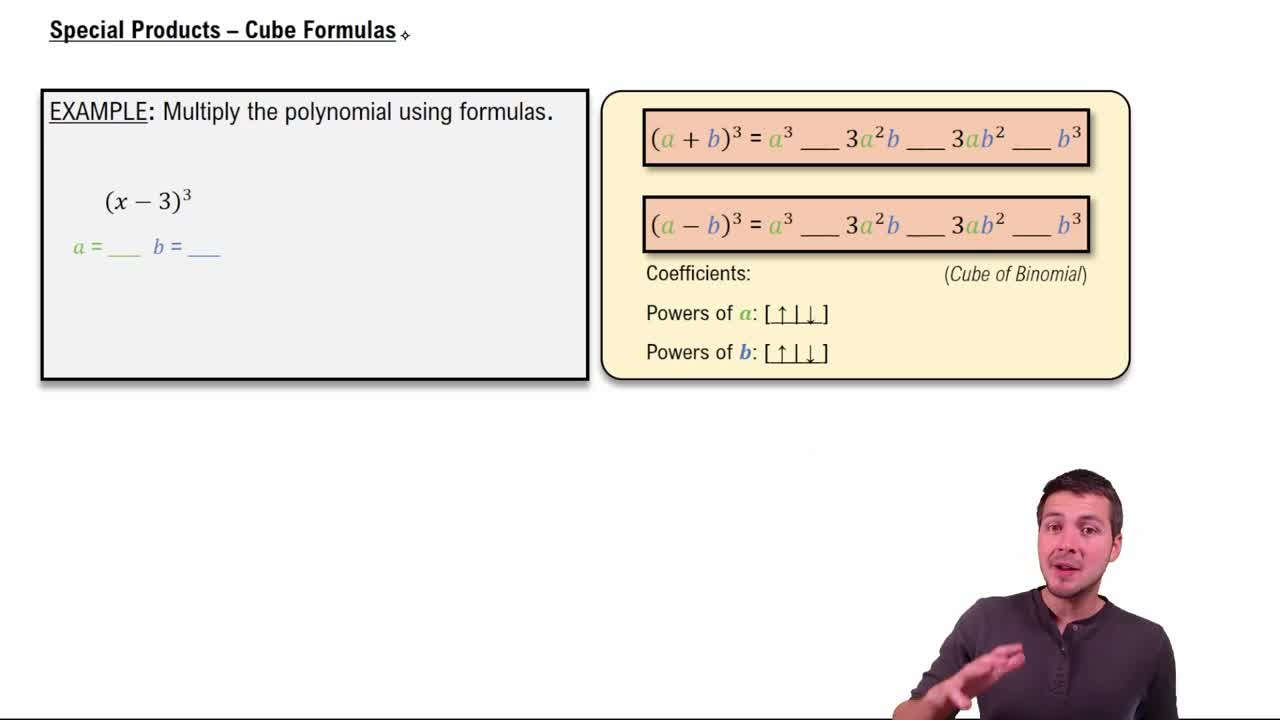
Special Products - Cube Formulas
Identifying the Middle Term in a Binomial Expansion
For an expansion of (a + b)^n, the total number of terms is n + 1. If n is even, the middle term is the (n/2 + 1)-th term. This term can be found by substituting k = n/2 into the general term formula.
Video consigliato:
Special Products - Cube Formulas
Handling Algebraic Expressions with Variables and Exponents
When expanding expressions like (3/x + x/3)^10, it is important to carefully apply exponent rules to variables and constants. Simplifying powers of variables with negative or fractional exponents ensures the correct form of each term.
Video consigliato:
Evaluating Algebraic Expressions
Pratica correlata
Domanda del libro di testo
699
views
Domanda del libro di testo
Let {an} = - 5, 10, - 20, 40, ..., {bn} = 10, - 5, - 20, - 35, ..., {cn} = - 2, 1, - 1/2, 1/4 Find a10 + b10.
847
views
Domanda del libro di testo
Use mathematical induction to prove that the statement is true for every positive integer n. 5 + 10 + 15 + ... + 5n = (5n(n+1))/2
1214
views
Domanda del libro di testo
Express each sum using summation notation. Use a lower limit of summation of your choice and k for the index of summation. a+ar+ar2+⋯+ ar12
864
views
Domanda del libro di testo
In Exercises 55–60, express each sum using summation notation. Use a lower limit of summation of your choice and k for the index of summation. 5+7+9+11+⋯+ 31
1618
views
Domanda del libro di testo
Use the graphs of the arithmetic sequences {a} and {b} to solve Exercises 51-58. Find the difference between the sum of the first 14 terms of {bn} and the sum of the first 14 terms of {an}.
1068
views
