Ch. 8 - Sequences, Induction, and Probability
Blitzer - College Algebra 8th Edition
Blitzer8th EditionCollege AlgebraISBN: 9780136970514Non è quello che usi tu?Cambia libro di testo
Capitolo 9, Problema 92

How many four-digit odd numbers less than 6000 can be formed using the digits 2, 4, 6, 7, 8, and 9?

Guida verificata passo dopo passo
1
Identify the constraints for the four-digit number: it must be less than 6000, so the first digit can only be 2 or 4 (since 6, 7, 8, 9 would make the number 6000 or greater).
Determine the possible digits for the last digit since the number must be odd. From the given digits (2, 4, 6, 7, 8, 9), the odd digits are 7 and 9, so the last digit can be either 7 or 9.
For the first digit, we have 2 choices (2 or 4). For the last digit, we have 2 choices (7 or 9).
For the second and third digits, since there are no restrictions mentioned, each can be any of the 6 given digits (2, 4, 6, 7, 8, 9), so each has 6 choices.
Calculate the total number of such four-digit odd numbers by multiplying the number of choices for each digit: number of choices for the first digit × number of choices for the second digit × number of choices for the third digit × number of choices for the last digit.

Risposta video verificata per un problema simile:

Questa soluzione video è stata consigliata dai nostri tutor come utile per risolvere questo problema.
Durata del video:
2m

Concetti chiave

Ecco i concetti essenziali che devi comprendere per rispondere correttamente alla domanda.

Place Value and Number Formation

Understanding place value is essential to form four-digit numbers. The first digit determines the thousands place and restricts the number's size (less than 6000 means the first digit must be 2, 4, or 5 if available). Each digit's position affects the overall number's value and constraints.
Video consigliato:
4:47
The Number e

Odd Number Criteria

An odd number ends with an odd digit. To form odd numbers, the units (last) digit must be chosen from the set of odd digits available. Identifying which digits are odd (in this case, 7 and 9) is crucial to ensure the number formed is odd.
Video consigliato:
4:47
The Number e

Counting Principles and Permutations

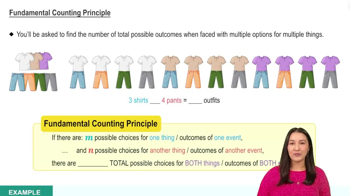
Counting the total number of valid numbers involves applying the multiplication principle. For each digit position, count the number of possible choices considering the restrictions, then multiply these counts to find the total number of combinations.
Video consigliato:
4:04
Fundamental Counting Principle