Ch. 8 - Sequences, Induction, and Probability
Blitzer - College Algebra 8th Edition
Blitzer8th EditionCollege AlgebraISBN: 9780136970514Non è quello che usi tu?Cambia libro di testo
Capitolo 9, Problema 1

Evaluate the given binomial coefficient.(83)\(\binom{8}{3}\)

Guida verificata passo dopo passo
1
Identify the binomial coefficient notation \( \binom{8}{3} \), which represents the number of ways to choose 3 elements from a set of 8 elements.
Recall the formula for the binomial coefficient: \[ \binom{n}{r} = \frac{n!}{r!(n-r)!} \], where \( n! \) denotes the factorial of \( n \).
Substitute \( n = 8 \) and \( r = 3 \) into the formula: \[ \binom{8}{3} = \frac{8!}{3!(8-3)!} = \frac{8!}{3!5!} \].
Express the factorials to simplify the expression: \[ 8! = 8 \times 7 \times 6 \times 5! \], so \[ \binom{8}{3} = \frac{8 \times 7 \times 6 \times 5!}{3! \times 5!} \].
Cancel the common \( 5! \) terms in numerator and denominator, then simplify the remaining expression \( \frac{8 \times 7 \times 6}{3!} \) to find the value.

Risposta video verificata per un problema simile:

Questa soluzione video è stata consigliata dai nostri tutor come utile per risolvere questo problema.
Durata del video:
2m

Concetti chiave

Ecco i concetti essenziali che devi comprendere per rispondere correttamente alla domanda.

Binomial Coefficient

The binomial coefficient, denoted as (n choose k), represents the number of ways to choose k elements from a set of n elements without regard to order. It is calculated using the formula n! / (k! (n-k)!), where ! denotes factorial.
Video consigliato:
03:41
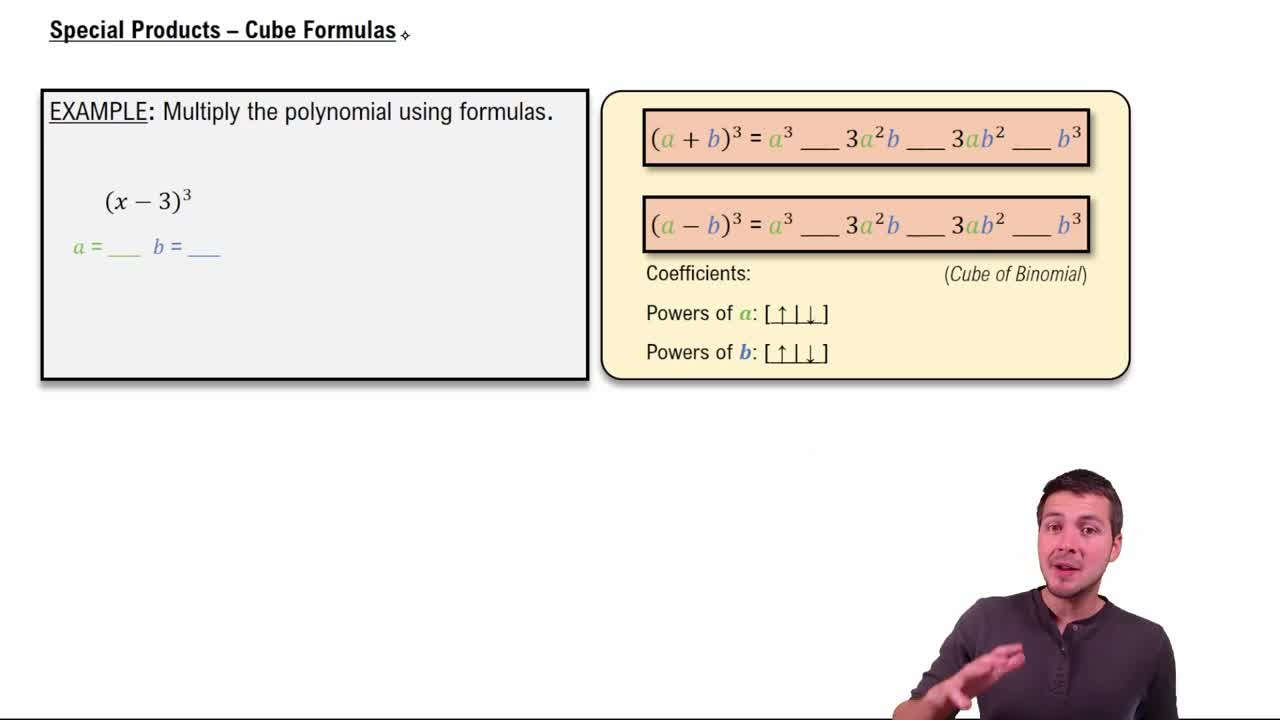
Special Products - Cube Formulas

Factorial Function

The factorial of a non-negative integer n, written as n!, is the product of all positive integers less than or equal to n. Factorials are essential in computing binomial coefficients and permutations, e.g., 5! = 5 × 4 × 3 × 2 × 1 = 120.
Video consigliato:
5:22
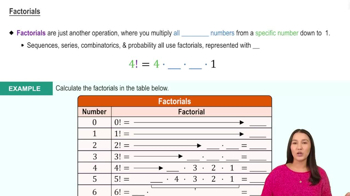
Factorials

Combinatorial Interpretation

Binomial coefficients count combinations, which are selections where order does not matter. Understanding this helps in problems involving probability, counting, and algebraic expansions like the binomial theorem.
Video consigliato:
4:04
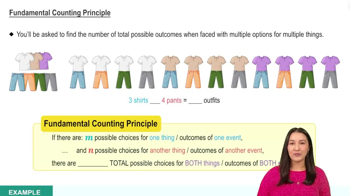
Fundamental Counting Principle