Ch. 8 - Sequences, Induction, and Probability
Blitzer - College Algebra 8th Edition
Blitzer8th EditionCollege AlgebraISBN: 9780136970514Non è quello che usi tu?Cambia libro di testo
Capitolo 9, Problema 41

Find each indicated sum. ∑i=15i!(i−1)!\(\sum\)_{i=1}^{5} \(\frac{i!}{(i-1)!}\)

Guida verificata passo dopo passo
1
First, understand the summation notation: \(\sum_{i=1}^{5} \frac{i!}{(i-1)!}\) means you will add the values of the expression \(\frac{i!}{(i-1)!}\) for each integer \(i\) from 1 to 5.
Next, simplify the general term \(\frac{i!}{(i-1)!}\). Recall that factorial notation means \(n! = n \times (n-1) \times (n-2) \times \cdots \times 1\), and specifically, \(i! = i \times (i-1)!\).
Using this, rewrite the term as \(\frac{i!}{(i-1)!} = \frac{i \times (i-1)!}{(i-1)!}\). Since \((i-1)!\) appears in both numerator and denominator, they cancel out, leaving you with \(i\).
Now, the summation simplifies to \(\sum_{i=1}^{5} i\), which means you need to add the integers from 1 to 5.
Finally, write out the sum explicitly as \(1 + 2 + 3 + 4 + 5\) and then add these values together to find the total sum.

Risposta video verificata per un problema simile:

Questa soluzione video è stata consigliata dai nostri tutor come utile per risolvere questo problema.
Durata del video:
5m

Concetti chiave

Ecco i concetti essenziali che devi comprendere per rispondere correttamente alla domanda.

Summation Notation

Summation notation (Σ) is a concise way to represent the sum of a sequence of terms. The index variable (i) runs from the lower limit to the upper limit, and each term is evaluated at each integer value of i. Understanding how to interpret and expand summation notation is essential for solving series problems.
Video consigliato:
05:18
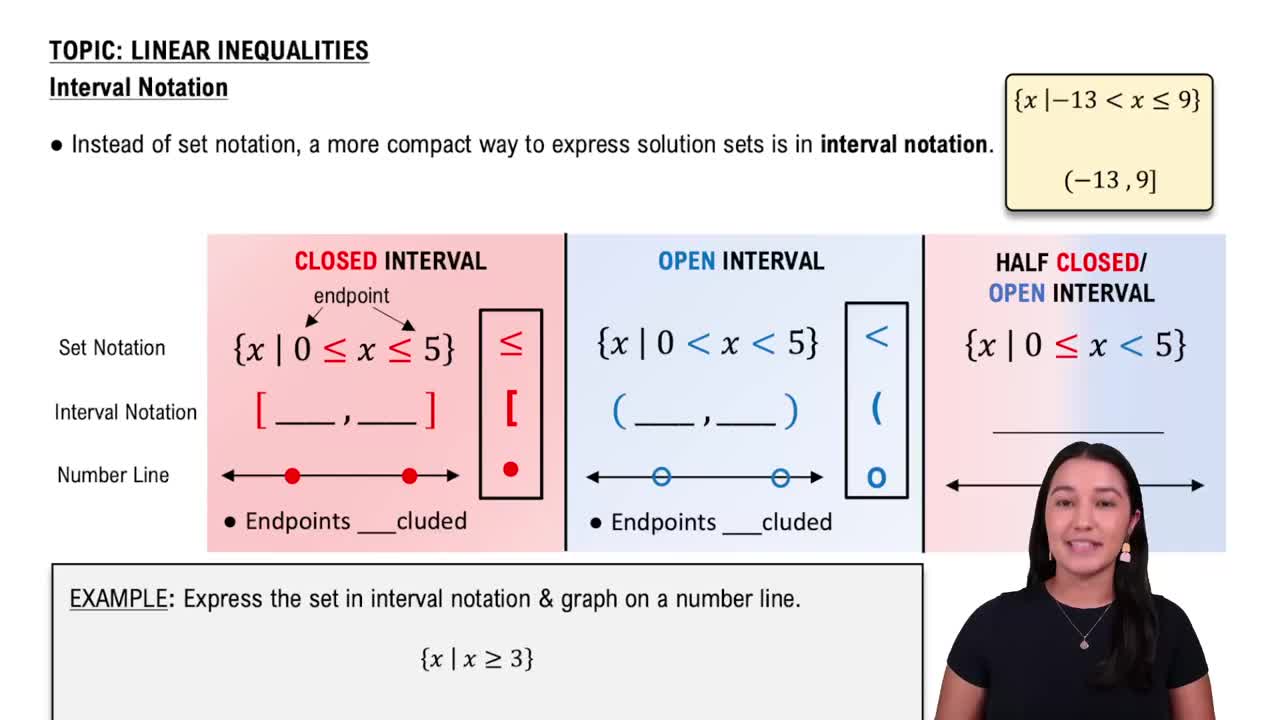
Interval Notation

Factorials

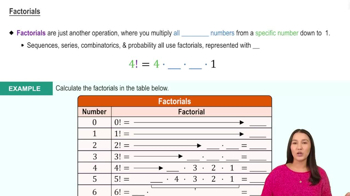
A factorial, denoted by n!, is the product of all positive integers from 1 up to n. For example, 5! = 5×4×3×2×1 = 120. Factorials are used in permutations, combinations, and series expressions, and simplifying factorial expressions often involves canceling common terms.
Video consigliato:
5:22
Factorials

Simplifying Factorial Expressions

When factorials appear in fractions, such as i!/(i−1)!, they can often be simplified by canceling common factors. Since i! = i × (i−1)!, the expression simplifies to i. Recognizing this simplification helps in evaluating sums more efficiently.
Video consigliato:
5:22
Factorials