Ch. 8 - Sequences, Induction, and Probability
Blitzer - College Algebra 8th Edition
Blitzer8th EditionCollege AlgebraISBN: 9780136970514Non è quello che usi tu?Cambia libro di testo
Capitolo 9, Problema 41

Find the term indicated in each expansion. (x − 1)9; fifth term

Guida verificata passo dopo passo
1
Identify the general term formula for the binomial expansion of \((x - 1)^9\). The \(k\)-th term is given by \(T_{k+1} = \binom{9}{k} x^{9-k} (-1)^k\) where \(k\) starts from 0.
Since we want the fifth term, set \(k = 4\) because the first term corresponds to \(k=0\).
Substitute \(k=4\) into the general term formula: \(T_5 = \binom{9}{4} x^{9-4} (-1)^4\).
Calculate the binomial coefficient \(\binom{9}{4}\) using the formula \(\binom{n}{r} = \frac{n!}{r!(n-r)!}\), but do not compute the numerical value yet.
Write the fifth term as \(T_5 = \binom{9}{4} x^5 (1)\) since \((-1)^4 = 1\), and this expression represents the fifth term in the expansion.

Risposta video verificata per un problema simile:

Questa soluzione video è stata consigliata dai nostri tutor come utile per risolvere questo problema.
Durata del video:
3m

Concetti chiave

Ecco i concetti essenziali che devi comprendere per rispondere correttamente alla domanda.

Binomial Theorem

The Binomial Theorem provides a formula to expand expressions of the form (a + b)^n. It states that the expansion is the sum of terms involving binomial coefficients, powers of a, and powers of b. This theorem is essential for finding specific terms in binomial expansions.
Video consigliato:
03:41
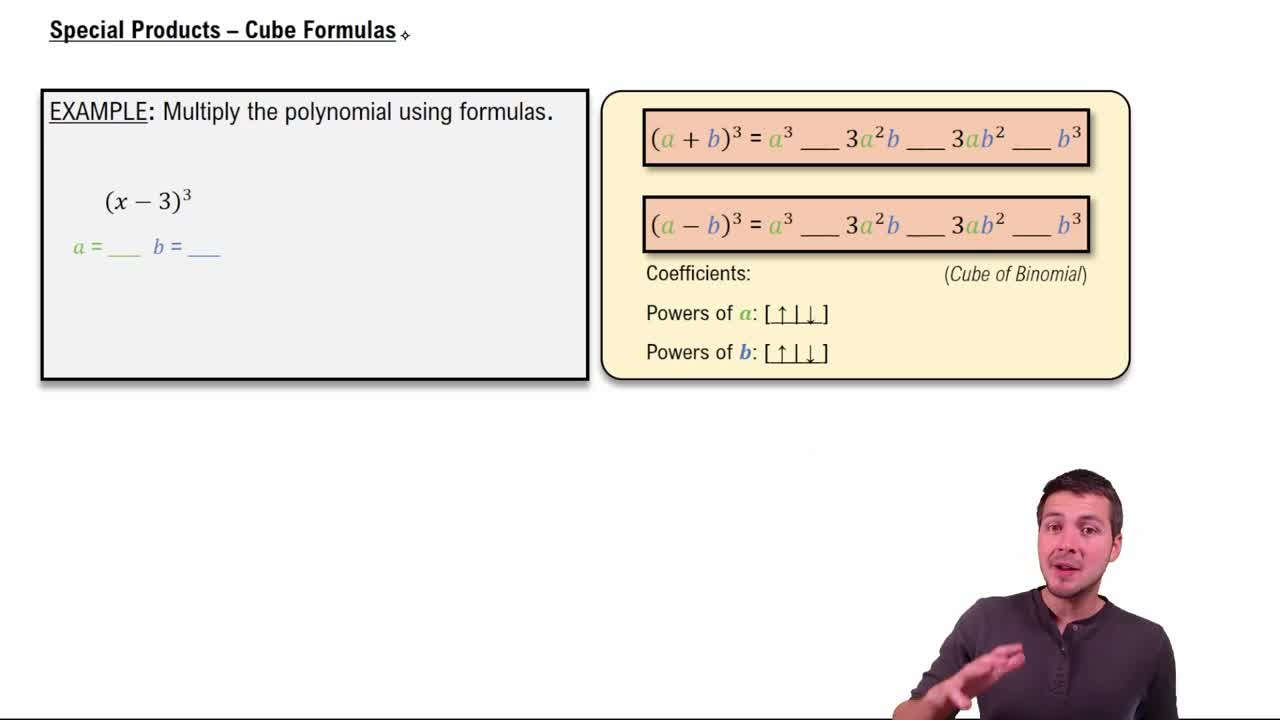
Special Products - Cube Formulas

Binomial Coefficients

Binomial coefficients, denoted as C(n, k) or "n choose k," represent the number of ways to choose k elements from n. They appear as coefficients in the binomial expansion and can be calculated using factorials or Pascal's Triangle. These coefficients determine the weight of each term.
Video consigliato:
03:41
Special Products - Cube Formulas

Term Identification in Binomial Expansion

In the expansion of (x + y)^n, the (k+1)-th term is given by C(n, k) * x^(n-k) * y^k. To find the fifth term, substitute k = 4. Understanding this formula allows you to directly compute any specific term without expanding the entire expression.
Video consigliato:
05:13
Introduction to Polynomials