Use the graphs of the arithmetic sequences {a} and {b} to solve Exercises 51-58. If {an} is a finite sequence whose last term is -83, how many terms does {an} contain?
Ch. 8 - Sequences, Induction, and Probability

Capitolo 9, Problema 53
In Exercises 43–54, express each sum using summation notation. Use 1 as the lower limit of summation and i for the index of summation. 1+3+5+⋯+ (2n−1)
Guida verificata passo dopo passo1
Recognize the pattern of the sum: the terms are 1, 3, 5, ..., which are consecutive odd numbers. Each term can be expressed as \(2i - 1\), where \(i\) is the index of summation starting from 1.
Identify the number of terms in the sum. Since the last term is given as \(2n - 1\), the number of terms is \(n\).
Write the summation notation using the index \(i\) starting at 1 and going up to \(n\), summing the expression for each term.
Express the sum as \(\sum_{i=1}^{n} (2i - 1)\), which compactly represents the sum of the first \(n\) odd numbers.
This summation notation captures the entire sum \(1 + 3 + 5 + \cdots + (2n - 1)\) in a concise mathematical form.

Risposta video verificata per un problema simile:
Questa soluzione video è stata consigliata dai nostri tutor come utile per risolvere questo problema.
Durata del video:
3mConcetti chiave
Ecco i concetti essenziali che devi comprendere per rispondere correttamente alla domanda.
Summation Notation
Summation notation is a concise way to represent the sum of a sequence of terms using the sigma symbol (∑). It includes an index of summation, lower and upper limits, and a general term formula. For example, ∑_{i=1}^n a_i represents the sum of terms a_i from i=1 to i=n.
Video consigliato:
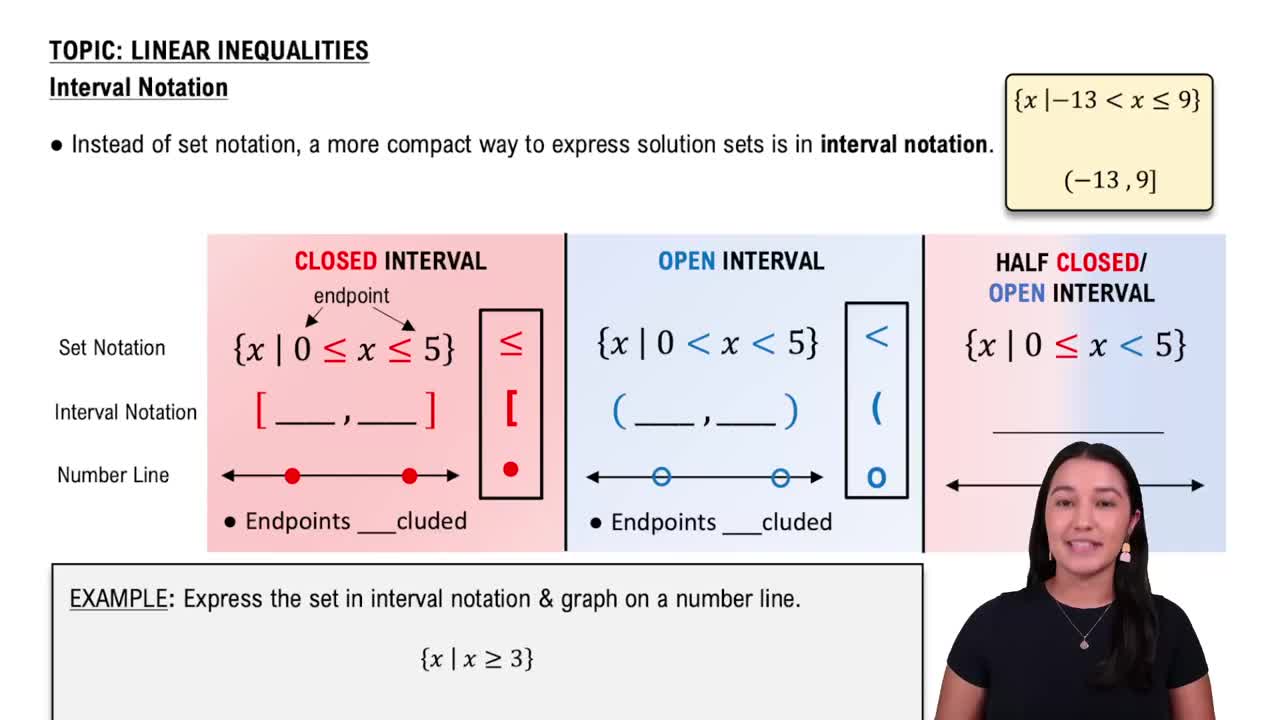
Interval Notation
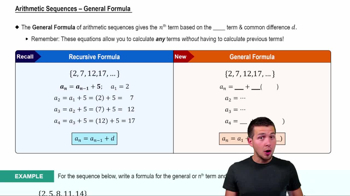
Arithmetic Sequences
An arithmetic sequence is a list of numbers with a constant difference between consecutive terms. In this problem, the sequence 1, 3, 5, ..., (2n−1) is arithmetic with a common difference of 2. Understanding this helps identify the general term formula for the sequence.
Video consigliato:
Arithmetic Sequences - General Formula
General Term of the Sequence
The general term formula expresses the nth term of a sequence as a function of n or the index i. For the sequence of odd numbers 1, 3, 5, ..., the nth term is given by 2i−1. This formula is essential to write the sum in summation notation.
Video consigliato:
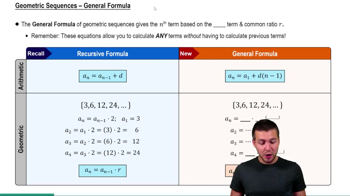
Geometric Sequences - General Formula
Pratica correlata
Domanda del libro di testo
939
views
Domanda del libro di testo
If you toss a fair coin six times, what is the probability of getting all heads?
617
views
Domanda del libro di testo
Use the formula for nCr to solve Exercises 49–56. You volunteer to help drive children at a charity event to the zoo, but you can fit only 8 of the 17 children present in your van. How many different groups of 8 children can you drive?
899
views
Domanda del libro di testo
Use the graphs of the arithmetic sequences {a} and {b} to solve Exercises 51-58.
Find a14+b12.
1232
views
Domanda del libro di testo
In Exercises 51–56, the general term of a sequence is given. Determine whether the sequence is arithmetic, geometric, or neither. If the sequence is arithmetic, find the common difference; if it is geometric, find the common ratio. an = 2n
877
views
Domanda del libro di testo
Find f(x + h) − f(x)/h and simplify. f(x) = x4+7
577
views