Ch. 8 - Sequences, Induction, and Probability
Blitzer - College Algebra 8th Edition
Blitzer8th EditionCollege AlgebraISBN: 9780136970514Non è quello che usi tu?Cambia libro di testo
Capitolo 9, Problema 45

In Exercises 45-46, it is equally probable that the pointer on the spinner shown will land on any one of the eight regions, numbered 1 through 8. If the pointer lands on a borderline, spin again. Find the probability that the pointer will stop on an odd number or a number less than 6.
A spinner divided into eight colored sections numbered 1 to 8, with an arrow pointing to section 2.

Guida verificata passo dopo passo
1
Identify the total number of equally likely outcomes on the spinner. Since the spinner is divided into 8 regions numbered 1 through 8, the total number of outcomes is 8.
Determine the set of outcomes that satisfy the condition 'odd number.' The odd numbers between 1 and 8 are 1, 3, 5, and 7.
Determine the set of outcomes that satisfy the condition 'number less than 6.' These numbers are 1, 2, 3, 4, and 5.
Find the union of the two sets (odd numbers or numbers less than 6). This means combining all unique numbers from both sets: {1, 3, 5, 7} ∪ {1, 2, 3, 4, 5}.
Calculate the probability by dividing the number of favorable outcomes (the size of the union set) by the total number of outcomes (8). The formula is \(\text{Probability} = \frac{\text{Number of favorable outcomes}}{8}\).

Risposta video verificata per un problema simile:

Questa soluzione video è stata consigliata dai nostri tutor come utile per risolvere questo problema.
Durata del video:
3m

Concetti chiave

Ecco i concetti essenziali che devi comprendere per rispondere correttamente alla domanda.

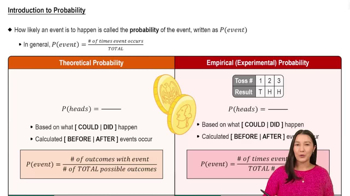
Basic Probability

Probability measures the likelihood of an event occurring, calculated as the ratio of favorable outcomes to total possible outcomes. In this problem, each of the eight spinner sections is equally likely, so the probability of landing on any section is 1/8.
Video consigliato:
5:37
Introduction to Probability

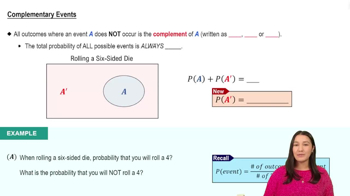
Union of Events

When finding the probability of either one event or another occurring, use the formula P(A or B) = P(A) + P(B) - P(A and B). This accounts for overlap between events, ensuring outcomes common to both are not counted twice.
Video consigliato:
4:23
Complementary Events

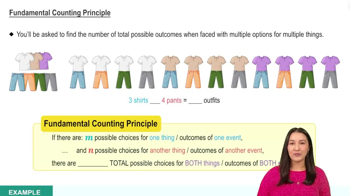
Set Operations and Counting

Identifying the favorable outcomes involves understanding sets: odd numbers {1,3,5,7} and numbers less than 6 {1,2,3,4,5}. Counting elements in these sets and their intersection helps determine the total favorable outcomes for the probability calculation.
Video consigliato:
4:04
Fundamental Counting Principle