Ch. 8 - Sequences, Induction, and Probability
Blitzer - College Algebra 8th Edition
Blitzer8th EditionCollege AlgebraISBN: 9780136970514Non è quello che usi tu?Cambia libro di testo
Capitolo 9, Problema 49

Use the Binomial Theorem to expand each expression and write the result in simplified form. (x3 +x-2)4

Guida verificata passo dopo passo
1
Identify the binomial expression to be expanded: \(\left(x^{3} + x^{-2}\right)^4\).
Recall the Binomial Theorem formula: \(\left(a + b\right)^n = \sum_{k=0}^{n} \binom{n}{k} a^{n-k} b^{k}\), where \(\binom{n}{k}\) is the binomial coefficient.
Apply the formula with \(a = x^{3}\), \(b = x^{-2}\), and \(n = 4\). Write the sum as \(\sum_{k=0}^{4} \binom{4}{k} (x^{3})^{4-k} (x^{-2})^{k}\).
Simplify each term inside the sum by applying the power of a power rule: \((x^{3})^{4-k} = x^{3(4-k)}\) and \((x^{-2})^{k} = x^{-2k}\). Then combine the powers of \(x\) by adding exponents: \(x^{3(4-k) + (-2k)}\).
Write out each term explicitly for \(k=0\) to \(k=4\) using the binomial coefficients \(\binom{4}{k}\), simplify the powers of \(x\), and then sum all terms to get the expanded expression.

Risposta video verificata per un problema simile:

Questa soluzione video è stata consigliata dai nostri tutor come utile per risolvere questo problema.
Durata del video:
13m

Concetti chiave

Ecco i concetti essenziali che devi comprendere per rispondere correttamente alla domanda.

Binomial Theorem

The Binomial Theorem provides a formula to expand expressions raised to a power, such as (a + b)^n. It states that (a + b)^n equals the sum of terms C(n, k) * a^(n-k) * b^k, where C(n, k) are binomial coefficients. This theorem simplifies the expansion process without multiplying the expression repeatedly.
Video consigliato:
03:41
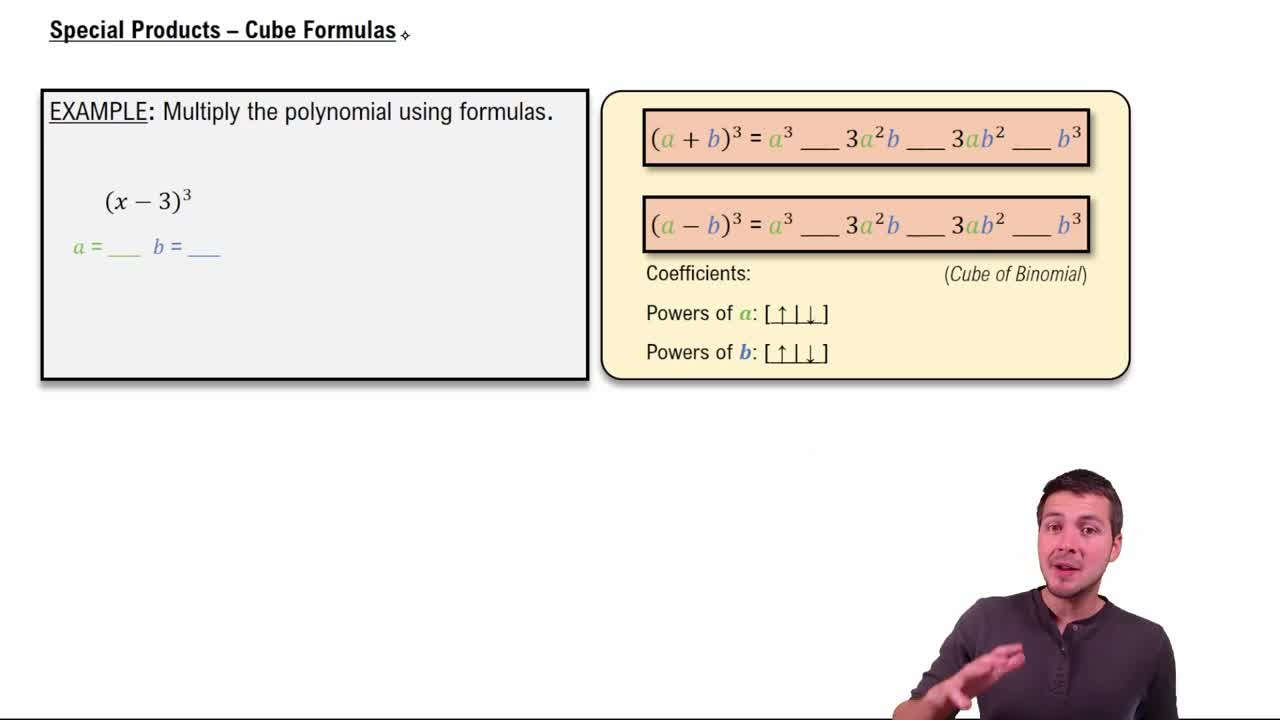
Special Products - Cube Formulas

Binomial Coefficients

Binomial coefficients, denoted as C(n, k) or "n choose k," represent the number of ways to choose k elements from n. They appear as coefficients in the binomial expansion and can be found using Pascal's Triangle or the formula C(n, k) = n! / (k!(n-k)!). These coefficients determine the weight of each term in the expansion.
Video consigliato:
03:41
Special Products - Cube Formulas

Handling Negative and Fractional Exponents

When expanding expressions like (x^3 + x^-2)^4, it is important to correctly apply exponent rules. Negative exponents indicate reciprocals (x^-2 = 1/x^2), and when multiplying powers with the same base, exponents add. Simplifying each term after expansion requires careful management of these exponents to write the final expression in simplest form.
Video consigliato:
6:37
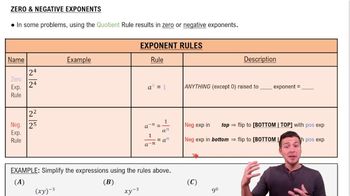
Zero and Negative Rules