Use mathematical induction to prove that each statement is true for every positive integer n. 1 + 3 + 5 + ... + (2n - 1) = n2
Ch. 8 - Sequences, Induction, and Probability

Capitolo 9, Problema 11
Use the Binomial Theorem to expand each binomial and express the result in simplified form.
Guida verificata passo dopo passo1
Identify the binomial expression to expand: \((3x + y)^3\).
Recall the Binomial Theorem formula: \(\displaystyle (a + b)^n = \sum_{k=0}^n \binom{n}{k} a^{n-k} b^k\), where \(\binom{n}{k}\) is the binomial coefficient.
Set \(a = 3x\), \(b = y\), and \(n = 3\). Write out each term of the expansion using the formula: \(\binom{3}{k} (3x)^{3-k} y^k\) for \(k = 0, 1, 2, 3\).
Calculate each binomial coefficient: \(\binom{3}{0}\), \(\binom{3}{1}\), \(\binom{3}{2}\), and \(\binom{3}{3}\), and simplify the powers of \$3x$ and $y$ accordingly.
Write the full expanded expression by summing all terms and simplify each term by multiplying coefficients and combining like factors.

Risposta video verificata per un problema simile:
Questa soluzione video è stata consigliata dai nostri tutor come utile per risolvere questo problema.
Durata del video:
4mConcetti chiave
Ecco i concetti essenziali che devi comprendere per rispondere correttamente alla domanda.
Binomial Theorem
The Binomial Theorem provides a formula to expand expressions raised to a power, such as (a + b)^n. It states that (a + b)^n equals the sum of terms involving binomial coefficients, powers of a, and powers of b. This theorem simplifies the expansion process without multiplying the binomial repeatedly.
Video consigliato:
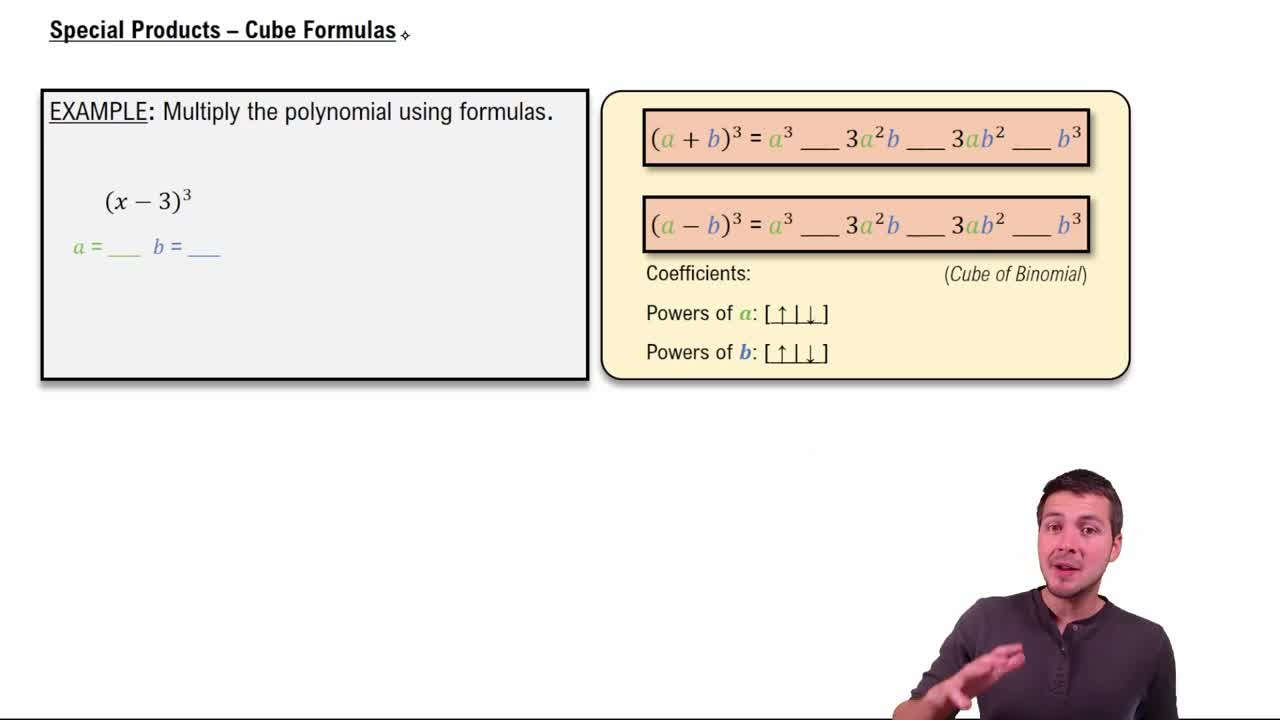
Special Products - Cube Formulas
Binomial Coefficients
Binomial coefficients, denoted as C(n, k) or "n choose k," represent the number of ways to choose k elements from n. They appear as coefficients in the expanded form of (a + b)^n and can be found using Pascal's Triangle or the formula C(n, k) = n! / (k!(n-k)!).
Video consigliato:
Special Products - Cube Formulas
Exponent Rules and Simplification
When expanding binomials, powers of each term must be calculated using exponent rules, such as (x^m)(x^n) = x^(m+n). After expansion, like terms should be combined and simplified to express the result in its simplest form, ensuring clarity and correctness.
Video consigliato:
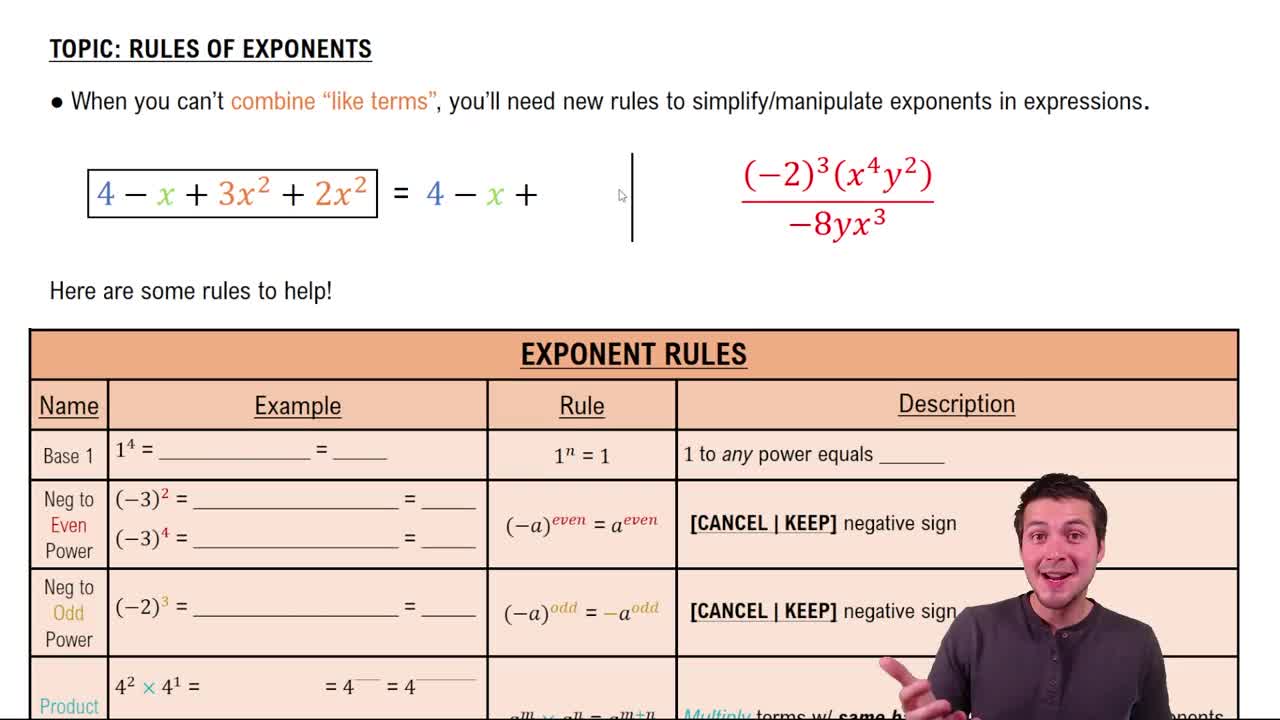
Introduction to Exponent Rules
Pratica correlata
Domanda del libro di testo
699
views
Domanda del libro di testo
Use the formula for nCr to evaluate each expression. 7C7
905
views
1
rank
Domanda del libro di testo
Use the formula for the general term (the nth term) of a geometric sequence to find the indicated term of each sequence with the given first term, a1 and common ratio, r. Find a40 when a1 = 1000, r = - 1/2
882
views
Domanda del libro di testo
Use the formula for the general term (the nth term) of a geometric sequence to find the indicated term of each sequence with the given first term, a1 and common ratio, r. Find a12 when a1 = 5, r = - 2
919
views
Domanda del libro di testo
Use mathematical induction to prove that each statement is true for every positive integer n. 4 + 8 + 12 + ... + 4n = 2n(n + 1)
726
views
Domanda del libro di testo
Write the first six terms of each arithmetic sequence. an = an-1 -10, a1 = 30
1007
views