Ch. P - Fundamental Concepts of Algebra
Blitzer - College Algebra 8th Edition
Blitzer8th EditionCollege AlgebraISBN: 9780136970514Non è quello che usi tu?Cambia libro di testo
Capitolo 1, Problema 11

Evaluate each exponential expression in Exercises 1–22. 4−3

Guida verificata passo dopo passo
1
Identify the base and the exponent in the expression \(4^{-3}\). Here, the base is 4 and the exponent is -3.
Recall the rule for negative exponents: \(a^{-n} = \frac{1}{a^n}\), where \(a\) is a nonzero number and \(n\) is a positive integer.
Apply the negative exponent rule to rewrite \(4^{-3}\) as \(\frac{1}{4^3}\).
Calculate the positive exponent part \$4^3$ by multiplying 4 by itself three times: \(4 \times 4 \times 4\).
Express the final answer as \(\frac{1}{4^3}\), which is \(\frac{1}{64}\) after evaluating the multiplication.

Risposta video verificata per un problema simile:

Questa soluzione video è stata consigliata dai nostri tutor come utile per risolvere questo problema.
Durata del video:
35s

Concetti chiave

Ecco i concetti essenziali che devi comprendere per rispondere correttamente alla domanda.

Exponents and Powers

Exponents indicate how many times a base number is multiplied by itself. For example, 4^3 means 4 × 4 × 4. Understanding this helps in evaluating expressions with positive exponents.
Video consigliato:
04:10
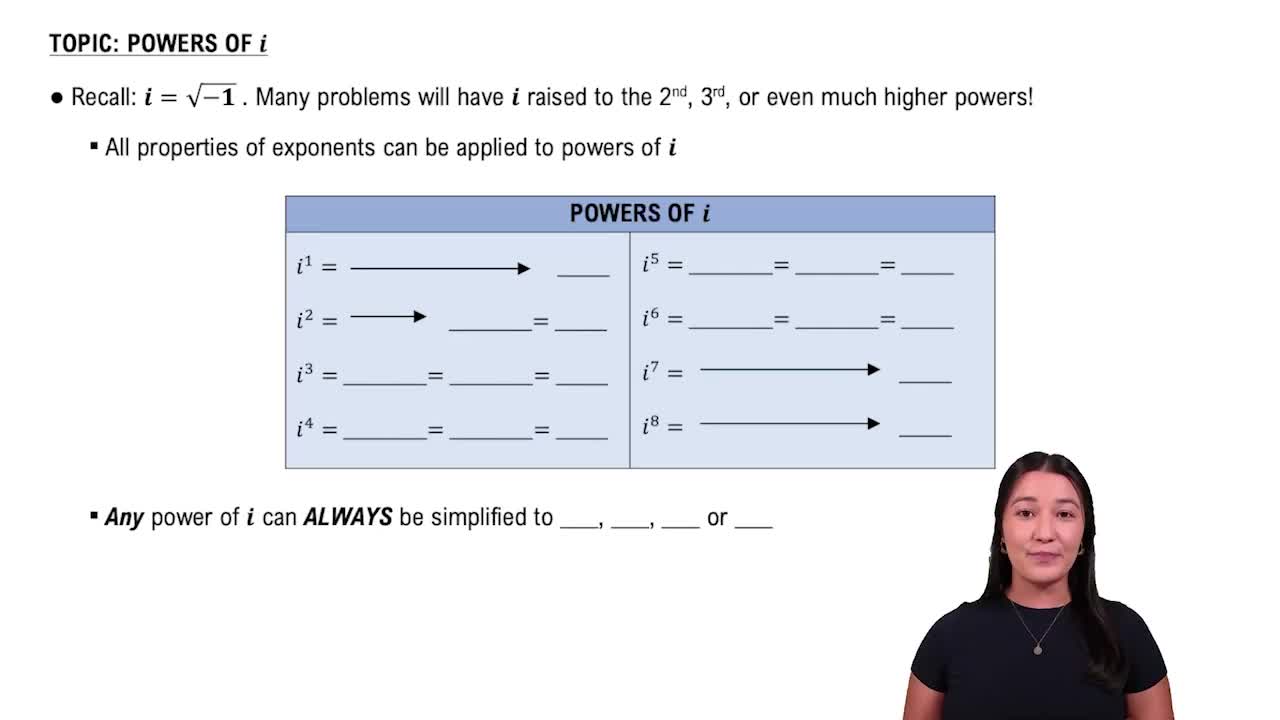
Powers of i

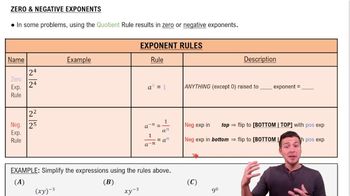
Negative Exponents

A negative exponent means taking the reciprocal of the base raised to the corresponding positive exponent. For instance, 4^(-3) equals 1 divided by 4^3, which is 1/64.
Video consigliato:
6:37
Zero and Negative Rules

Evaluating Exponential Expressions

To evaluate an exponential expression, calculate the power indicated by the exponent, considering the sign of the exponent. This involves applying rules for both positive and negative exponents to simplify the expression.
Video consigliato:
03:11
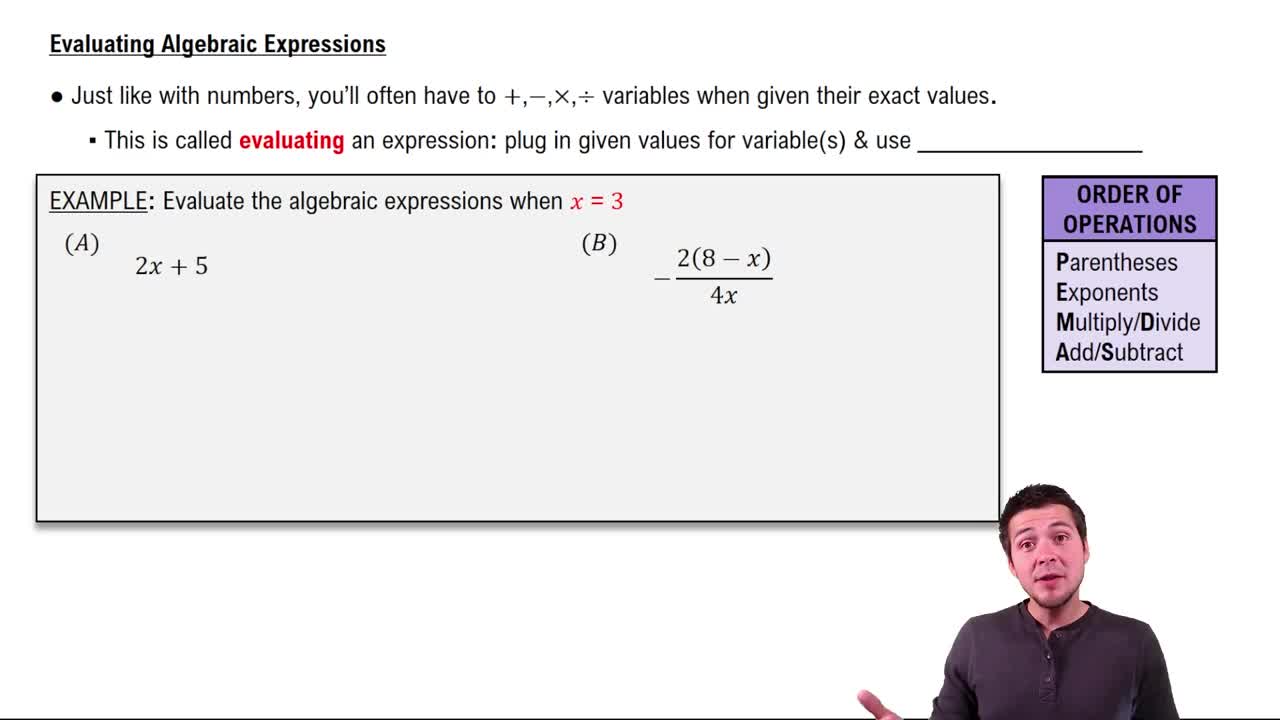
Evaluating Algebraic Expressions